

Audio By Carbonatix
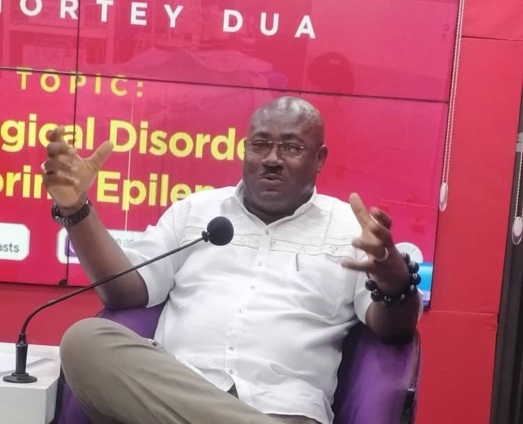
Neurologist and Head medical SubBMC at Korle-Bu Teaching Hospital has offered crucial advice on how to properly assist someone experiencing a seizure.
Prof Patrick Adjei's guidance was aimed at dispelling common misconceptions and promoting safe, effective ways to help those with epilepsy.
In an interview on Joy FM’s Ultimate Health show, Prof. Adjei emphasised the importance of not putting anything in the person’s mouth during a seizure. Contrary to popular belief, attempting to insert an object, such as a spoon, can cause more harm than good.
"If you try to force something into their mouth, you could push the tongue backward, potentially blocking the airway, which could be fatal," he explained to host Nortey Dua.
Additionally, the force of muscle contractions during a seizure is so strong that it could cause the person to bite down hard enough to break a tooth, which might then obstruct their airway.
Instead, Prof. Adjei recommended that bystanders focus on ensuring the person’s safety by helping them lie down and protecting their head.
“Place something soft under their head to prevent injury as they convulse,” he advised adding that if nothing soft is available, using your foot as a cushion can be an alternative.
He also cautioned against restraining the person, as this could lead to broken bones due to the intense muscle contractions.
The distinguished professor highlighted the importance of recognizing when a seizure turns into a medical emergency.
"A regular seizure typically lasts about three minutes," he noted. "However, if it extends beyond five minutes, it's critical to seek immediate medical attention."
He reassured listeners that all medical professionals in Ghana are trained to handle epilepsy emergencies, underscoring the importance of getting the person to a healthcare facility promptly.
These actions can make a significant difference in preventing harm and ensuring the well-being of persons with epilepsy.
The medical practitioner also explained that the term 'epileptic' influences the stigmatisation. He urged all to rather say "Persons living with epilepsy, or persons with epilepsy" as the former connotes a certain level of denigration, disregard for the individual having the condition.
Latest Stories
-
Ghana needs a law to sustain constitutional reforms – CDD-Ghana
2 hours -
COVID fumigation audit: Auditor-General has a lot of questions to answer – Akwatia MP
2 hours -
Stranded Ghanaian medical graduates in Cuba appeal to Mahama for immediate return
2 hours -
GNFS contains fire outbreak at Teshie Lekma Road near Lekma Hospital
8 hours -
Samia Nkrumah rejects the narrative that Ghanaians were happy after Nkrumah’s overthrow
9 hours -
A Mother’s pain: Tribute by Ivan Baidoo’s mother
9 hours -
‘Forgive us for staying away’ — Samia Nkrumah leads family back to Nkroful, pledges to preserve Nkrumah’s legacy
10 hours -
Ernest Nuamah scores twice as Lyon beat Rennes
10 hours -
‘My dear Ivan’ – A father’s tribute to a son tragically killed
10 hours -
GNPC Explorco advances Voltaian Basin drilling preparations with 13.5km access road
10 hours -
Cabinet approves facility manager for Borteyman Sports Complex – Kofi Adams
11 hours -
Sanitation is improving; critics may be ‘living in another world’ – Salaga South MP replies Bekwai MP
11 hours -
Government must do more to tackle sanitation crisis – Bekwai MP
11 hours -
World Cleanup Day: GFF begins sanitation education in local communities
11 hours -
EU Ambassador, IGP discuss stronger cooperation on policing and security
11 hours