


Audio By Carbonatix
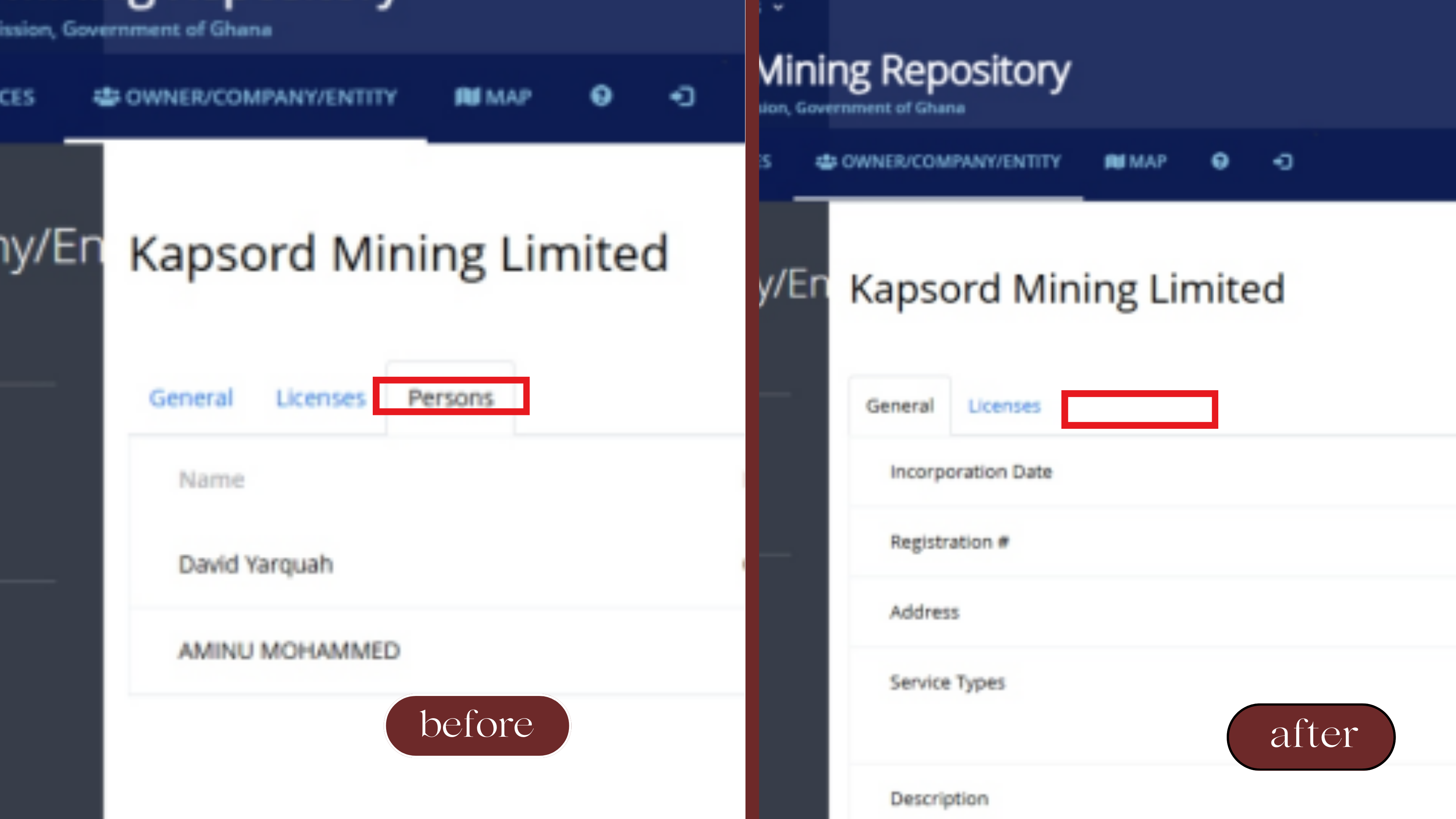
The Minerals Commission has deleted crucial information about mining companies from its website after The Fourth Estate reported on how leading members of the New Patriotic Party (NPP) and government appointees had been granted concessions to mine and prospect in forest reserves.
The deleted information pertains to the ‘contact persons’ of mining companies and the political affiliations of applicants for mining leases. The Chief Executive of the Minerals Commission, Martin Ayisi, had referred to contact persons as “consultants” in an interview with The Fourth Estate. These individuals apply for mining licenses on behalf of mining companies and serve as the liaison between the mining industry regulator and the companies.
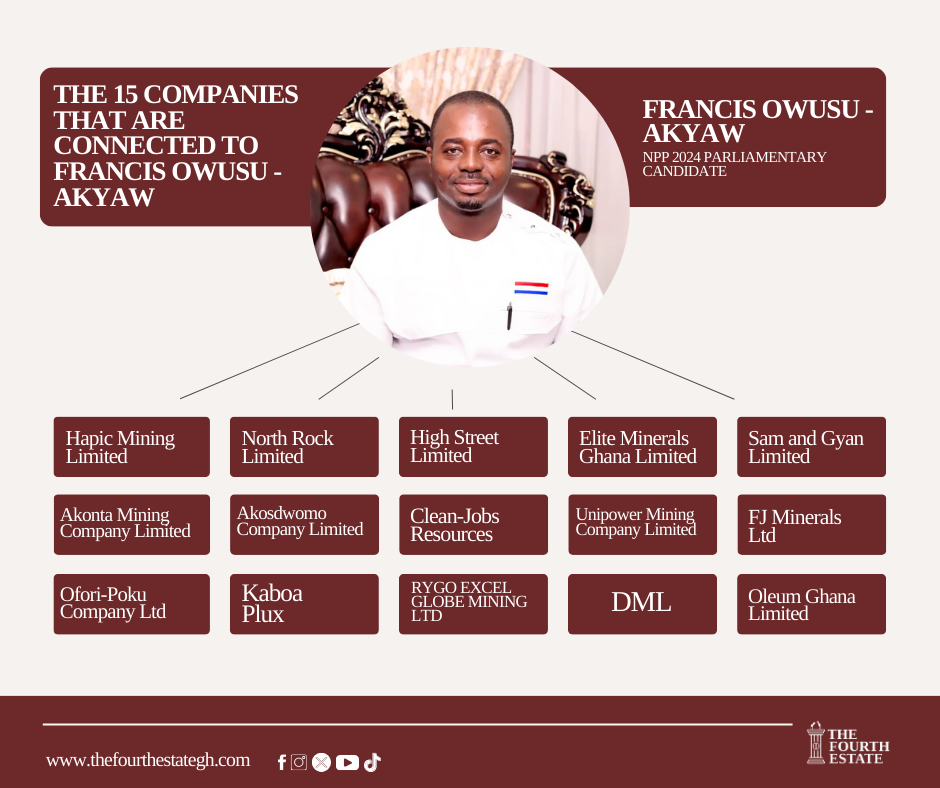
In a recent exposé, The Fourth Estate revealed that the NPP Parliamentary Candidate for Juaben, Francis Owusu-Akyaw, serves as the contact person for at least 15 mining companies. Some of these companies, including his own, FJ Minerals Limited, have obtained mining licenses to operate or prospect in forest reserves across various regions in Ghana.
He also owns another company, DML Investment Limited. DML is the company through which Mr Owusu-Akyaw provides consultancy services for mining companies. On its website, the company touts its connections to the top hierarchy of the Minerals Commission as a competitive advantage.
“We have established key relationships with upper management at the Ghana Minerals Commission. These relationships have been instrumental in securing and operating concessions in the country,” it says.
When The Fourth Estate questioned Mr Ayisi about the relevance of knowing the political affiliations of individuals applying for mining leases in an earlier interview, he responded: “Sometimes it informs the kind of decision you should make.”
However, the Minerals Commission removed this crucial information from its website on the very day The Fourth Estate published its report.
The Commission’s Chief Executive, Mr Ayisi, did not respond to The Fourth Estate’s enqiries regarding the reason for the deletion of the information
EITI’s Response
In an email to The Fourth Estate, the Extractive Industries Transparency Initiative (EITI), an international organization promoting open and accountable management of oil, gas, and mineral resources, emphasized the importance of disclosing the identities of Politically Exposed Persons (PEPs) in the minerals application process.
Gilbert Makore, EITI’s Regional Director for Anglophone and Lusophone Africa, stated that this is crucial because “a PEP, by using their political prominence and influence, maybe in a position to abuse their power to solicit bribes, secure public funds, or engage in other corrupt practices, including on issues relating to license allocations.”
Regarding Francis Owusu-Akyaw’s consultancy services for the 15 companies, Mr. Makore said he could not comment specifically on the case as he was unaware of it. He noted that any follow-up action would be the responsibility of the relevant authorities.
Without referencing any particular case, Mr. Makore highlighted that the involvement of PEPs in companies seeking mining licenses can elevate the risk of conflicts of interest. To mitigate these risks, he said: “It is imperative that the procedures for licensing are clear and that there are no deviations from the established processes.” He added that the Ghana EITI publishes an annual report that provides citizens and stakeholders with a diagnostic summary of potential deviations in the licensing process.
With many applicants owning multiple companies and applying for various concessions—some for as many as 10—Mr. Makore noted that most mineral licenses in Ghana are allocated on a ‘first-come, first-served’ basis, with some awarded through a tendering process. He explained that if an owner with multiple companies uses one to apply for a mining right, priority is given to the first company that applies, provided they meet all the obligations and requirements of the Minerals and Mines Act and its regulations.
He also noted that laws regarding mining ownership vary significantly by country and jurisdiction. For example, Zambia’s mining sector is considering anti-monopoly provisions that would limit a company to holding no more than five mining permits. Such provisions help manage risks related to ownership concentration, political capture, and conflicts of interest in the mining sector.
Latest Stories
-
Prof. Prempeh calls for public review of draft constitutional reform bills
6 minutes -
AFCON 2027Q: ‘I have never seen a poor performance from Black Stars like against Gambia’ – Nii Lante Vanderpuye
11 minutes -
Nigeria set to launch National Digital Address System 9 years after Ghana showed the way
34 minutes -
Policy rate decision takes time to reflect in lower lending rates – BoG
44 minutes -
Western Regional Minister applauds Karpowership’s role in Ghana’s power sector
1 hour -
Livestream: Road safety crises: Where are we getting it wrong?
1 hour -
Enterprise Life celebrates 25 years of protecting families and building trust
1 hour -
ICC London rules in favor of Ghana against Tullow over $400m tax charge
1 hour -
We are disappointed in ICC’s ruling over our corporate income tax assessment in Ghana – Tullow Oil
2 hours -
Cost of building inflation for August 2026 increases to 4.6% – GSS
2 hours -
Today’s front pages: Wednesday, September 30, 2026
2 hours -
Bawumia highlights agricultural, compulsory insurance reforms in IBAG engagement
2 hours -
Ghana will secure Tullow tax revenues while protecting Jubilee, TEN investments – Ato Forson
2 hours -
Ghana wins $393m Tullow tax arbitration as tribunal upholds GRA assessment
2 hours -
Gender Minister assures women’s group of action on Affirmative Action, Development Bank
3 hours