

Audio By Carbonatix
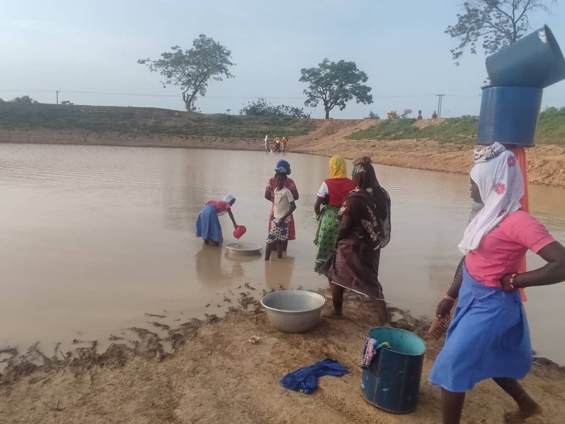
Despite substantial investment in river and groundwater resources for large-scale irrigation and urban water supply in Africa, these efforts frequently neglect vulnerable rural communities on degraded or low-quality lands that need focused water interventions to enhance their ecology and break free from poverty.
The 2024 State of Africa’s Environment report, released today in Nairobi revealed that large-scale water development projects frequently result in inefficient and inequitable distribution of resources, often displacing vulnerable communities. Balancing growing water demand with decreasing availability is identified as one of the major environmental challenges facing developing countries in the coming decades.
The theme of the 2024 edition is water, making a strong argument for prioritizing water in Africa’s development strategy. The report examines the continent's challenges—ranging from poverty and conflicts to high disease burdens—through the perspective of water.
The report also emphasizes that increasing populations, along with ongoing industrialization, urbanization, and agricultural modernization, are driving up water demand while reducing freshwater supply, particularly in the absence of effective pollution regulation mechanisms.
“The future scenario is one characterized by overexploitation of water resources, decreased accessibility to clean water, and increased competition for and potential of conflict over water resources. Africa is the world’s second driest continent, after Australia and also the most water-stressed one,” it said.
The report referenced data from the Lancet Planetary Health journal published in November 2022, which indicated that nearly 36% of people in the region experienced water insecurity. Quoting the Pacific Institute, it noted a 34% increase in incidents of violence over water resources from 2022 to 2023, with at least 71 incidents reported in 2023 compared to 53 in 2022.
“In 2023, Africa reported the highest number of water-related conflicts and disputes since 2019. Major institutional, policy and technological initiatives are, therefore, required to ensure an efficient, socially equitable and environmentally sustainable management of water resources.”
According to the report, a key factor driving the overexploitation of water resources is the current focus on rivers and groundwater while neglecting rainwater and floodwater, which are more abundant. Relying solely on rivers and groundwater for all water needs, it said, would place extreme pressure on riverine ecosystems and groundwater resources, a situation already being observed across the continent.
“Countries, particularly in Africa, use only a small part of its water endowment. Two major discontinuities have emerged worldwide in water management since the 19th century. One, the State has emerged as the major provider of water replacing communities and households as the primary units for the provision and management of water. Two, there has been growing reliance on the use of surface and groundwater, while the earlier reliance on rainwater and floodwater has declined, even though rainwater and floodwater are available in much greater abundance than river water or groundwater.”

Rainwater harvesting boosts water supplies and engages the public in water management.
Rainwater harvesting is identified as one of many ways to enhance water supplies and engage the public in water management, making it a shared responsibility. The report advocates for the revival of ancient but fading wisdom to address modern freshwater needs effectively, equitably, and sustainably while integrating advancements in science and technology.
” Water harvesting and integrated land-water management is not new to the African continent, or to many other parts of the developing world,” it emphasized.
Citing instances in arid regions with just 100 mm of annual rainfall, one hectare of land can theoretically collect up to one million litres of water – saying due to the correlation between population density and rainfall, smaller land areas can capture the same amount of rainwater in more densely populated regions.
“It will also reduce the current demand on government institutions to meet water needs, reduce the need for government subsidies, and help everyone to internalise the full costs of their water requirements, thus encouraging the public to be more conserving in its water demand.”
The report stated that water harvesting should be a key component of an integrated program for the sustainable development of land and water resources on a watershed basis, aimed at enhancing overall biomass output in rural communities.
“Every household becomes involved both in the provision of water and in the protection of water sources. It means making water the subject of a people’s movement, re-establishing the relationship between people and their environment and turning water into a sacred element of nature. It means the empowerment of urban and rural communities to manage their affairs with the state playing a critical supportive role and the civil society playing a critical role in encouraging equity and sustainability in the use of water. It means a role for everybody concerning water.”
Latest Stories
-
ICU urges GHABA members to transform hairdressing skills into sustainable enterprises
11 minutes -
Ghana eyes stronger trade ties as Australia hosts multicultural trade and investment forum
20 minutes -
Margaret-Marie Krakue
23 minutes -
Ayariga announces plans for live broadcast of MMDAs’ meetings on local radio stations
26 minutes -
Mrs Anna Tackie
28 minutes -
Ghana links Afghan heroin and Brazilian cocaine to global drug markets – Global Organised Crime Index
35 minutes -
NHIA launches nationwide inter-school quiz to deepen students’ knowledge of NHIS
42 minutes -
Political protection could be masking Ghana’s cocaine trade – Global Organised Crime Index
47 minutes -
AFCON 2027Q: ‘We have to dissolve the GFA’ – Effia MP after Black Stars lose to Gambia
49 minutes -
NPP announces voting schedule and ID requirements for October 3 national elections
51 minutes -
Lupus can mimic HIV symptoms and damage kidneys if untreated – KNUST expert
54 minutes -
Focus on Sickle Cell Foundation seeks to introduce sickle cell education through comics in Ghanaian schools
60 minutes -
NPP rewrites the campaign playbok as opposition reality shapes National Executive contest
1 hour -
Road safety education will fail without enforcement – NRSA boss
1 hour -
Daily Insight for CEOs: Finishing Q3 strong and entering Q4 with purpose
1 hour