

Audio By Carbonatix
The 17 Nations Sustainable Development Goals have always been an abstract subject to many Ghanaians, especially the layperson.
With only 6 years to reach the attainment of the global goals, many households reel under the impact of the environmental challenges.
This is attributable to the low public sensitisation to attract more people to strive for a sustainable nation.
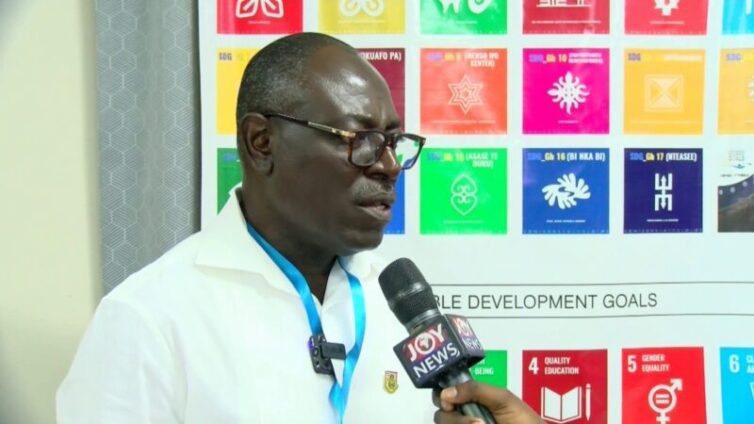
In creating public awareness as the country races against time to achieve the goals, an architect and lecturer at the Kwame Nkrumah University of Science and Technology (KNUST) has developed local symbols and meanings for the Sustainable Development Goals.

Seventeen unique goals to be achieved globally by countries under the United Nations for a sustainably developed world.
Ghana, like many countries who signed this treaty, have more to accomplish before the 2030 targeted deadline.
But, are people even aware of these goals?
“No, I haven’t seen or heard them before,” Adwubi, a hairdresser at Ayigya in Kumasi, said.
Another also added: “I have seen them but I don’t really understand”.
This level of low awareness confirms a 2023 research on Examining the level of Public Awareness on the Sustainable Development Goals in Africa: Empirical Evidence from Ghana.
It revealed some Ghanaians knew about goal 1 to 4 of the SDGs, but generally awareness of the global goals was low.
It surmised that the government must re-examine and adopt an effective communication policy framework which involves the local population and communities.
Each of the 17 sustainable development goals comes with a unique blend of colours and symbols.
Out of the numerous languages of the world, the SDG symbols are only transcribed into six dialects.
But researchers in Ghana are adopting the local arts and meanings from the Adinkra symbols to represent the goals.
Known as “Adinkratecture”, the 17 designs were selected from the over 96 known Adinkra symbols and localized into the Ghanaian parlance for a more comprehensive description while clamoring for action.
Prof Rexford Asaase-Oppong is the brain behind the piece.
“One of the key things about Sustainability is our capability and ability to appreciate our culture and bring culture into it. Sustainability is about people and development,” he said.
The Adinkra symbols, ascribed to the Ashanti’s and by extension Akans, is believed to have originated from the Gyaman tribe in Ghana’s neighboring country, Ivory Coast.
Named after the traditional ruler of the tribe, Kwadwo Adinkra, the Adinkra symbol, despite being artistic, has meanings which communicate.
Cultural Historian at the Manhyia Palace, Teacher Sarfo Kantanka, explains “the unique nature of the symbols allows it to be well-communicated and people can easily understand these symbols just as we see them in our local attires and graffiti”.
The team allowed some members of the public to explain some of the Adinkra symbols.
“That is Sankofa, and the other is Gye Nyame. Sankofa means to revisit and take up a rejected tradition or object,” Akua Nimo, a vendor, hurriedly explained some of the Adinkra Symbols.
The SDGs remain an abstractive subject and many individuals are closely vulnerable to the vagaries of the implications of environmental sustainability.
Prof Asaase-Oppong says little has been done to include the vulnerable in the global conversations as it has only been for the intellectuals.
“Health and well-being is basically abstract. But if you bring it to our local system and you’re showing a symbol of ‘Aho)den’ - strength - to the local person, they will know that if I have strength, I will be able to work and reduce poverty,” he said.
There is a call for the incorporation of the symbology in the local curriculum to expose children to climate action and environmental sustainability.
The adinkra symbols - globally known to be of African descent - is expected to contribute to communicating meanings for the needed action in protecting the world.
Latest Stories
-
Power restoration fault suspected in Kumasi Central Market fire
4 hours -
The 7-foot giant of Ngleshie Amanfro: Seven-foot Ghanaian Ephraim Saawa dreams of joining the national basketball team
5 hours -
Government promises support for Kumasi Central Market fire victims
5 hours -
Vibes The Movie: Big Ghun’s Ghanaian film earns five nominations at 2026 REFFA
6 hours -
MamaCare CEO warns unresolved conflicts among health workers could undermine maternal and neonatal care
6 hours -
Health professionals urged to translate medical knowledge into practice to save mothers
6 hours -
Conflicts among care providers linked to maternal, neonatal deaths – Expert
8 hours -
GIS marks 10th TIME conference, champions improved teaching practices
8 hours -
BRICS Or Balance? What Ghana’s bid really means
8 hours -
GPRTU wants full TRAFFITECH-GH implementation to start in 2027
9 hours -
How 10-mile walks for basic education birthed a 50-year legal career for Justice Korbieh
9 hours -
Mahama announces plans to import electric wheelchairs for PWDs
9 hours -
KGL U17 Colts 2026: Western beat Prempeh Elite Academy to set up final final with Greater Accra Region
9 hours -
Late Solanke strike salvages 10-man Spurs draw at Man United
9 hours -
Gender Ministry to monitor welfare of Nana Akua Addo’s children amid domestic violence case
9 hours