

Audio By Carbonatix
Fish farmers have been urged to always contact professionals in aquaculture to draw suitable biosecurity plans for them to implement in their farms.
This would not only help them manage fish mortality and secure their investments but would also contribute to protecting human life since healthy fish would be produced and supplied to the market for consumption.
Mr Theodore K. Owuani, the Ashanti Regional Laboratory Manager of the Fisheries Commission, who made the call, said it was important for people interested in fish farming to have biosecurity in mind, to ensure that they did not record unexpected losses to discourage them.
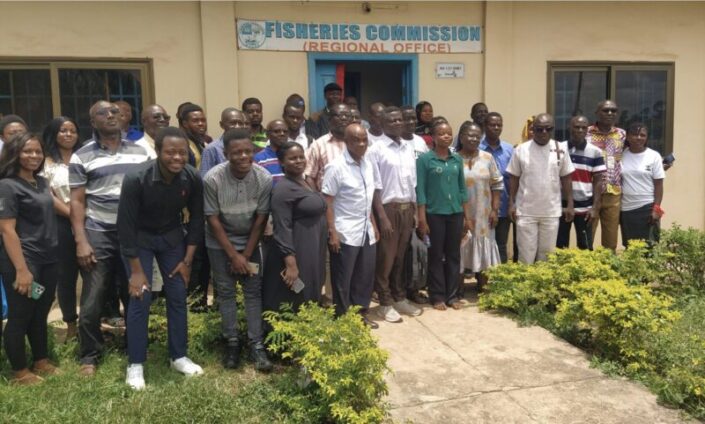
He was speaking at a biosecurity training workshop for about 58 fish farmers in the Ashanti region.
The training was to help the farmers acquire the requisite skills and knowledge in biosecurity, to help secure their investment by preventing unnecessary fish mortality through the introduction and spread of infections and diseases.
Biosecurity involves management plans and measures put in place to prevent the introduction and spread of infections and diseases among organisms.
Mr Owuani pointed out that though fish mortality should be expected it should not be above 15 per cent of stocked fish, and asked farmers to always contact their zonal officers to introduce them to good hatchery to purchase their brood stock.
This is because, some hatcheries were abusing the use of antibiotics in their farms, and this could cause problems for them, he said.
He indicated that, disease and infection outbreaks depended on three factors which included pathogens, which already existed in the water (environment), the environment and the host (fish).
Mr Owuani, the disease or pathogens in the water manifested when the fish was stressed through overstocking in ponds leading to fish competing for oxygen, poor handling and water parameters.
“When the fishes are stressed, their immune systems break down making them vulnerable to infections and diseases,” he stated.
He named other factors that contributed to infections and disease spread on and between farms as not quarantining new brood stock, poor feed storage, contaminated water and equipment, vectors and others.
Mr Owuani said biosecurity plans were specific to every farm because they had different challenges which needed varied solutions.
He mentioned some biosecurity plans and measures as covering ponds with nets, using clean pathogen-free water sources, sourcing fingerlings from certified hatcheries, and making a pest management programme.
Latest Stories
-
Association of Medical Councils of Africa to host 28th annual conference at Mövenpick Ambassador Hotel
18 seconds -
ECG’s GH¢200m upgrade spending must translate into reliable power – IES
31 seconds -
Ablekuma North MP supports 500 SHS freshmen with back-to-school items
2 minutes -
Dentsu School of Influence opens Ghana applications for aspiring content creators
2 minutes -
Demystifying Mathematics: Building confidence in young learners
2 minutes -
Journalists must strengthen credibility in digital era – Kwesi Pratt urges
4 minutes -
Benjamin ‘Clean Sheet’ Asare wins GPL Player of the Year, bags $38,000 vehicle from JAC Motors
9 minutes -
‘We need to investigate the ‘system’—IES calls for probe into recent blackouts
10 minutes -
AMCOA conference in Accra to tackle health worker migration, patient safety
14 minutes -
NCA Director-General urges journalists to protect public trust in digital era
14 minutes -
NSMQ 2026: Accra Girls make flying start, cruise past Asamankese, Sandema to book one-eighth spot
16 minutes -
Schools as sanctuary
17 minutes -
Bilingual and Multilingual Education: Harnessing linguistic diversity for better learning
18 minutes -
2026 Joy Sports Invitational Tournament: The Luckiest confirmed as headline sponsors
20 minutes -
NSMQ 2026: Edinaman SHS ends seven-year wait, qualifies for one-eighth stage
23 minutes