

Audio By Carbonatix
The Ghana Infrastructure Investment Fund (GIIF) is set to play a pivotal role in promoting sustainable financing for housing projects across the country, according to Minister for Works and Housing, Kojo Oppong Nkrumah.
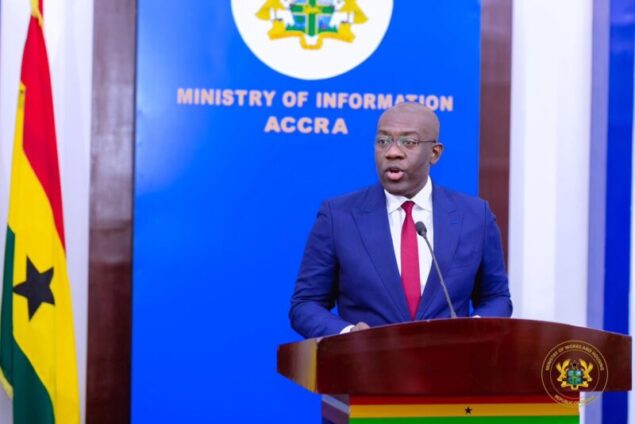
Speaking at a press briefing in Accra on Monday, September 30, the Minister stated government's commitment to addressing Ghana’s housing deficit, which is currently estimated at 1.8 million units.
He highlighted the need for innovative financing solutions to facilitate affordable housing projects, which are crucial in reducing the deficit.
To that end, the GIIF will partner with the Ministry of Works and Housing to develop sustainable financial frameworks that will drive housing development.
“The creation of the Ghana Infrastructure Investment Fund (GIIF) will help raise sustainable resources for nationwide housing projects, which is vital if we are to bridge the housing gap,” Mr Oppong Nkrumah said.
One of the primary strategies of the GIIF will be the establishment of a Public-Private Partnership (PPP) model to encourage private sector participation in housing provision.
This model will offer various incentives, such as land grants and tax breaks, to attract private developers.
In addition to the GIIF’s efforts, the Minister underscored the significance of the National Homeownership Fund (NHF), launched in 2018, to promote affordable housing.
The NHF has collaborated with commercial banks to implement the National Mortgage Schemes, which, during their pilot phase, facilitated the issuance of over 300 mortgages.
Mr Oppong Nkrumah also provided updates on ongoing housing projects.
The stalled Koforidua Affordable Housing Project will soon resume after being handed over to the State Housing Company Limited.
The aim is to accelerate construction while maintaining high standards.
In a separate development, he confirmed that negotiations are underway to hand over the Saglemi Housing Project to a private developer.
This move is expected to ensure the project's completion and the sale of its units without further government investment.
Lastly, the Minister highlighted the District Housing Programme, which is aimed at addressing the housing needs of public sector workers in rural areas, including those affected by the Akosombo Dam spillage.
Through partnerships with traditional authorities, this initiative seeks to secure unencumbered land, thus removing barriers that have long hindered real estate development in such areas.
Latest Stories
-
Yaw Ampofo Ankrah hasn’t taken or received any money to facilitate visas – Lawyer insists
8 minutes -
World Cup visa scandal: Senyo Hosi urges focus on constitutional accountability
8 minutes -
La Beach demolition: Senyo Hosi condemns lack of consultation
19 minutes -
Russian glide bomb attack on Zaporizhzhia kills at least 15 people
34 minutes -
Jinapor warns underperforming energy sector CEOs of consequences, says no protection for failure
36 minutes -
Fire destroys head of tipper truck on Lower Volta Bridge
40 minutes -
Palmer signs new Chelsea contract until 2034
42 minutes -
World Cup visa scandal: Mahama will act on corruption allegations – Abass Nurudeen
44 minutes -
Abass Nurudeen accuses Minority of ‘scandal scavenging’ over World Cup visa controversy
45 minutes -
US Embassy recognised NSA, GFA and GTA as separate entities for visa applications – Sports Minister’s aide
51 minutes -
Only 30% of Ghanaian teachers satisfied with their jobs – CAPCOE data reveals
1 hour -
Communities affected by construction of Akosombo Dam urge government to speed up compensation process
1 hour -
World Cup visa scandal: Sports Ministry not shielding anyone – Sports Minister’s special aide
2 hours -
World Cup visa scandal: Over 30 people misrepresented as GTA board members to US Embassy – Vincent Assafuah alleges
2 hours -
Fire destroys wooden structure near Yesu Mo Villa at Bush Road
2 hours