

Audio By Carbonatix
On Tuesday, tens of millions of voters will step into ballot booths across the United States.
But the results of the election - including whether Kamala Harris or Donald Trump will be the next president - will not be official until votes are counted and verified, which could take days to fully complete.
In the battleground states expected to decide the election's winner, the process will be highly scrutinized. Trump is already questioning the trustworthiness of many of their voting processes and in 2020 he challenged the results of many of their votes in court.
Here is what to know about voting in 2024.
When does vote counting begin and how long will it take?
The first polls will begin closing at 18:00 EST (23:00 BST) on Tuesday, but counting votes will extend far beyond then.
In most cases, it can take weeks to reach an official tally, partly because of state rules.
For example, in two battleground states - Pennsylvania and Wisconsin - election workers are not allowed to begin processing mailed-in ballots until election day. That is expected to slow the counting greatly.
It's important to note that news organisations use unofficial results and projections when they announce winners on election night or the following days, instead of waiting for the final and official count.
Who does the counting?
Counting, too, varies from location to location and depends on the equipment used.
Some counties "feed" ballots into optical scanners, while others may use touch-screen systems or ballot-marking devices to record votes.
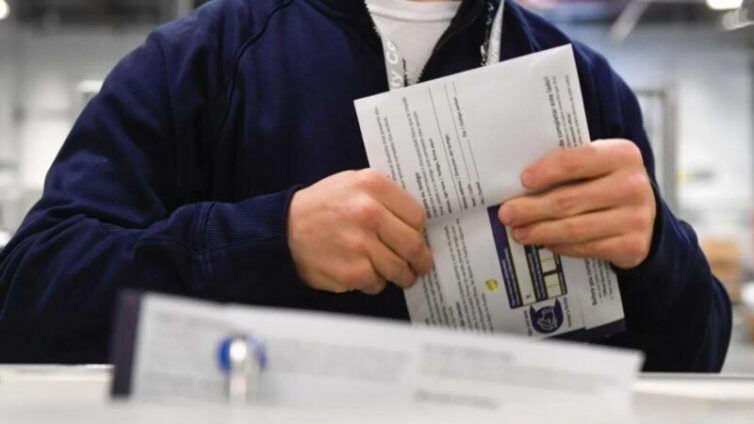
The scanners are the most common. They tabulate results, which are then manually recounted and double-checked by hand.
Results are, in turn, shared with electoral officials, the parties and eventually with the public.
What can slow down the process?
The counting can be slowed down by disruptions, legal challenges or complications around provisional ballots.
Numerous legal challenges have already been filed.
As of 1 November, there were 203 voting and election cases pending in 40 states, according to Marc Elias, a Democratic election lawyer who filed many of the responses to Trump's 2020 lawsuits.
They are concentrated in the battleground states of Georgia, which has 25 legal challenges, Pennsylvania, North Carolina, Wisconsin and Arizona, according to his count.
Provisional ballots are given to voters when it is unclear whether they are eligible to cast ballots. This could happen, for example, if a person cannot be found in rolls of registered voters.
Ballots can also be challenged by election workers or - in some states - by poll watchers. Once challenged, ballots must be reviewed by election supervisors and made available to state canvass boards before being included, or stricken, from the official final tally.
When would a recount take place?
Each state has its own procedure for recounts and what can trigger them.
In the battleground states of Pennsylvania and Michigan, recounts automatically occur when the numbers of votes received by each candidate are especially close.
In Pennsylvania's case, for example, an automatic recount is required if the margin of victory is less than or equal to half a percentage point.
Recounts can also be requested by candidates, courts or groups of voters, although the rules vary considerably among states.
Typically a request must be made within three to seven days.
In the vital swing state of Arizona, for example, a recount must be requested within two days of the declaration of unofficial results.
What does certification mean?
Again, the results that the public hears on election night are not official - and are instead a mix of preliminary data released by officials and projections from the Associated Press news agency or Reuters.
All states must certify their official results by 11 December.
But many key states have earlier deadlines. Georgia, for example, must certify its final tally by 22 November, while Michigan and Pennsylvania have until 25 November.
The next step takes place six days later, on 17 December, when presidential "electors" meet and send their states' results to Congress.
The electoral votes must be received by the President of the Senate - the Vice President, in this case Kamala Harris - by 25 December.
State electors came under intense scrutiny in 2020, when Trump and officials in seven states tried to use alternate, or "fake", electors to overturn his election loss.
This year, some expect the certification process to be drawn out by legal battles, including potentially numerous challenges from Trump and his political allies in Pennsylvania.
Latest Stories
-
MMDCEs charged to ensure Landing Beach Committees do not sell premix fuel beyond approved prices
14 minutes -
The Inconvenient Truth: Democracy does not fail in The Chamber, it fails in the Committee Room
34 minutes -
There is absolutely nothing wrong with what the Chief Justice said
43 minutes -
App launched to help Ghanaians verify prospective partners’ marital status before marriage
53 minutes -
‘I have gone through a lot these past 2 days’ – A-Plus reveals after New Winneba violence
55 minutes -
DBG takes GH¢2.5bn development funding beyond Accra as it pushes industrial transformation
56 minutes -
Vice President Jane Opoku-Agyemang calls for accurate teaching of slavery history in schools
58 minutes -
Ghana has duty to preserve slave-trade sites and tell their full story – Vice President
1 hour -
West Africa can be self-sufficient in rice production – John Dumelo
1 hour -
Over 300 arrested over extremist recruitment attempts along northern border – Agalga
1 hour -
Housing Minister seeks shorter construction period for Kaneshie–First Light Road works
1 hour -
Ghana cannot afford complacency over extremist threats – Agalga
2 hours -
African leaders call for decisive investments to deliver a more sustainable food system for the continent
2 hours -
Ahmed Ibrahim orders traffic plan ahead of Pamprom Junction road closure
2 hours -
Full funding for Accra-Kumasi Expressway to be ready by year-end without borrowing – Ato Forson
2 hours