

Audio By Carbonatix
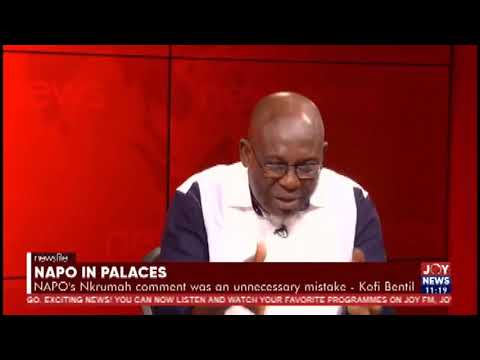
The Vice President of IMANI Africa, Kofi Bentil, has stated that electoral violence is deeply ingrained in Ghana’s political culture, stressing the urgent need for the country to confront this issue head-on to put an end to it.
Speaking at Joy FM’s Newsfile programme on Saturday, December 14, Mr Bentil highlighted that the roots of political violence in Ghana can be traced back to the time of Ghana's late president, Dr Kwame Nkrumah.
He explained how the overthrow of Nkrumah led to the demonization and destruction of his legacy, a pattern that continued through to the era of the late Jerry John Rawlings.
Mr Bentil emphasized that this issue is not a recent phenomenon; it has become a deeply embedded part of Ghana's political culture. “It’s in our culture, and we must understand it,” he said.
He noted that this violence is not limited to any single political party but has affected both the New Patriotic Party (NPP) and the National Democratic Congress (NDC).
According to him, even in today’s democratic era, political violence continues to persist, and this must be reversed.
He expressed his satisfaction that two prominent political figures had recently made the right statements regarding the issue. However, he pointed out that the tone and political posture of some leaders still leave much to be desired. “What we are observing politically is not something we fully agree with,” he stated.
To effectively combat this menace, Mr Bentil called on law enforcement agencies to take stronger action against perpetrators of electoral violence.
He argued that, due to the cultural nature of the problem, it is necessary to take decisive steps to break this cycle. He further stressed that political parties must offer their full support to efforts aimed at curbing electoral violence.
“These are basic crimes,” he said, urging that they should be addressed in a manner that sets an example for society. “If we do not make a determined effort to tackle this issue, we will never be able to break this culture,” he warned.
Reflecting on the broader political landscape, Mr Bentil lamented that many politicians come to power for brief eight-year terms, only to serve their own interests. “We, the citizens, are left to fend for ourselves in the aftermath,” he said, expressing his dismay at the current state of affairs.
Latest Stories
-
Government prioritises foundational learning to improve education outcomes
2 minutes -
Ghana, Côte d’Ivoire deepen maritime security cooperation through joint boundary inspection
8 minutes -
Three-hour rainfall exposes poor drainage system in Kadjebi
14 minutes -
Food inflation never responded – Dr Yamson says Ghana must stop throwing money at short-term fixes
48 minutes -
Oil set for second weekly rise as unsettled US-Iran war crimps supply
1 hour -
US teen drops lawsuit against Meta, Google and Snap ahead of trial
1 hour -
Meghan could return to acting once back in UK
1 hour -
Bali jails Swiss tourist for insulting sacred Day of Silence
2 hours -
At least 50 killed, mostly children, as overloaded boat capsizes in Nigeria
2 hours -
Cameroon president returns home after 10-week absence
2 hours -
Mineworkers demand release of $34.5 million in trapped savings
2 hours -
Stability must last 10 years, not 4 – Dr Yamson challenges gov’t to make boom-bust economy last
2 hours -
Tunisia opposition protests against president amid economic discontent
3 hours -
Nii Lante Vanderpuye apologises to Sammy Gyamfi, NDC over GoldBod comments
4 hours -
US sanctions more Cuban companies and officials
4 hours