

Audio By Carbonatix
Finance Minister, Dr Cassiel Ato Forson, has warned that excessive and inefficient public spending is pushing the country towards economic instability.
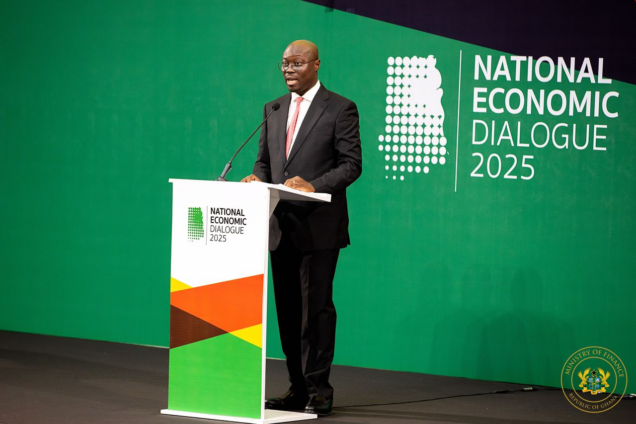
Speaking at the National Economic Dialogue in Accra, he stressed the urgent need to reform government expenditures, calling for tighter fiscal discipline and better resource allocation.
Dr. Forson revealed that Ghana’s government expenditure has grown faster than GDP over the past decade, leading to an unsustainable fiscal situation.
The bulk of spending is tied up in wages and salaries, which consume a significant portion of government revenue, high energy subsidies, which drain public funds without improving efficiency and ballooning interest payments, leaving little room for investment in infrastructure and social services.
“These rigid expenditures make it almost impossible to direct resources toward economic transformation. We are spending more but getting less in return,” he lamented.
The Finance Minister criticised the poor allocation of resources in crucial sectors, particularly healthcare, education, and infrastructure.
Health Sector Underfunding and Misuse
Despite growing healthcare demands, the National Health Insurance Scheme (NHIS) is struggling due to financing shortfalls and misallocation of resources.
Dr Forson revealed that only 58% of NHIS funds go towards actual claims payments, with the rest diverted to non-core activities.
“The NHIS is meant to ensure healthcare for all, but inefficiencies and financial leakages are crippling it,” he stated.
Education Spending Failing to Deliver Results
Education spending is skewed toward secondary and tertiary levels, leaving basic education underfunded.
A significant portion of funds is allocated to staff compensation, with little left for classroom materials or infrastructure improvements.
“Our children are our future, yet the majority of education funds go to wages rather than improving learning conditions,” Dr Forson pointed out.
Infrastructure Projects Left Unfinished
The Minister also highlighted the wasteful spending on incomplete infrastructure projects, citing Agenda 111, where $400 million was spent over four years without a single operational hospital. Completing these projects would require an additional $1.5 billion.
“We cannot continue spreading resources across too many projects without completing any. This approach is wasteful and unsustainable,” he said.
Dr. Forson described Ghana’s energy sector as a major financial burden, costing the country 2% of GDP annually.
He noted that despite government transfers totaling $2.1 billion over the past two years, the energy sector remains in crisis, with projected financial shortfalls exceeding $9 billion by 2026.
Key issues include high generation costs due to lack of competition, massive revenue losses by ECG, which collects only 62% of total energy sold and tariffs that do not reflect real costs, leading to mounting debts.
“The energy sector is bleeding our economy. Without radical reforms, it will become unsustainable,” Dr. Forson warned.
To address these spending inefficiencies, Dr. Forson outlined several urgent reforms, including reallocating funds to priority areas, such as healthcare, education, and infrastructure, enhancing efficiency in public spending, and ensuring every cedi is spent effectively.
He also mentioned reforming state-owned enterprises (SOEs), including COCOBOD and ECG, to reduce financial losses and eliminating wasteful subsidies, while protecting the vulnerable.
Dr Forson also called for Implementing strict procurement and financial management controls to curb corruption and mismanagement.
“We cannot afford to continue spending recklessly. Every Ghanaian is feeling the impact of poor financial decisions. Now is the time for discipline, accountability, and smarter spending,” he concluded.
The National Economic Dialogue continues with discussions on how to implement these critical reforms.
Latest Stories
-
GNFS contains fire outbreak at Teshie Lekma Road near Lekma Hospital
4 hours -
Samia Nkrumah rejects the narrative that Ghanaians were happy after Nkrumah’s overthrow
6 hours -
A Mother’s pain: Tribute by Ivan Baidoo’s mother
6 hours -
‘Forgive us for staying away’ — Samia Nkrumah leads family back to Nkroful, pledges to preserve Nkrumah’s legacy
6 hours -
Ernest Nuamah scores twice as Lyon beat Rennes
6 hours -
‘My dear Ivan’ – A father’s tribute to a son tragically killed
6 hours -
GNPC Explorco advances Voltaian Basin drilling preparations with 13.5km access road
6 hours -
Cabinet approves facility manager for Borteyman Sports Complex – Kofi Adams
7 hours -
Sanitation is improving; critics may be ‘living in another world’ – Salaga South MP replies Bekwai MP
7 hours -
Government must do more to tackle sanitation crisis – Bekwai MP
7 hours -
World Cleanup Day: GFF begins sanitation education in local communities
8 hours -
EU Ambassador, IGP discuss stronger cooperation on policing and security
8 hours -
Africa Nations Volleyball Championship: Ghana set up quarterfinal clash with Cameroon after beating Chad
8 hours -
Meet Dr Benjamin Appiah Osei — Ghana’s three-time tourism awards winner
8 hours -
UEFA & CONCACAF demand Fifa pays $10m to all 211 members
8 hours