

Audio By Carbonatix
Despite significant policy interventions under Ghana’s National Health Insurance Scheme, maternal and neonatal health outcomes continue to face serious challenges.
Out-of-pocket expenses and a shortage of qualified health professionals remain critical barriers to access.
According to a joint report by the World Bank and the World Health Organization, Ghanaian households still bear approximately 35% of total healthcare costs—an alarming statistic that undermines universal health coverage efforts.
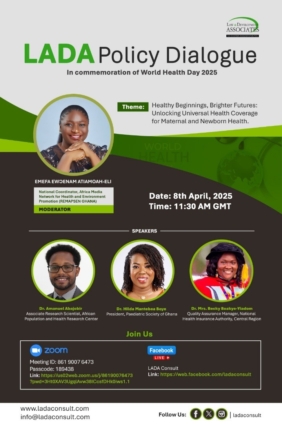
At a recent Policy Dialogue organised by Law and Development Associates (LADA) in commemoration of World Health Day, health experts gathered to assess the state of maternal and neonatal care and propose actionable solutions to ease the burden on families.
Ghana continues to record rising maternal and newborn deaths, despite the Free Maternal Health Care Policy (FMHCP) introduced in 2008 under the National Health Insurance Scheme.
At the LADA dialogue on universal health coverage for maternal and newborn health, Quality Insurance Manager at the NHIA in the Central Region, Dr. Becky Boakye-Yiadom identified out-of-pocket payments as a major contributor to maternal mortality. She stressed the need for enhanced public awareness on healthcare rights and entitlements.
"We must intensify communication to ensure that women know what they’re entitled to under the NHIS. Many maternal deaths are preventable if the financial burden is lifted”, she added.
Also speaking at the event, Dr. Catherine Attoh, Technical Officer for Reproductive, Maternal, Newborn, Child and Adolescent Health at WHO Ghana, Dr. Catherine Attoh, called for greater collaboration between government, civil society, the private sector, and development partners. She raised concern about funding cuts from USAID, emphasizing the need for a united front to safeguard maternal health gains.
"Now, more than ever, we need strong partnerships to sustain maternal health services, especially with reduced donor support”, she stated.
Meanwhile, Associate Research Scientist at the African Population and Health Research Centre, Dr. Manuel Abajobir, highlighted incentives for maternal health service providers and transparent data systems as key measures to curb maternal mortality both in Ghana and across the sub-region.
"Investing in MHCR initiatives and making data more accessible can significantly improve outcomes. These are proven tools for driving accountability and change”, he remarked
As Ghana strives toward Universal Health Coverage, stakeholders agree that bridging the financing gap, strengthening healthcare systems, and ensuring equitable access must remain top priorities in addressing the maternal health dilemma.
Latest Stories
-
Ghana’s cashew industry faces processing gap as Côte d’Ivoire moves to capture more value
8 minutes -
“Our greatest wealth is not in our soil but our people” — Upper West Minister
13 minutes -
Luex Healthcare launches children’s health education book series with Luey the Lion
26 minutes -
NAGRAT urges gov’t to communicate early if September deadline cannot be met
58 minutes -
We trust government to meet September deadline on teachers’ promotions – NAGRAT
1 hour -
“We dare not fail” – Gov’t promises to honour teachers’ promotion pay deal
1 hour -
The GH¢19.8 billion mirage: Inside Ghana’s state enterprise turnaround
1 hour -
Luv FM High School Debate: KNUST SHS and Osei Adutwum SHS set up thrilling final after dramatic semi-finals
2 hours -
KNUST AI Coordinator urges structured adoption of AI in teacher education
2 hours -
Nepal rescuers blast hillside in search of hydropower workers as families wait anxiously
2 hours -
Teachers who pass promotional exam to get January 2026 start date after gov’t resolves promotion dispute – Dr Apaak assures
2 hours -
NSMQ 2026: St. John’s School rally from slow start to book semi-final spot
2 hours -
Promotion pay row: Gov’t gives teachers September 2026 to complete salary adjustments
2 hours -
Financial irregularities plummet by 62.9% as state tightens fiscal controls
2 hours -
DVLA to expand mobile services to underserved communities in Ghana’s Eastern Corridor of the Northern Region
3 hours