

Audio By Carbonatix
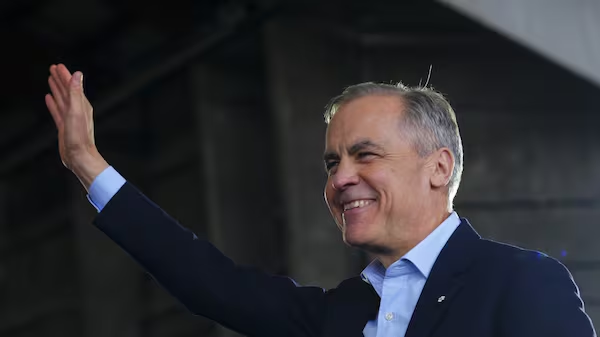
Canadian Prime Minister Mark Carney's Liberals retained power in the country's election on Monday, but CTV News predicted they would fall short of the majority government he had wanted to help him negotiate tariffs with U.S. President Donald Trump.
The Liberals need to win 172 of the House of Commons' 343 electoral districts, known as seats, for a majority that would allow them to govern without support from a smaller party.
The Reuters Tariff Watch newsletter is your daily guide to the latest global trade and tariff news. Sign up here.
The Liberals were leading or elected in 161 districts, followed by the Conservatives with 150, with votes still being counted.
The westernmost province of British Columbia, where polls closed last, could decide whether Liberals fall short of a majority government.
Shachi Kurl, president of the Angus Reid Institute, a polling firm, told Reuters the Liberal win hinged on three factors.
"It was the 'anybody-but-Conservative' factor, it was the Trump tariff factor, and then it was the Trudeau departure ... which enabled a lot of left-of-centre voters and traditional Liberal voters to come back to the party," Kurl said, referring to the resignation of unpopular former Prime Minister Justin Trudeau.
Carney had promised a tough approach with Washington over its import tariffs and said Canada would need to spend billions to reduce its reliance on the U.S. But the right-of-centre Conservatives, who called for change after more than nine years of Liberal rule, showed unexpected strength.
Minority governments in Canada rarely last longer than 2-1/2 years.
The Canadian Broadcasting Corporation projected a Liberal win but did not yet say if it expected a minority or majority government.
The result, though, capped a notable comeback for the Liberals, who had been 20 points behind in the polls in January before Trudeau announced he was quitting and Trump started threatening tariffs and annexation.
"I look back to as recently as December, when everyone was writing the Liberal Party off," Liberal Transport Minister Chrystia Freeland told CTV. "People were even talking about whether we would retain official party status in the next election. Tonight, when it is clear that we are going to form the government, from my perspective, that is an outstanding result."

Freeland's resignation from the Liberal cabinet in December after a clash with Trudeau led to his resignation.
Trump's threats ignited a wave of patriotism that swelled support for Carney, a political newcomer who previously led two G7 central banks.
Trump re-emerged as a campaign factor last week, declaring that he might raise a 25% tariff on Canadian-made cars because the U.S. does not want them. He said earlier he might use "economic force" to make Canada the 51st state.
Carney has emphasised that his experience handling economic issues makes him the best leader to deal with Trump, while Conservative leader Pierre Poilievre has tapped into concerns about the cost of living, crime and a housing crisis.
Trump, in a social media post on Monday, reiterated his call for Canada to become the 51st state.
"Good luck to the Great people of Canada," he said. "Elect the man who has the strength and wisdom to cut your taxes in half, increase your military power, for free, to the highest level in the World, have your Car, Steel, Aluminum, Lumber, Energy, and all other businesses, QUADRUPLE in size, WITH ZERO TARIFFS OR TAXES, if Canada becomes the cherished 51st. State of the United States of America. No more artificially drawn line from many years ago."
CONSERVATIVE DISAPPOINTMENT
Tensions with the U.S. have caused supporters of two smaller parties, the left-leaning New Democratic Party and the separatist Bloc Québécois, to shift to the Liberals. The Conservatives, however, appeared on track to make gains in the seat-rich Toronto area to prevent a Liberal majority government.
The Liberals are the last party to win four consecutive elections in Canada, accomplishing the feat in 2004.
Poilievre focused his campaign on domestic issues and the need to fix a country that he said the Liberals had "broken."
Neither the Carney nor Poilievre camp was immediately available for reaction to the CTV and CBC forecasts.
Latest Stories
-
Aggrieved Gold Coast Fund Management Company customers to petition Mahama over locked-up funds
28 seconds -
NSMQ 2026: PRESEC, Legon dethrones defending champions Mfantsipim in thrilling battle to book semi-final spot
14 minutes -
Ghana’s cashew industry faces processing gap as Côte d’Ivoire moves to capture more value
25 minutes -
“Our greatest wealth is not in our soil but our people” — Upper West Minister
31 minutes -
Luex Healthcare launches children’s health education book series with Luey the Lion
43 minutes -
NAGRAT urges gov’t to communicate early if September deadline cannot be met
1 hour -
We trust government to meet September deadline on teachers’ promotions – NAGRAT
1 hour -
“We dare not fail” – Gov’t promises to honour teachers’ promotion pay deal
2 hours -
The GH¢19.8 billion mirage: Inside Ghana’s state enterprise turnaround
2 hours -
Luv FM High School Debate: KNUST SHS and Osei Adutwum SHS set up thrilling final after dramatic semi-finals
2 hours -
KNUST AI Coordinator urges structured adoption of AI in teacher education
2 hours -
Nepal rescuers blast hillside in search of hydropower workers as families wait anxiously
2 hours -
Teachers who pass promotional exam to get January 2026 start date after gov’t resolves promotion dispute – Dr Apaak assures
2 hours -
NSMQ 2026: St. John’s School rally from slow start to book semi-final spot
2 hours -
Promotion pay row: Gov’t gives teachers September 2026 to complete salary adjustments
3 hours