

Audio By Carbonatix
Former Vice President, Dr. Mahamudu Bawumia, has cautioned against the use of tariffs as a solution to trade imbalances, stressing that such deficits are macroeconomic in nature and not the result of trade policy failures.
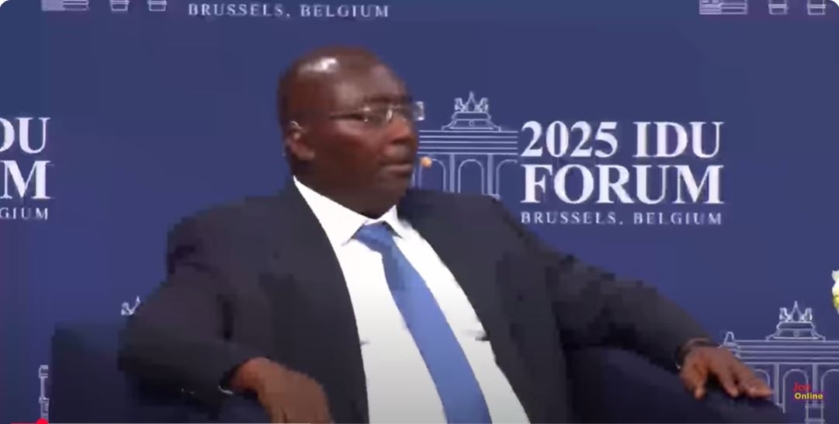
Speaking at the International Democracy Union (IDU) Forum in Brussels on Saturday, May 17, Dr. Bawumia responded to a question on how the weaponisation of trade is affecting African economies, particularly Ghana, and what strategies can enhance the continent's economic resilience.
“Policymakers are increasingly ignoring both economic fundamentals and the lessons of history,” he said.
“If you look at the share of global trade, Africa contributes just 2.5% of global exports and 2.9% of imports, while Asia, Europe, and the U.S. dominate global trade flows with significant imbalances.”
Dr. Bawumia argued that despite these imbalances, imposing tariffs does not address the root cause of trade deficits.
“You cannot fix a trade deficit with tariffs, it simply doesn’t work,” he emphasised.
Explaining further, he referenced the national income identity, noting that a trade deficit reflects a gap between a nation’s savings and investment.
“If a country spends more than it saves, it will run a trade deficit. That’s a macroeconomic problem, not a trade policy problem,” he said.
He cited historical examples, such as the 1930s Smoot-Hawley Tariff Act in the U.S., which contributed to the Great Depression, and the U.S.-China tariff war in 2018–2019, which negatively impacted global trade.
“The recent increase in average U.S. tariff rates from 2.4% to 10% is the largest since 1943, and its effects will be significant,” he warned.
Turning attention to Africa, Dr. Bawumia acknowledged that the continent is somewhat insulated from U.S. trade shocks, with Africa exporting 6.5 per cent and importing 4.4 per cent of goods to and from the U.S.
However, he highlighted countries like Lesotho, whose textile exports to the U.S. account for 50 per cent of their total exports under the African Growth and Opportunity Act (AGOA), are vulnerable.
Dr Bawumia predicted that Africa’s response to global trade disruptions will include a renewed push for self-reliance and stronger intra-African trade ties.
Latest Stories
-
Digitalisation, AI key to Ghana’s tourism transformation – GHATOF
5 minutes -
Stronger GTA-private sector partnership needed to grow tourism – GHATOF
15 minutes -
Amazon eyes Ghana for broadband expansion after talks with Mahama
59 minutes -
National Investment Quiz 2026: Six schools qualify for quarter-finals
1 hour -
‘Do not let Russia pay for its madness with lives of your people’ – Zelensky to Ghana, 46 other countries
2 hours -
6,079 promotion cases fully processed and paid – CAGD says amid nationwide teachers’ strike
2 hours -
Teacher unions to meet government Monday over nationwide strike
2 hours -
Photo story: Republic Bank-JoyNews Habitat Fair clinic wraps up after three days of housing solutions, expert engagement
2 hours -
National Peace Council urges investment in youth to sustain Ghana’s peace
3 hours -
Afenyo-Markin urges youth to speak up against injustice
3 hours -
CAF annuls Edo Queens victory, orders WAFU B final to resume from extra time
3 hours -
Interior Minister urges traditional authorities to enforce anti-bushfire bye-laws
3 hours -
3rd Republic Bank-JoyNews Habitat Fair Clinic ends on a high note after three days of strong patronage
3 hours -
Ten climbers missing after avalanche hits Himalayan base camp
4 hours -
NPP had more permanent fuel relief measures than current GH¢2 diesel cut – Amin Adam
4 hours