

Audio By Carbonatix
In developing countries, girls face numerous challenges regarding Water, Sanitation, and Hygiene (WASH) due to various factors, namely limited access to clean water, inadequate sanitation facilities, and a lack of menstrual hygiene support.
Women and girls are disproportionately affected by the lack of access to basic water, sanitation and hygiene facilities due to their needs during periods of increased vulnerability to infection around menstruation and reproduction.
Many girls in developing countries lack access to clean, safe drinking water and must travel long distances for accessibility, which can be time-consuming, dangerous, and prevent them from attending school or other activities.
Lack of access to safe water, sanitation, and hygiene can lead to waterborne diseases, increased susceptibility to infections, and overall health problems.
Inadequate WASH infrastructure in schools can lead to absenteeism, decreased school attendance, and even dropout rates for girls.
The time spent collecting water and managing sanitation can impact girls' economic opportunities and reduce their ability to participate in income-generating activities.
The challenges of WASH can have significant psychosocial impacts on girls, such as increased stress, anxiety, and feelings of shame or isolation.
In this regard, the Social Development and Improvement Agency (SODIA) has commenced a Water, Sanitation, and Hygiene (WASH) audit in five selected community schools in the Tain District.
It is being done in partnership with ActionAid Ghana's Brong Ahafo Regional Programme (BARP) with support from the Young Urban Women Movement (YUWM) and the Ghana Education Service (GES) in Tain District.
Since April and May 2025, ActionAid and SODIA have supported YUWM to embark on a WASH Audit in five (5) selected schools in communities, namely Namasa, Kwametenten, Hiamankyene, Njau-Tanoso and Wiasekrom, with findings shared to stakeholders.
The WASH audit aims to promote inclusive education, particularly for the girl child, in line with Sustainable Development Goal 4 (SDG 4) on quality and inclusive education.
It will also empower students and community members to address water- and sanitation-related health Issues in their schools.
The audit advocates for affordable and safe sanitary materials, accurate information about menstruation and menstrual health, facilities and infrastructure that allow for dignified menstrual management and addressing challenging societal norms and taboos surrounding menstruation.
The initiative is also tied to the celebration of World Menstrual Hygiene Day on May 28, 2025.
By promoting inclusive education and improving WASH facilities, this initiative seeks to create a conducive learning environment for all students, particularly girls.
Ibrahim Yusif, Programme Coordinator for SODIA, in remarks at Nsawkaw in the Bono Region, said his outfit recognises the strength and resilience of girls and women worldwide.
For us, the Programme Coordinator noted, this celebration is not just about acknowledging the challenges women face but about taking concrete actions to address them.
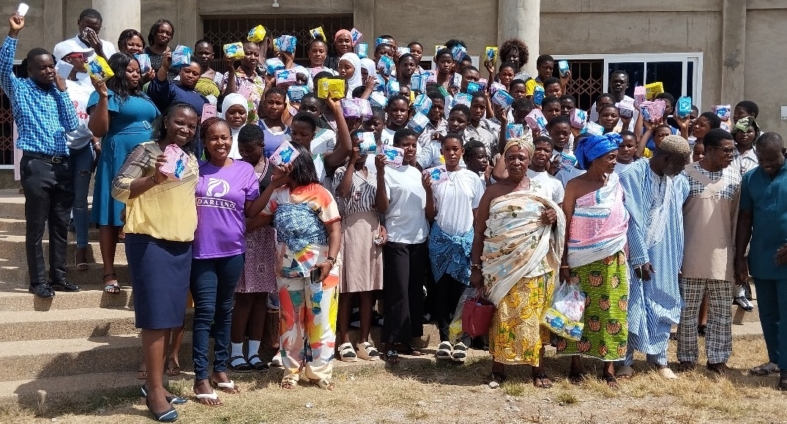
"We have distributed essential educational materials and hygiene products to our Sponsored Eighteen (18) community schools in the Tain and Banda districts, respectively," he reiterated.
According to Mr Ibrahim, SODIA has provided over 750 pieces of sanitary pads to support menstrual hygiene management of girls, 2,500 exercise books to foster learning and knowledge acquisition,
He said that 1,500 pens, 450 pencils, and 650 mathematical sets were to equip students with the necessary tools for academic success, and 1,100 clear bags were to protect and carry educational materials.
The Programme Coordinator said these efforts are part of their commitment to empower girls and promote inclusive education, saying that every girl deserves access to quality education and the opportunity to reach her full potential.
Mr. Ibrahim noted that by addressing barriers to education, including menstrual hygiene management, we aim to create a supportive environment where every girl can thrive.
He emphasised the importance of collective action to ensure that menstruation doesn't limit anyone's access to education, health or opportunities and to promote a world where everyone can manage their menstruation with dignity without barriers, free from stigma and taboos.
Again, the Programme Coordinator indicated, "Let us work together to create a world where menstruation is no longer a barrier to education but an opportunity for girls to grow, learn, and thrive."
Latest Stories
-
Ghana needs a law to sustain constitutional reforms – CDD-Ghana
3 hours -
COVID fumigation audit: Auditor-General has a lot of questions to answer – Akwatia MP
3 hours -
Stranded Ghanaian medical graduates in Cuba appeal to Mahama for immediate return
3 hours -
GNFS contains fire outbreak at Teshie Lekma Road near Lekma Hospital
9 hours -
Samia Nkrumah rejects the narrative that Ghanaians were happy after Nkrumah’s overthrow
10 hours -
A Mother’s pain: Tribute by Ivan Baidoo’s mother
11 hours -
‘Forgive us for staying away’ — Samia Nkrumah leads family back to Nkroful, pledges to preserve Nkrumah’s legacy
11 hours -
Ernest Nuamah scores twice as Lyon beat Rennes
11 hours -
‘My dear Ivan’ – A father’s tribute to a son tragically killed
11 hours -
GNPC Explorco advances Voltaian Basin drilling preparations with 13.5km access road
11 hours -
Cabinet approves facility manager for Borteyman Sports Complex – Kofi Adams
12 hours -
Sanitation is improving; critics may be ‘living in another world’ – Salaga South MP replies Bekwai MP
12 hours -
Government must do more to tackle sanitation crisis – Bekwai MP
12 hours -
World Cleanup Day: GFF begins sanitation education in local communities
12 hours -
EU Ambassador, IGP discuss stronger cooperation on policing and security
12 hours