

Audio By Carbonatix
Alphonce Felix Simbu made history on Monday (15), becoming the first athlete from Tanzania to win a global title by claiming gold in the men's marathon at the World Athletics Championships Tokyo 25.
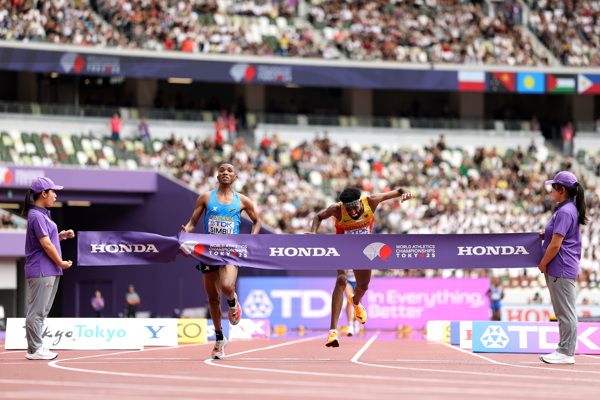
He achieved the feat in style – with the smallest winning margin ever in a global championships marathon, having outsprinted Germany's Amanol Petros in the closing stages to finish just 0.03 ahead.
One of only two athletes representing Tanzania at the World Championships, Simbu was always in contention. He kicked in the closing 30 metres and with victory, he upgraded the world bronze medal he won in 2017 to gold.
“Today means celebrations in Tanzania,” he said. “We have written new history as a country. It was my dream. I am at peace. It is about discipline, training and never giving up.
“After 2017 I have been trying to win another medal but failed at it. Last year Paris was a challenge and this year I told myself: I will try my best. I did different types of training under different weather conditions.”
Simbu and Petros were both credited with the same time: 2:09:48.
“I have never seen something like this in the marathon – both races (men and women) came down to a sprint finish. It's like the 100m,” said Petros.
“This is four months of hard work in training – running, eating and sleeping. It was hard. But this silver gives me energy and bigger motivation that I can win bigger competitions. I was so sure I was winning, he (Simbu) surprised me. He kicked like crazy. I accept I lost today but tomorrow I can win. Today is a learning experience.”
Italy’s Iliass Aouani took bronze in 2:09:53.
“I am proud and happy about the way I conducted the race,” he said. “I was relaxed at the end and pushed through, but the other guys had more legs than me. It means a lot. This is a hard sport, people do not know that behind this medal are a lot of frustrations, a lot of bad races, missed opportunities.”
Kenya’s Vincent Ngetich took an early lead, with all the athletes grouped together. He led through 5km in 15:22, followed closely by athletes including Petros, Simbu and Aouani, plus Abel Chelangat, Isaac Mpofu, Sondre Moen, Suldan Hassan, Deresa Geleta and Stephen Kissa.
In the hot and humid conditions, athletes cooled themselves with ice and sponges, even passing them to each other.
Ngetich, running on the edge of the course, slightly increased the pace, with Chelangat and Kissa close behind. The leading pack briefly scattered before regrouping.
At Akihabara turn, Ngetich pushed the pace again, but Germany’s Richard Ringer took over and led the group through 10km in 30:48, alongside defending champion Victor Kiplangat, Chelangat, Petros, Simbu, Ngetich and Mohamed Reda El Aaraby.
The leading roles kept changing, with Morocco’s El Aaraby taking over before Ethiopia’s Tadese Takele – this year’s Tokyo Marathon champion – surged ahead. Ngetich again took the lead through the Ginza turn.
Kiplangat then grabbed a cooler and moved to the front, pushing the pace downhill. Sweden’s Hassan led a group of more than 20 runners through 20km in 1:01:54 but Kiplangat remained in control at the halfway point (1:05:19), followed by the likes of Hassan, Geleta, Kissa, Elroy Gelant and Kipkoech.
Geleta took a turn at the front, leading the pack through 30km in 1:32:27, but it was Kiplangat who surged at 33km – leading for around 6km before falling back and out of contention.
Meanwhile, his compatriot Chelangat took the lead, followed by a series of challengers – all in single file. Soon, the lead group was down to five.
As the race wound up, Chelangat and Haimro Alame dropped back, leaving Aouani, Petros and Simbu to battle for the gold. With the stadium in sight, Simbu nearly went off course.
Once inside, Petros surged with 200 metres to go, with Simbu in pursuit. Petros glanced back twice and the world title came down to a photo finish. Both were timed at 2:09:48, separated by just three hundredths of a second.
“When we entered the stadium, I was not sure if I would win. I did not know if I won. But when I saw the video screens and me on the top of the results, I felt relieved,” said Simbu.
“Before this event, I was training in Tanzania, and the conditions there helped me to win this race. I remember, when I was in Paris last year (at the Olympics), it was very challenging for me – the hills, all ups and downs. So, before Tokyo, I decided to train on different surfaces. Sometimes I went to hills, and that is what made the difference here. I had many tough moments during the race, but I told myself that I would never give up.”
Latest Stories
-
Bagbin adjourns Parliament indefinitely
16 minutes -
African Most Beautiful USA Queen to host Community Zumba Dance session in Accra
16 minutes -
Cocaine probe: Speaker got it wrong by blocking parliamentary inquiry – Minority Leader
29 minutes -
FoSCel foundation calls for end to stigma and stereotyping against people living with sickle cell disease
41 minutes -
Auditor-General to track audit recommendations as GH¢280.5m in surcharges remains unpaid
41 minutes -
Walewale MP withdraws ‘rude’ comment on Bagbin’s Parliament recall, apologises
58 minutes -
FoSCel founder urges curriculum reform to strengthen sickle cell education in Ghana
1 hour -
United States launches America.Gov for public services 5 years after Dr. Bawumia launched Ghana’s version Ghana.Gov
1 hour -
Cocaine probe: Majority used super majority with Speaker’s support to weaken Parliament – Afenyo-Markin
1 hour -
UGMC Research Director calls for deliberate pathway from research to patient care
1 hour -
IEAG calls on FDA to resolve delays in import code issuance
2 hours -
UGMC research must translate laboratory findings into healthcare solutions – Prof Evelyn Yayra Bonney
2 hours -
Court remands 3 over alleged gold concentrate robbery
2 hours -
Two bodies stuck at St. Anne’s mortuary after refrigeration engines break down
2 hours -
‘We will not let this matter rest’ – Afenyo-Markin after Bagbin rejects narcotics probe
2 hours