

Audio By Carbonatix
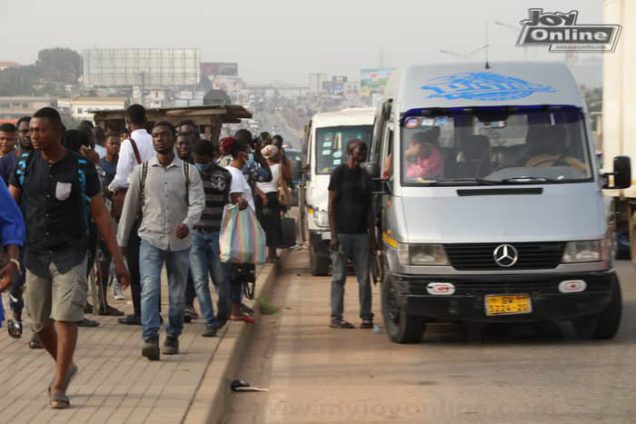
On a typical weekday morning in Accra, motorcycles weave recklessly between overcrowded trotro minibuses, their exhaust pipes emitting dark, choking clouds.
Dust rises from the unpaved shoulders of major roads, stirred by impatient vehicles weaving in and out of traffic.
Commuters press masks to their faces. A mother, holding her child’s hand, pauses mid-crossing, the acrid smell of petrol lingering in the air.
This postcard of rush-hour chaos is both a traffic problem and a warning signal that Accra’s air is becoming increasingly unbreathable.

Air quality monitoring tells a stark story. According to the Air Quality Life Index (AQLI) 2025 report, fine particulate pollution (PM₂.₅) is costing the average Ghanaian nearly 0.8 years of life expectancy, roughly nine months stolen from every life.
This makes dirty air the country’s sixth biggest external health threat, just behind malnutrition and HIV/AIDS.
Transport emissions are estimated to be responsible for nearly half of Accra’s ambient fine particulate matter (PM₂.₅), driven by a public transport system dominated by aging trotros, inefficient private cars, and roads that generate dust as vehicles pass.
In some of the worst-affected areas like Agbogbloshie, Makola and Nima, air pollution monitoring consistently records levels far above World Health Organization safety limits.
Health experts say the consequences are serious and escalating.
28,000 premature deaths are recorded every year as a result of air pollution in Ghana, according to the World Health Organization (2020).
The annual average concentration of particulate matter (PM2.5) pollution in Ghana was 11 times higher than WHO 2021 recommended concentration levels in 2019.
Air pollution is the second-highest health risk factor for death and disability, after malnutrition. Young children and adults over 50 are most at risk of disease and premature death.
Ghana’s aging vehicle fleet bears much of the blame. Over 95 percent of domestic road transport is conducted by older petrol and diesel-powered vehicles with limited emissions controls, contributing heavily to both outdoor and indoor air pollution.
Recognizing the urgency, Accra has joined the global Breathe Cities initiative, committing to reduce air pollution and carbon emissions by 30 percent by 2030.
Local authorities, the Clean Air Fund, and C40 Cities are working to deploy more air-quality sensors, improve public transport regulation, and engage citizens in air-quality monitoring and decision-making.
On the policy front, Ghana’s National Electric Vehicle (EV) Policy, launched in December 2023, targets an eventual transition to electric public transport, with the goal of phasing out fossil-fuel vehicles entirely by 2045.
An inter-ministerial E-Mobility Policy Working Group has also been established to coordinate efforts across transport, energy, finance, and industry ministries.
Meanwhile, UNDP Ghana has begun exploring the commercial opportunities for EV charging infrastructure, investing in pilot projects to accelerate green mobility.
Despite these efforts, significant challenges remain. Ghana currently has only a handful of public EV charging stations, and the high cost of electric vehicles is a major barrier to adoption.
Many roads continue to be dusty, unpaved and congested, reinforcing the cycle of emissions and poor air quality.
Citizens, too, are pushing for change. Community groups and NGOs are helping install low-cost air quality sensors in schools and markets, giving residents real-time data and a voice in local air-quality debates.
Commuters, trotro drivers, street vendors and schoolchildren report that smoggy air has become part of daily life, and many say they are ready for cleaner alternatives.
If Accra, and Ghana’s other rapidly growing cities, are serious about this year’s theme of “Clean Air, Collective Action: Mobilizing for Equitable and Climate-Resilient Cities”, transport reform must be a core part of the strategy.
Designing cleaner, more equitable mobility systems isn’t just a climate goal. It’s a public health imperative and a test of whether collective action can break the cycle of pollution, congestion and unequal exposure to toxic air.
As Ghana figures out ways to reduce emissions, we must ask whether citizens, policymakers and planners can work together to reimagine urban mobility so that everyone can breathe easier.
The author, Kenneth Awotwe Darko is a multimedia journalist, climate change and sustainability enthusiast.
Latest Stories
-
Linking LEAP to productive inclusion could cut extreme poverty by 2030 – UNICEF
38 minutes -
Trade Ministry backs use of creative arts to rehabilitate prison inmates
39 minutes -
Negotiations with government to continue despite strike suspension – GNAT
43 minutes -
‘Ghana cannot afford to waste public resources; every cedi has a job’ – Ato Forson
45 minutes -
Ghana expects economic boost as World Assemblies of God Congress brings 10,000 delegates to Accra
52 minutes -
Joy in Nayilifong as Farouk Aliu Mahama donates 100kVA transformer to improve power supply
1 hour -
Chief Justice urges employers to tackle mental health stigma in workplaces
2 hours -
Analysis: Ghana’s yellow fever numbers reveal a gap between vaccination and protection
3 hours -
Education Ministry welcomes suspension of teachers’ strike
3 hours -
Vice Chancellors Ghana appeal to striking university administrators to resume work
3 hours -
KNUST postpones 2026/2027 academic year reopening indefinitely amid GAUA strike
3 hours -
Fire destroys mattress factory at Sokoban in Kumasi
3 hours -
ECOM-SMS Ghana launches ‘Agriculture Our Future Clubs’ to address threat of ageing farmer population
3 hours -
Nicholas Atsu Kumi
3 hours -
Cherif Sarr: Economic participation needs more pathways, not one prescribed route
3 hours