

Audio By Carbonatix
Ghana’s economy expanded by 4.5% in July 2025, according to the latest Monthly Indicator of Economic Growth (MIEG) released by the Ghana Statistical Service (GSS).
The figure represents a slowdown from the 8.3% growth recorded in July 2024, signaling a moderation in the pace of economic activity despite continued expansion across key sectors.
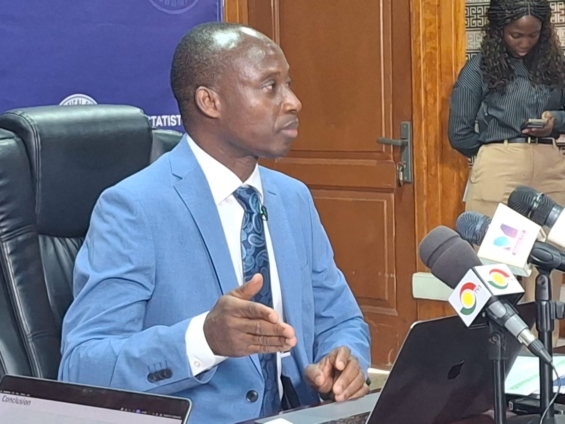
Speaking at a media briefing, Government Statistician, Dr. Alhassan Iddrisu, explained that the MIEG serves as a high-frequency measure of economic performance, providing an early signal on the direction of Ghana’s economy.
Built on the same framework as the quarterly GDP, he said the MIEG tracks monthly changes in the country’s economic activity to support timely policy and investment decisions.
“The economy continued to expand in July 2025, though at a slower rate compared to the same period last year,” Dr. Iddrisu noted.
The data showed that the Services sector maintained its strongest performance recording 6.4% growth in July 2025, up from 4.5% in July 2024.
The sector contributed the largest share (58.4%) to the overall MIEG growth, underlining its sustained dominance in Ghana’s economic structure.
The Agriculture sector also posted an impressive growth, expanding by 8.0% in July 2025, a significant rebound from 2.4% in July 2024.
This acceleration, according to the report, reflects increased output and productivity in crop and livestock production, contributing 37.1% of the total MIEG growth for the month.
In contrast, Industry slowed sharply, with growth of just 0.1% in July 2025, down from 17.7% a year earlier.
The sector’s contribution to overall growth stood at 0.9%, suggesting a marginal expansion driven largely by modest performance in manufacturing and construction.
According to the GSS, the latest figures point to continued resilience in services and agriculture, but also highlight structural weaknesses in Ghana’s industrial base, which remains vulnerable to high production costs and reduced external demand.
It emphasised that the MIEG will continue to serve as a vital tool for tracking short-term shifts in the economy and informing policy interventions aimed at stabilising growth and supporting sectoral recovery.
Latest Stories
-
Education Ministry to meet teacher unions on Monday as strike begins over promotion arrears
4 minutes -
Gender Minister calls for stronger financing, accountability to improve lives of Africa’s children
8 minutes -
Shoot to maim illegal miners if ‘shoot to kill’ is opposed – Kwame Jantuah
9 minutes -
24-hour Economy Secretariat to support 2026 Inter Tourism Expo
10 minutes -
Ghana must produce more of what it imports to create jobs – Mahama
15 minutes -
New cocoa producer price looms as COCOBOD seeks funding for 2026/27 season
18 minutes -
From paddle and sail to smart ships: What maritime industry means to the world and why Ghana must turn policy into practice
19 minutes -
McDAN warns SMEs against founder-dependent growth, urges stronger systems
21 minutes -
‘Feel free to invest; golden era for Ghana is beginning’ – Ato Forson
22 minutes -
Ghana outlines plans to expand port infrastructure and strengthen maritime sector
34 minutes -
EPA shuts down Ponlok Company over smoke emissions, poor waste management
35 minutes -
Nii Armah Ashitey enters NDC National Chairmanship race
36 minutes -
Ghana prepares to reopen diplomatic mission in Ireland
41 minutes -
Mahama woos US investors for Ghana’s power, technology and industrial sectors
42 minutes -
New College of Education in Tuobodom to end teacher training struggles in Bono East – Regional Minister
48 minutes