

Audio By Carbonatix
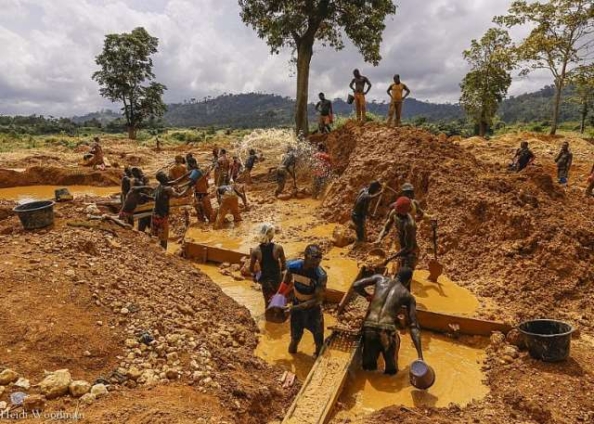
Air Commodore David Anetey Akrong, the Commandant of the Kofi Annan International Peacekeeping Training Centre (KAIPTC), has described illegal small-scale mining, popularly known as galamsey, as an existential threat to Ghana’s survival.
He warned that the menace had evolved into a national crisis with grave implications for the country’s environment, economy, and human security.
Speaking at the “Reflections on Security Series” seminar held at the KAIPTC in Accra, Air Commodore Akrong said the widespread degradation of forests, pollution of rivers, and destruction of arable lands had placed Ghana’s water security, public health, and sustainable development at serious risk.
The seminar, on the theme: “Galamsey as an Existential Threat to Ghana: A Call for Reflection and Action,” brought together policymakers, academics, security experts, civil society organizations, and media practitioners to deliberate on the multi-dimensional challenges posed by illegal mining and explore collaborative strategies to curb it.
Air Commodore Akrong said illegal mining, once seen as a livelihood activity, had transformed into a deeply entrenched network of organised criminality involving corruption, money laundering, and the exploitation of vulnerable populations.
He cautioned that, “If left unchecked, these dynamics threaten not only the sustainability of the country’s natural resources but also the legitimacy of governance institutions and the stability of local communities.”
He cited the contamination of major water bodies such as the Pra, Ankobra, Birim, and Offin with toxic chemicals, including mercury, cyanide, and arsenic, as evidence of the alarming scale of environmental destruction.
The Commandant said, “Entire communities are at risk, while the siltation of reservoirs is jeopardising access to potable water for several towns and cities,” emphasising that the crisis had far-reaching public health consequences.
According to him, galamsey had triggered a “silent public health emergency,” contributing to kidney diseases, respiratory ailments, birth defects, and the spread of waterborne and vector-borne diseases across mining communities.
He noted that the threat extended beyond environmental degradation, as illegal mining was now intertwined with transnational criminal networks that facilitate illicit financial flows and smuggling of industrial equipment and weapons, potentially fueling broader insecurity.
Air Commodore Akrong commended successive governments for their various interventions, including the establishment of the Inter-Ministerial Committee on Illegal Mining, Operation Vanguard, Operation Halt, the National Anti-Illegal Mining Operations Secretariat (NAIMOS), and the Responsible Community Mining Scheme.
However, he admitted that the persistence of illegal mining pointed to deeper governance and institutional challenges.
Participants examined how illegal small-scale mining had become a magnet for both local and foreign actors, driven by lucrative returns and weak enforcement mechanisms. The practice continues to undermine national security and development due to its links with organised criminality, corruption, and illicit financing.
Experts at the seminar interrogate several key issues, including the true extent of illegal mining, its existential threat to the nation, the effectiveness of response mechanisms, and reasons behind the limited success of past interventions.
Discussions also focused on identifying realistic, actionable measures that could galvanize cooperation between state and non-state actors to stem the tide.
Air Commodore Akrong reiterated that as a Centre of Excellence in research, training, and policy dialogue, the KAIPTC remained committed to providing an open and trusted platform for constructive engagement on national and regional security challenges.
He expressed optimism that the deliberations would “generate actionable insights that contribute meaningfully to the fight against illegal mining.”
The seminar formed part of KAIPTC’s ongoing “Reflections on Security Series,” a platform designed to promote open and evidence-based discussions on complex national and regional security challenges.
It brought together stakeholders from academia, civil society, the media, the security services, the extractive sector, and traditional authorities.
Latest Stories
-
Postponement not an option as Kenya races to be ready for Afcon 2027
1 hour -
ICE agent shoots and wounds man in Texas as locals demand answers
1 hour -
Ed Sheeran admits ‘mistakes’ at first show since Macklemore controversy
2 hours -
I’ll never discuss my finances with man, even if he’s my husband – Nancy Isime
3 hours -
Wizkid, Wande Coal advised me on how to leave school for music – Davido
3 hours -
Senegal job an ‘absolute dream’ for new boss Vieira
3 hours -
Harry and Meghan’s media treatment echoes what happened to Diana, Earl Spencer tells BBC
4 hours -
Nvidia boss rejects AI extinction fears as ‘doomsday narratives’
4 hours -
Workers came across human remains – and unearthed a mass grave of 572 people
4 hours -
Each Jehovah’s Witness member now decides whether to accept or donate main blood components
4 hours -
Trump says US will form ‘AI Force’ and appoint an artificial intelligence tsar
4 hours -
Google’s Gemini AI hacked three companies in security test
4 hours -
Converse pulls ‘deeply upsetting’ advert after backlash
5 hours -
Warren Buffett steps down after six decades at Berkshire – ‘Father Time always wins’
5 hours -
Billionaire Man United owner says he has lost confidence in the UK
5 hours