

Audio By Carbonatix
Ghana’s Energy and Green Transition Minister, John Abdulai Jinapor, says government is taking decisive steps to reverse the sharp decline in oil production and restore investor confidence in the petroleum sector.
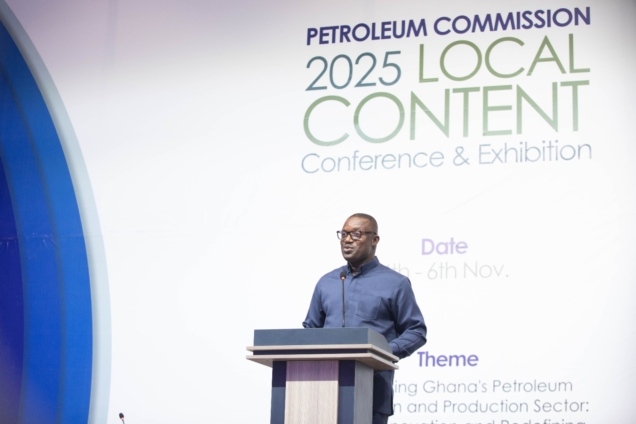
Speaking at the 2025 Local Content Conference and Exhibition (LCCE) in Takoradi, the Minister announced a series of reforms aimed at “revitalising Ghana’s Petroleum Exploration and Production Sector, driving innovation, and redefining local content for a competitive energy economy.”
Sector Decline
Mr. Jinapor revealed that crude oil production has dropped by 32% between 2019 and 2025, falling from 71.4 million barrels to 48.2 million barrels.
“This downward trend tells a sobering story,” he said. “It not only reduces government revenue but limits opportunities for indigenous Ghanaian companies — the backbone of our local industry participation.”
He attributed the decline to regulatory inefficiencies, protracted licensing processes, ambiguous policies, and a burdensome tax regime that have made Ghana less competitive.
Policy Reset and Reforms
To address these challenges, the Minister announced a Legislative Review Committee tasked with assessing Ghana’s upstream petroleum laws and fiscal framework. The committee is expected to submit its report by the end of November 2025.
“The goal is clear: to attract new exploration investments, encourage reinvestment by existing operators, and enhance recovery from producing fields,” Mr. Jinapor stated, adding that the review could lead to amendments to the Petroleum (Exploration and Production) Act, 2016 (Act 919).
He also hinted at a review of fiscal terms to make Ghana’s upstream regime more flexible and investor-friendly, particularly for companies exploring deep-water and frontier basins like the Eastern/Keta Basin.
“Our fiscal regime must reward investors who take bold, calculated risks while securing a fair share for the nation,” he emphasized.
Boosting Gas and Local Content
The Energy Minister underscored government’s commitment to expanding gas processing and transportation infrastructure, in collaboration with state agencies and upstream operators.
He also pledged greater enforcement of local content regulations to increase Ghanaian participation in the sector.
“Increasing sector investment alone is insufficient if the benefits do not flow to Ghanaians,” he said. “Our petroleum resources must be a catalyst for sustainable economic growth and national industrial competitiveness.”
Petroleum Commission Signals Renewed Investor Interests
The Acting Chief Executive Officer of the Petroleum Commission, Emelia Hardcastle, revealed that since the Mahama administration resolved longstanding disputes in the upstream sector, three supermajors and one large independent company have expressed interest in Ghana’s oil blocks.
“We have heard the industry loud and clear,” she said. “Measures are being taken to restore investor confidence, attract capital, and expand contract opportunities for Ghanaian companies.”
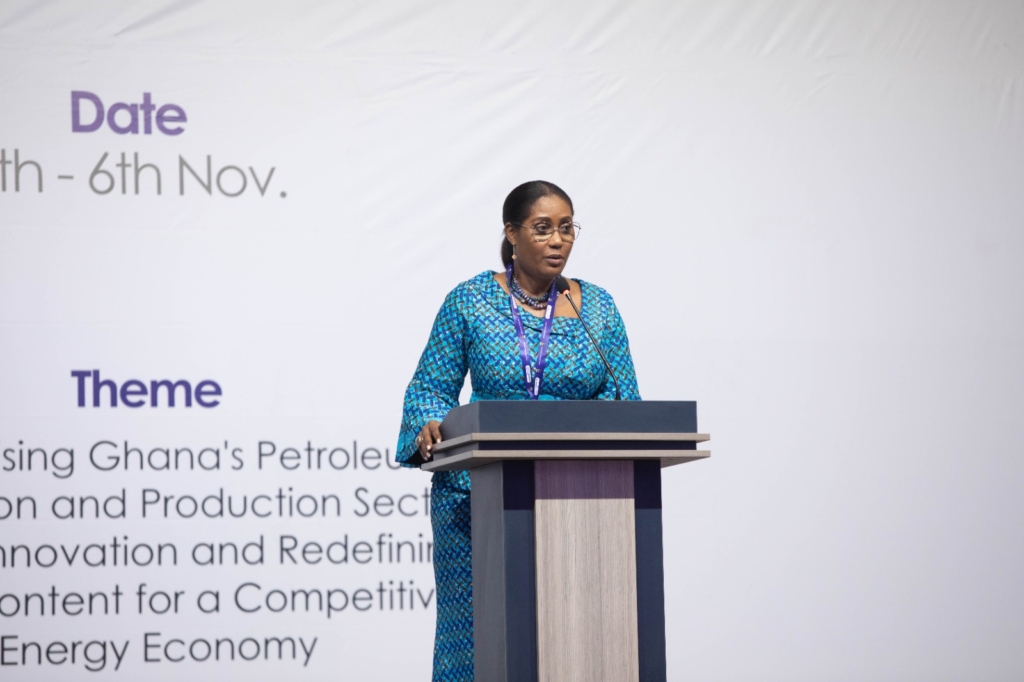
She stressed the need for “bold thinking, strategic collaboration, and innovation” to ensure Ghana’s resources do not become stranded in the global energy transition era.
Western Region Vital Role
Welcoming delegates, Western Regional Minister Joseph Nelson highlighted the centrality of the region to Ghana’s oil and gas story, from the discovery of the Jubilee Field to the development of TEN and Sankofa-Gye Nyame projects.
“When the national industry experiences a slowdown, the effects are felt swiftly within our regional economy,” he said. “Conversely, when the sector thrives, the impact strengthens communities and reinforces shared prosperity.”
He urged deeper collaboration between industry players and educational institutions such as Takoradi Technical University and UMaT, to enhance skills transfer and innovation.
A Call for Unity and Action
All three speakers emphasised the importance of collaboration across government, regulators, industry players, and host communities to sustain growth in the oil and gas sector.
“Ghana’s oil and gas industry stands at a defining moment — a crossroads of immense opportunity and profound responsibility,” Mr. Jinapor said. “Together, we must build a resilient, vibrant, and forward-looking energy economy.”
The 2025 Local Content Conference and Exhibition brought together delegates from Nigeria, Senegal, Uganda, Namibia, Mozambique, Trinidad & Tobago, and several other countries, reaffirming Ghana’s role as a regional hub for petroleum dialogue and investment.
Latest Stories
-
SIGA did not conjure or manufacture figures – Prof Kpessa-Whyte
14 minutes -
Government just put a spin on SIGA report – Miracles Aboagye
25 minutes -
Big Chef Season 5: Two contestants face exit in Jollof Challenge
43 minutes -
SIGA’s ‘massive turnaround’ claim not borne out by data – Bright Simons
50 minutes -
Nhyiaeso Chief assures support to end encroachment on utility corridors in Kumasi
50 minutes -
Two lorry station masters arrested over alleged plot to kill creditor over ₵91k debt
1 hour -
SIGA’s claim on highest audited proportion inaccurate – Bright Simons
1 hour -
Money bouquets, spraying and dancing on cash unlawful – BoG warns
2 hours -
Sam George pushes for nationwide 4G upgrade of rural telephony sites
2 hours -
Local Government Ministry to support MMDAs to deliver gov’t agenda
2 hours -
At least five killed in Sudan’s South Kordofan in attack by rebel group
2 hours -
“Music is so stressful” – Headless YouTuber on why he won’t return
2 hours -
Cleveland police chief proud of force but being ‘let down’ by funding
3 hours -
Black Sherif drops new 6-track EP ‘Sun Sherif’
3 hours -
GTA partners Africa’s Brain Bank for Medical City groundbreaking
3 hours