

Audio By Carbonatix
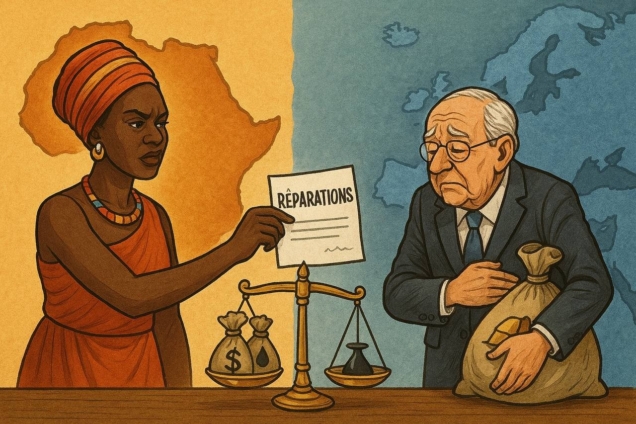
The global push for slavery and colonialism reparations is entering a decisive phase, as Caribbean leaders are preparing for high-level negotiations in the United Kingdom from November 17 to 20, 2025, marking one of the most coordinated efforts yet to confront former colonial powers over the economic and human devastation caused by centuries of exploitation.
The CARICOM delegation will use its visit to demand concrete steps from Britain on reparations for slavery. CARICOM’s renewed diplomatic offensive is part of a broader worldwide movement in which calls for compensation, apologies, and debt cancellation have intensified.
While Caribbean nations are pressing forward with a unified agenda, the African Union (AU) is developing its own reparations framework and both blocs are now aligning their efforts more closely than ever.
The CARICOM Reparations Commission has long argued that the legacy of slavery is not an abstract historical grievance but a measurable cause of persistent underdevelopment. Its ten-point plan calls for formal apologies, major educational programs, debt relief, and financial compensation.
African states see a similar pattern: the wounds of the transatlantic slave trade and colonial rule have translated into structural economic disadvantages that still shape the continent today.
This parallel experience is driving a growing partnership between the AU and CARICOM.
Both organizations seek not only acknowledgment of past crimes but a transformation of the systems that continue to marginalize formerly colonized regions.
In 2025, reparations became one of the AU’s flagship political priorities. The organization has not yet announced the monetary figures it intends to seek from European nations, but its legal foundation is already established.
Through Decision 934, the AU formally defined slavery, colonialism, and genocide as crimes against humanity, a landmark step for its reparations agenda.
The AU’s campaign is spearheaded by Aisha Banda, appointed by the AU Commission to chair its Reparations Task Force. Her leadership has generated widespread anticipation, as African governments and civil society await concrete proposals and timelines.
The significance of her role, which outlines Banda’s mission to push reparations into a new phase of continental advocacy.
Although European powers increasingly position themselves as partners in development, African scholars argue that many contemporary economic mechanisms simply replicate colonial-era hierarchies.
Debt dependence, unequal access to technology, and control over resource flows remain central obstacles for African states.
According to some analysis, multinational corporations dominate African markets through offshore structures, selective trade rules, and “green investment” schemes that often mirror extraction-based models from the colonial period.
Critics say this environment undermines claims that historical injustices should be left to the past. Instead, they argue, reparations must be seen as a way to change the rules of global economic engagement.
What makes today’s reparations movement unique is that it is no longer framed solely as a matter of historical redress. Leaders and experts across Africa and the Caribbean insist that the consequences of slavery and colonialism continue to shape the present and cannot be separated from ongoing economic struggles.
For millions of people across both regions, reparations represent a pathway to correcting structural inequalities that persist despite decades of independence. The upcoming London talks will serve as a major test of whether former colonial powers are ready to engage with these demands seriously — or continue to avoid conversations about responsibility and restitution.
As 2025 progresses, one message grows increasingly clear: reparations are not about revisiting the past; they are about fixing the present.
Latest Stories
-
Afenyo-Markin’s influence is limited by minority numbers in Parliament – Haruna Iddrisu
13 seconds -
Police administration is doing a yeoman’s job – President Mahama
3 minutes -
GoldBod tells PAC Bank of Ghana authorised its foreign exchange transactions
3 minutes -
GCB customers call for more frequent engagement with bank leadership
8 minutes -
Dark Signals: The death trap of non-functioning traffic lights along Asokwa-Aputuogya Road
10 minutes -
80–90% of gold purchased and exported is now refined in Ghana– Sammy Gyamfi
28 minutes -
Dichemso M/A teachers go house-to-house to get absent pupils back to class after strike suspension
31 minutes -
Meet Dr Hazel and Nhyira: Mother and daughter called to the Ghana Bar
33 minutes -
Black Star Fashion Week: Can Ghana turn the runway into a tourism attraction?
34 minutes -
Ghana sends 61 health workers to Grenada under Labour Export Programme
46 minutes -
Central banks should avoid reacting too strongly to headline inflation – IMF
53 minutes -
Kumasi: One injured, shops destroyed in Atasemanso fire in Kumasi
1 hour -
Global economy proving resilient, growth projected at 3.1% in 2026 – IMF
1 hour -
NDC targets all 6 parliamentary seats in Ahafo Region for 2028
1 hour -
Ghana targets thousands of overseas nursing jobs under Labour Export Programme
1 hour