

Audio By Carbonatix
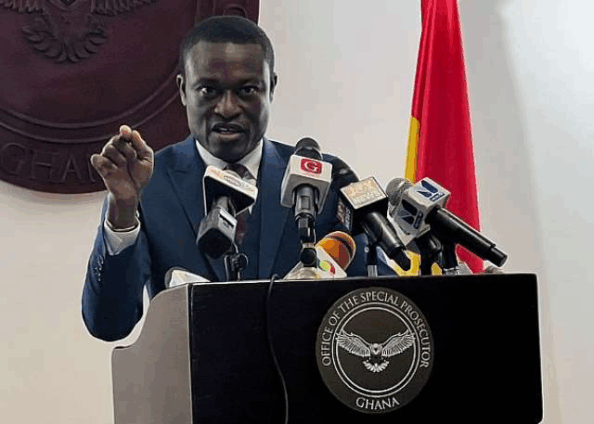
The Office of the Special Prosecutor (OSP) has been fighting for legitimacy since the day it was conceived. Long before it opened its doors, many dismissed it as a needless duplication, another drain on the public purse. Others saw it as a political tool created by former President Akufo-Addo to present the illusion of a serious anti-corruption agenda. And of course, those who benefit from corruption were never going to be enthusiastic about an institution designed to expose their rot.
So, from the very beginning, the OSP had doubters and enemies.
Once it became operational, the criticisms did not ease. We all remember how its first head, Martin Amid, a man widely regarded for his integrity, was hounded and frustrated until he resigned under controversial circumstances. Even Ghana’s current Speaker of Parliament, Alban Bagbin, publicly rubbished the office. Remarkably, he described the law establishing the OSP as an “act in futility” and “needless,” arguing that its powers merely duplicated those of the Attorney General. That’s the same Parliament that passed the law in the first place.
If a Speaker can pour that level of scorn on a national anti-corruption institution, who won’t follow suit? Many politicians may not voice it openly, but they share similar sentiments in private.
The hostility we see today is not new; it has been building from the start. And I won’t pretend to be holier-than-thou. I also had my doubts and shared some harsh views about the office. But once it became operational and began using state resources, I accepted reality and supported its work. A young institution operating under a new legal framework will naturally face challenges. Throwing out the entire institution because of early missteps is short-sighted.
Yet many critics, especially those who opposed the OSP from day one, will tolerate no mistakes. What is even clearer is that neither of the two major political parties likes the idea of the OSP. Why? Because it is the only institution with the mandate and relative independence to pursue corruption across the political divide. And that makes politicians uncomfortable.
Today, we are witnessing a coordinated attempt to discredit the office and turn public opinion against it. Sadly, it seems to be working. Many Ghanaians who do not fully understand the deeper issues at play have joined the chorus. Others are driven purely by partisanship. We are weakening an institution we need desperately, and doing so knowingly.
Constructive criticism helps institutions grow; what we are seeing now, however, is largely destructive. It looks like a deliberate attempt to push the government to shut the OSP down. And honestly, this should not surprise anyone. Even the administration that birthed the office showed open discomfort with its independence. Why would those who inherited it feel otherwise?
If we truly care about Ghana’s future, and our constant complaints about corruption are genuine, then we must support this office. The current disrespect toward the OSP and its leadership is excessive and counterproductive. And if we can demand perfection from an office barely a decade old, why haven’t we demanded the same intensity of accountability from older institutions?
Take a moment to compare:
Attorney General’s office — 148 years old
CID — 104 years
EOCO/SFO — 33 years
CHRAJ — 32 years
FIC — 17 years
All these institutions are far older than the OSP, have gone through all phases of institutional maturity, and yet none has been flawless. We still give them room to improve. Why can’t we extend the same grace to the OSP, which is still relatively young?
The OSP was established in 2018, but it did not become fully operational immediately. It struggled with no staff, inadequate office space, and delayed regulations. After Amidu resigned, the office went dormant for months. Realistically, in its seven to eight years of existence, there have been long periods of inactivity, yet critics unfairly use the entire timeline to judge its output.
Still, under Kissi Agyebeng since 2021, the OSP has recorded notable achievements:
Prosecutions and Convictions
Seven convictions; major trials ongoing in Accra, Kumasi, and Tamale.
High-profile cases include the SML scandal, NPA GH₵280 million extortion scheme, payroll fraud, PPA procurement breaches, and the GES appointment-letter racket.
Asset Recovery and Financial Protection
Recovered GH₵4.24 million in stolen assets.
Blocked ghost-worker payments, saving GH₵34.2 million in 2024.
Prevented losses under the NDA contract and the TOR–Torentco deal.
Triggered a 333.8% rise in Customs auction revenue after the Labianca case.
Corruption Prevention and Reforms
Influenced legislative reforms eliminating major tax loopholes.
Led to the suspension of the Agyapa deal and the TOR–TEPL agreement.
Reached millions through anti-corruption sensitisation.
Cracked down on a US$40 million counterfeit currency syndicate.
Institutional Development
Grown from a three-bedroom office with no staff to a 10-storey facility with 249 workers.
Strengthened partnerships with the Audit Service, FBI, UNODC, and Interpol.
These are not trivial achievements.
Institutions, like products, go through a lifecycle: introduction, growth, maturity, and decline. The OSP is still in its infancy, yet we expect it to perform miracles. But anti-corruption work is grounded in law and due process. Anger and impatience cannot change that.
This is exactly how Martin Amidu was hounded out, and we are now repeating the cycle with Kissi Agyebeng.
If we continue on this path, the OSP will collapse, not because it failed, but because we killed it.
Ghana deserves better. And the OSP deserves the space to grow, strengthen, and serve this country well.
Let’s cut this office some slack and allow it to find its feet, for the sake of Mother Ghana.
Latest Stories
-
Shatta Wale challenges UPSA students to build entrepreneurial mindsets
20 minutes -
Finance Minister advises African governments to strengthen regional tax cooperation
2 hours -
NPP accuses NDC of master-minding demolition of Ho regional office fence
2 hours -
Ghana plans stronger regional power trade with Nigeria
2 hours -
GRA Commissioner-General calls for stronger tax cooperation to boost regional revenue mobilisation
2 hours -
NACOC needs more personnel to tackle drug trafficking – Toobu
2 hours -
Railway workers resist KMA eviction order, demand consultation
2 hours -
Legacy Leadership Africa Institute to host boardroom women’s leadership programme
2 hours -
Ghana needs a law to sustain constitutional reforms – CDD-Ghana
5 hours -
COVID fumigation audit: Auditor-General has a lot of questions to answer – Akwatia MP
5 hours -
Stranded Ghanaian medical graduates in Cuba appeal to Mahama for immediate return
6 hours -
GNFS contains fire outbreak at Teshie Lekma Road near Lekma Hospital
12 hours -
Samia Nkrumah rejects the narrative that Ghanaians were happy after Nkrumah’s overthrow
13 hours -
A Mother’s pain: Tribute by Ivan Baidoo’s mother
13 hours -
‘Forgive us for staying away’ — Samia Nkrumah leads family back to Nkroful, pledges to preserve Nkrumah’s legacy
13 hours