

Audio By Carbonatix
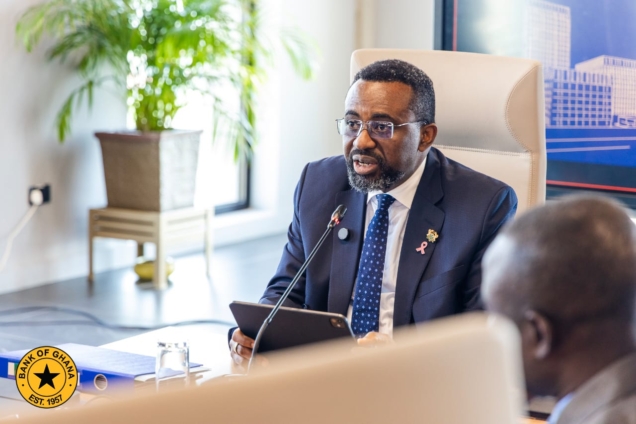
The Governor of the Bank of Ghana has pledged to build an agile central bank ready for emerging risks.
According to him, financial technology and crypto pose real challenges and therefore his outfit is updating legislation, creating capacity, and strengthening its balance sheet to withstand shocks.
Speaking in an interview with the Director of the International Monetary Fund’s Director of Africa Department, Abebe Selassie, the Governor said, “My vision is a central bank with the manpower, agility, and resilience to manage future risks—crypto today, something else tomorrow”.
“My mandate is clear: achieve price and financial stability, and I believe we’re on course. But two priorities stand out. First, tackling dollarisation. I’ve seen this challenge for decades, and making the cedi the sole legal tender is critical for effective monetary policy. My second priority is to build an agile central bank ready for emerging risks.”
To safeguard the independence of the central bank, Dr. Asiama said the Bank of Ghana has introduced legislative reforms to eliminate central bank financing of the government and clearly define emergencies.
“The impact on banks from sovereign exposure has been significant and should never happen again. But corporate bond activity is picking up, and we’re trying to list more banks on the stock exchange to attract long-term capital and strengthen equities”, he mentioned.
“On the central bank side, domestic debt restructuring hit our balance sheet hard, and rebuilding is a medium-term priority. To safeguard independence, we’ve introduced legislative reforms to eliminate central bank financing of the government and clearly define emergencies”, he explained.
In describing the framework for managing foreign exchange, he pointed out that his outfit followed a managed float to smooth volatility, not to dominate the foreign exchange market. “Recent intervention was due to large payments to independent power producers, bondholders, and declining remittances due to currency appreciation”.
He added that conditions have improved with mining inflows now going through banks, and “unused foreign exchange offers flow into reserves”. “We are increasing local processing of commodities to address our reliance on raw materials such as gold, oil, and cocoa”, he concluded.
Latest Stories
-
Today’s front pages: Tuesday, August 18, 2026
29 minutes -
Banks’ sustainable success will be defined less by interest margins – PwC
1 hour -
Baffoe-Bonnie was part of ‘grand conspiracy’ against Torkornoo – Afenyo-Markin
2 hours -
The GIPA Act: Resetting Ghana’s investment framework
2 hours -
GIPA secures investor leads at Invest Fest 2026
3 hours -
Ghana’s missing billions: What 16 years of Auditor-General reports show
3 hours -
Police disown viral flyer on AirPods, earphones use while driving
3 hours -
Stop using media to challenge judicial decisions – Thaddeus Sory to lawyers
3 hours -
The next generation expects more than degrees from universities
3 hours -
Ebenezer Dwomoh to stage fourth stand-up comedy special in Kumasi
3 hours -
Central Regional Minister urges traditional leaders to hold public officials accountable
3 hours -
Ada Traditional Council suspends four members for defying cancellation of 2026 Asafotufiami durbar
3 hours -
Association of Small-scale Industries, GEA strengthen artisans through mentorship, coaching
3 hours -
Two arrested over alleged galamsey activities in Tanoso
3 hours -
Ghana rises to sixth-largest gold producer globally after record 2025 output
3 hours