


Audio By Carbonatix
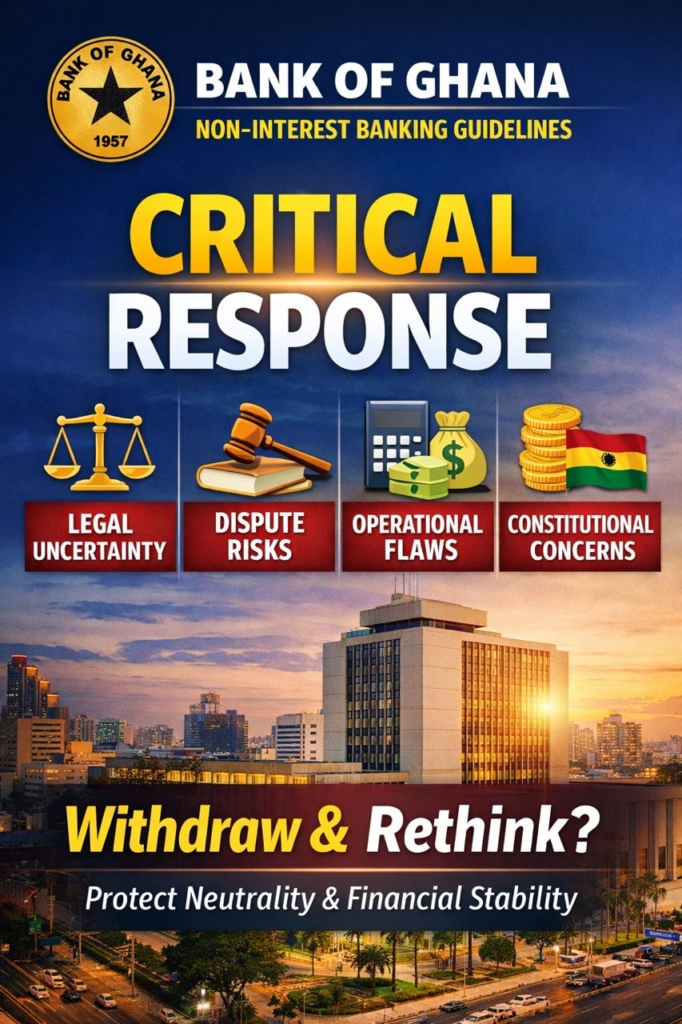
Advocates for Christ Ghana (A4CG), through its Economy, Business & Finance Gate, has formally called on the Bank of Ghana (BoG) to withdraw its Exposure Draft on the Regulation and Supervision of Non‑Interest Banking, citing what it describes as deep legal, prudential, and regulatory flaws.
In a detailed submission dated December 23, addressed to the Governor of the Bank of Ghana, A4CG, a Christian professional advocacy group, acknowledged the central bank’s objectives of promoting financial innovation and inclusion but argued that the draft guidelines, as currently framed, are “not fit for implementation.”
The group said the BoG lacks a tested non‑interest banking model tailored to Ghana’s legal and financial environment, resulting in internal contradictions and regulatory incoherence.
Among the key concerns raised are conflicting standards hierarchies, unclear supervisory authority between the BoG and internal non‑interest banking committees, and dispute‑resolution mechanisms that could weaken consumer protection.
A4CG warned that the proposed structures risk creating a parallel governance and adjudicatory system that may undermine constitutional equality before the law and dilute the central bank’s supervisory primacy.
The submission also criticised the proposed “window” model, which would allow conventional banks to operate non‑interest banking units within existing institutions. According to A4CG, this approach is operationally complex, cost‑opaque, and vulnerable to manipulation in the absence of detailed accounting, audit, and supervisory frameworks.
On prudential regulation, the group argued that applying conventional capital adequacy rules to non‑interest banks without tailored guidance is technically unsound, given the different risk profiles involved.
It further questioned whether there is sufficient market demand in Ghana to justify the costs and systemic implications of a specialised non‑interest banking regime.
A4CG emphasised that its objections are not ideological or faith‑based, but grounded in constitutional neutrality, consumer protection, and public‑interest considerations.
It recommended that any future framework be comprehensively redesigned to ensure regulatory clarity, equal treatment of consumers, and transparency, while avoiding regulatory arbitrage.
The organisation concluded by urging the Bank of Ghana to withdraw the draft, undertake a thorough technical revision, and re‑engage stakeholders to preserve institutional credibility and public confidence.
Below is the full submission:
Latest Stories
-
Gauff’s flaw forgotten on winning US Open return
3 hours -
Birds stop play but Medvedev flies into third round
3 hours -
LA Clippers fined $30m by NBA over Leonard scandal
3 hours -
Uber to cut over 3,000 jobs in major global restructuring
3 hours -
Tiger Woods gets five-year driving ban after reckless driving plea
3 hours -
South African airline behind daring stadium stunt cancels next flyby
3 hours -
PURC urges ECG to address outages, metering delays
4 hours -
Police engage traders over alleged harassment, extortion on Aflao-Accra highway
4 hours -
Uber shuts operations in Nigeria and Uganda with immediate effect
4 hours -
Netherlands moves billions in gold to London in ‘crisis preparedness’ move
4 hours -
Legal vacation does not halt urgent court cases – Chief Justice
4 hours -
Keta residents react with mixed feelings to fresh fuel price hike
4 hours -
Managing Director on GH¢150,000 bail over five dud cheques
5 hours -
BOSTenergies reports strong 2025 performance, pays first-ever dividend to government
5 hours -
Carlos Queiroz reappointed as Black Stars head coach
5 hours