

Audio By Carbonatix
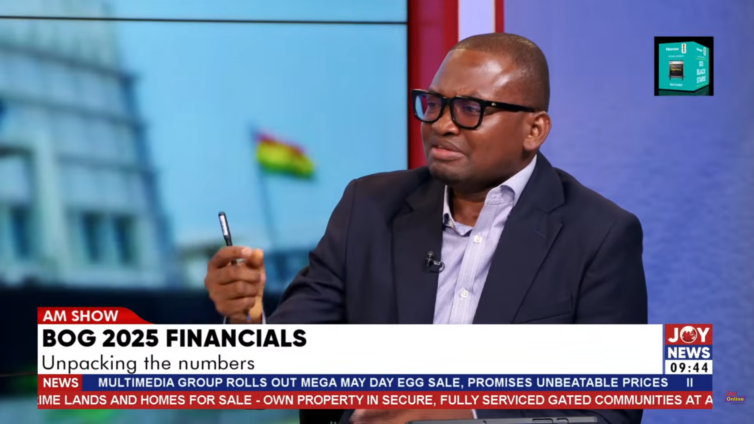
The Head of Finance at UMB Capital, Nelson Cudjoe Kuagbedzi, has argued that the performance of the Bank of Ghana (BoG) should not be solely measured by its balance sheet, but rather by its ability to meet its core mandate of maintaining price stability within the economy.
Speaking on JoyNews' AM Show on Friday, May 1, Mr Kuagbedzi provided a detailed analysis of the Bank of Ghana's operations and the significant policy interventions undertaken to stabilise the economy.
Mr Kuagbedzi began by clarifying a common misconception surrounding the role of the Bank of Ghana, particularly in contrast with commercial banks.
He explained that the BoG does not operate as a profit-driven enterprise, nor does it engage in financial intermediation like commercial banks.
Rather, the primary mandate of the central bank, as outlined in Section 3 of the Bank of Ghana Act, 2002 (Act 612), is to maintain the stability of general prices within the economy.
This focus on price stability requires the use of various monetary tools, which can sometimes come at a significant cost.
“The core mandate of the Bank of Ghana is to maintain price stability. When you read Section 3 of the Bank of Ghana Act, it clearly states that the primary mandate of the Bank is to maintain the stability of general prices in the economy,” Mr Kuagbedzi explained.
“In their quest to achieve that stability, certain tools must be deployed, and those tools come at a cost.”
Mr Kuagbedzi emphasised that the success or failure of the central bank should be judged not by its balance sheet but by its ability to fulfil this mandate.
He argued that the public should assess whether, by the end of 2025, the BoG has successfully maintained price stability and achieved policy rate transmission into market rates.
Mr Kuagbedzi provided an in-depth look at the state of the Ghanaian economy at the end of 2024, outlining key macroeconomic indicators to provide context for the discussions surrounding the Bank of Ghana’s performance.
“At the end of 2024, the economy grew by 5.7%, but inflation stood at 23.8%, the currency depreciated by 20%, and lending rates were over 30%. Our debt-to-GDP ratio was 61.8%, and we recorded a fiscal deficit of 7.9%. Business and investor confidence were low due to high inflation and a challenging economic environment,” he said.
The central bank's policy rate was 27%, and lending rates were high, creating an environment where access to credit was costly for businesses and consumers alike.
Despite these challenges, Mr Kuagbedzi pointed out that there were several significant interventions undertaken by the Bank of Ghana in response to the economic difficulties.
Mr Kuagbedzi outlined the four key mechanisms the Bank of Ghana employed to reverse the economic trends of 2024.
These included a tight monetary stance, support for the banking sector, aggressive reserve accumulation, and measures to manage foreign exchange (FX) operations.
“The Bank of Ghana took a tight monetary stance to curb inflation. They kept the policy rate high in order to absorb excess liquidity in the system, which helped stabilise inflation and the currency,” he explained.
“They also implemented aggressive reserve accumulation strategies, ensuring that reserves were built in a more sustainable and organic manner, rather than relying on borrowed funds from the IMF.”
Further policy measures included directives to market players, such as the requirement for mining companies to channel their dollar receipts through designated banks, and the introduction of a fee for withdrawing foreign currency from bank accounts to curb the activities of informal forex traders, commonly known as ‘Abochie’.
Mr Kuagbedzi explained that by 2025, these interventions had resulted in significant improvements across several macroeconomic indicators.
Inflation dropped from 23.8% to 5.4%, the Ghanaian cedi became the best-performing currency in emerging markets, and lending rates decreased to about 20%.
The country’s debt-to-GDP ratio fell to 45.3%, and international reserves increased from $9.1 billion to $13.1 billion.
“These policy interventions yielded substantial results,” Mr Kuagbedzi said. “We saw improvements in inflation, exchange rate stability, and investor confidence. The currency strengthened, and the cost of capital for businesses also reduced.”
While the Bank of Ghana’s macroeconomic interventions had a positive impact, Mr Kuagbedzi acknowledged that these actions came at a cost.
The Bank of Ghana had to absorb excess liquidity from the financial system, which required the issuance of high-interest bills.
These bills, due to the high inflation rate, were expensive, and the interest expense associated with them significantly affected the Bank’s income.
“In 2024, the Bank of Ghana’s losses were attributed largely to the high interest rates on the bills issued to absorb excess liquidity,” he explained.
“The absorption of excess liquidity cost the Bank a significant amount, with the losses more than doubling from 8 billion Ghana cedis in 2024 to around 16 billion Ghana cedis in 2025.”
He further explained that the domestic debt exchange program had also impacted the Bank’s earnings, with several banks struggling to meet capital adequacy requirements.
Mr Kuagbedzi suggested that the Bank of Ghana’s recovery would depend on whether inflation remains under control and whether liquidity absorption requirements decrease.
With inflation now in single digits (3.2% at the end of March 2026), he projected that the Bank’s absorption of excess liquidity would lessen, improving its financial position.
“Looking ahead, we expect that the Bank of Ghana’s fiscal health will improve as inflation stays low and liquidity absorption reduces,” he concluded. “This will help stabilise the Bank’s equity position and reduce its paper losses.”
Mr Kuagbedzi emphasised that the Bank of Ghana’s performance should ultimately be judged based on its ability to fulfil its mandate of price stability and not solely on its balance sheet.
“The discussion about the performance of the Bank of Ghana should focus on the achievement of its core mandate, as laid out in the Bank of Ghana Act, rather than just looking at its balance sheet,” he said.
Latest Stories
-
MTN Ghana trains civil society organisations on artificial intelligence
12 minutes -
GoldBod FX framework aims to make dollar supply predictable – Acheampong
46 minutes -
How does a Ghanaian team make it to the BAL?
53 minutes -
Ghana’s investment climate presents opportunities for industrial growth and job creation.
54 minutes -
‘I paid thousands to a company for jobs that never came’
1 hour -
SSNIT intensifies informal sector enrolment drive with Techiman float
2 hours -
Ghana seeks long-term mining investments that benefit local communities – Armah-Kofi Buah
2 hours -
GHATOF demands compensation for 85 businesses affected by La Pleasure Beach demolition
2 hours -
Bono Regional Minister calls for investor education to drive economic growth
2 hours -
Ghana’s Ambassador to China, Kojo Bonsu, presents credentials to Nepalese President
2 hours -
Fairtrade Africa’s Cocoa Hubs Project strengthens rural service centres in cocoa-growing communities
2 hours -
MPs are not development officers – Edem Kpotosu
2 hours -
SEC cautions investors against fraudulent investment schemes
2 hours -
Land Ministry urges rCOMSDEP operators to reserve earnings for land reclamation
2 hours -
Commercial drivers give authorities one week to clear traders from lorry terminals, bus stops
2 hours