

Audio By Carbonatix
Americans pulling into a Starbucks drive‑thru may be greeted by a friendly staff member. But at some locations, it is actually an AI robot entering the orders.
Behind the counter inside the store, baristas can lean on a virtual personal assistant to recall recipes or manage schedules.
In the back of the shop, a scanning tool has taken on the painstaking process of counting inventory, relieving staff of one of retail's most tedious chores, in a bid to fix the out-of-stock gaps that have frustrated the firm.
The new technology is part of the hundreds of millions of dollars the 55-year-old coffee giant has been investing to win back customers after several years of declining sales.
And there are signs that the effort is working.
Last week, the company reported its first sales increase in two years at established stores in the US - its biggest and most important market, accounting for some 70% of revenue.
Still, the firm's share price slid 5% reflecting investor concerns that all the spending, which includes $500m (£363m) to boost staffing, had hurt profits.
Chief executive Brian Niccol says he is confident that consistent sales growth will ultimately address that problem.
But with the company promising to find $2bn in cost savings over the next three years, investments in technology are crucial to ensuring that improved sales also yield better profits.
"I think that's all going to come," he told the BBC. "I really do believe we've got the right plan in place."
Niccol joined the company in 2024, when the business was under pressure.
Customers were baulking after a string of price increases. Competition was heating up, and the brand faced boycott calls tied to unionised barista disputes over pay and benefits, as well as the company's stance on the Israel-Gaza war.
The 52-year-old, who had wowed the industry with his turnaround of fast-casual burrito chain Chipotle Mexican Grill, quickly began making changes.
He declared a halt to price increases, simplified the menu and set a target for baristas to complete orders in four minutes or less.
Starbucks also cut thousands of corporate roles, closed underperforming stores, and sold a significant stake in the firm's China business.
But the father-of-three and former fraternity brother at Ohio's Miami University tends to talk about Starbucks’ challenges in more general terms, describing a company that got caught up in spreadsheets and financial averages and strayed too far from its roots as a community coffeehouse.
"We lost our focus because we got a little too distracted on efficiency and technology, and lost, I think, our focus on experience, customer and connection," he said.
"The business is not an average business. The business is a coffee shop-by-coffee shop business."
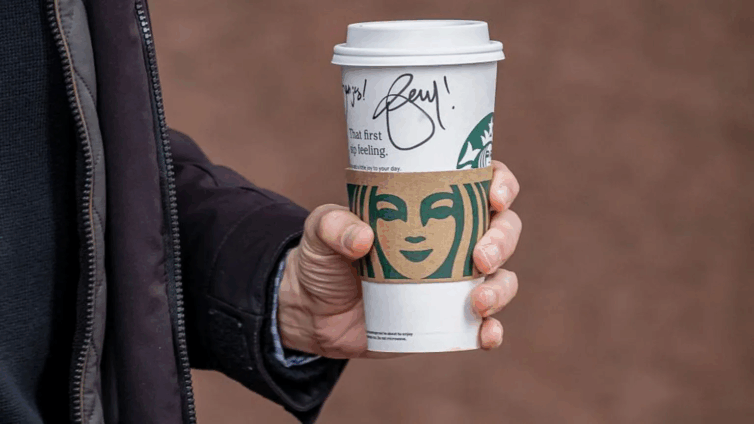
To improve the experience, staff were urged to resume writing customer names on cups by hand.
The firm also started sprucing up shops with inviting armchairs, new paint and ceramic mugs - all part of a $150,000-per-store "uplift" that is expected to take four years to complete.
Those changes were accompanied by more hard-edged policies, such as stricter staff uniforms and rules that bar customers from using the bathroom without a purchase.
The firm's push to deploy AI at a time when top brass are emphasising the importance of a personal touch might seem ironic, but Niccol sees little tension.
"It's a way for us to make the experience... have less friction," he said.
The company is trialling an AI-powered chatbot that can help match drinks to customer moods, and is introducing the ability to schedule orders to reduce customer wait times.
At drive-throughs, Starbucks is testing a system to process orders and free up staff to focus on hospitality or making the coffees.
At the firm's recent investor day, Niccol told analysts he was confident the business had momentum, outlining ambitious expansion plans - especially overseas, where it hopes to nearly double its footprint to almost 40,000 stores in the years ahead.
"Things are really taking hold," he said, before analysts started peppering him with questions about profits.
Unlike last year, the company is not ruling out price increases.
However, Niccol said, "It really is the last lever I want to pull. In the event we do have to take pricing, it should be fairly muted."
He is banking on the firm being helped by broader trends, as general inflation recedes and the price of coffee, which has soared in recent years, moderates slightly.
In recent months, US President Donald Trump also removed coffee from the list of items subject to tariffs, which had driven up costs last year.
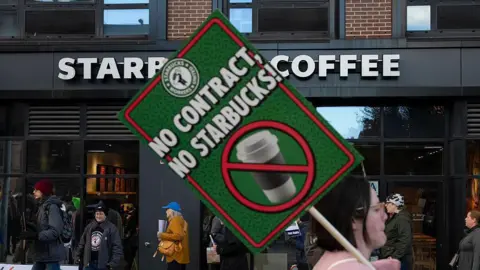
Social media fervour against the brand has died down as well, though the union battle continues to dog the company, with organisers accusing Niccol of stonewalling contract talks.
That fight has also put a spotlight on Niccol's remote working arrangements, private jet use and compensation. He was granted a package worth $97m in 2024 and $30m last year, compared with the average employee's earnings of about $17,300.
Niccol said he was "wildly open" to the conversation but declined to give a timeline for when the two sides might reach a contract.
"I would love to get to a deal. It's got to be one that can be a viable, sustainable deal," he said.
The boss told analysts that Starbucks did not plan to backtrack on its labour investments as it hunts for savings, confident that what sets the firm apart is not its coffee, but its cafes.
"People want these places to gather," he told the BBC.
"It doesn't matter if you're eight years old or 80 years old, a third place is relevant and when we can provide the third place that everybody feels safe, welcome and a part of, then I think the Starbucks brand is the solution."
Latest Stories
-
Mahama convenes high-level meeting to strengthen border security and narcotics control
13 minutes -
Thara Mills Simmonds named 2026 Forty Under 40 Achiever in Education
17 minutes -
Ghana deepens diaspora diplomacy: Embassy pledges enhanced consular support for Ohio communities in Columbus
25 minutes -
Ghana’s maternal health success story at risk without rural incentives – UNFPA
25 minutes -
Gaps in suicide data affect prevention interventions in Ghana – Accra Psychiatric Hospital MD
26 minutes -
Ghana Armed Forces to participate in Accra-Kumasi Expressway construction – Mahama
26 minutes -
Use chiefs to stop disputes from flooding Ghana’s courts – Deputy AG to governing council of ADR
40 minutes -
Four arrested as police bust alleged kidnapping, torture and extortion syndicate
42 minutes -
NPA increases price floor from September 16; petrol to sell at GH¢16, diesel at GH¢16.77
1 hour -
OMJ fufils BECEPIP schorlaship promise, awards 12 learners
1 hour -
Photos: GAF hands over 175.6km right-of-way for Accra-Kumasi Expressway construction to gov’t
1 hour -
Accra-Kumasi Expressway to be operated and maintained for 50 years through toll revenue
1 hour -
LGA holds Landmark Conference, AGM and Elections as the Committee on Politics and Elections emerges as the Overall Best Committee for 2025/2026.
1 hour -
JSALK Beverages pays medical bills of struggling nursing mothers at Nkawie-Toase Hospital
1 hour -
Accra-Kumasi Expressway to be operated as business to recover taxpayers’ investment – CEO
1 hour