

Audio By Carbonatix
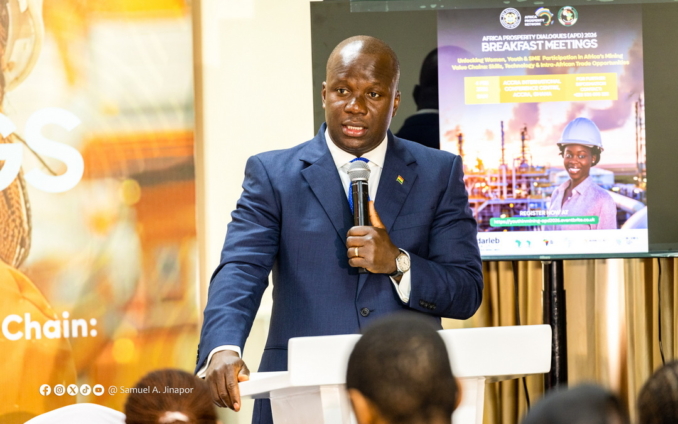
Former Minister for Lands and Natural Resources and Member of Parliament for Damongo, Samuel A. Jinapor, has called on African governments, mining companies and financial institutions to take deliberate steps to integrate women, youth and small and medium-scale enterprises (SMEs) into the full spectrum of Africa’s mining value chains.
Speaking at the Africa Prosperity Dialogues (APD) 2026 Mining Breakfast Meeting and Workshop held at the Accra International Conference Centre on Wednesday, Mr. Jinapor said that although Africa remains one of the most mineral-rich regions in the world, the structure of the continent’s mining industry continues to limit its contribution to inclusive growth and sustainable development.
Africa, he noted, produced more than 1,000 tonnes of gold in 2023, accounting for over 27 per cent of global output, with Ghana and South Africa among the top producers.
He said Ghana, in particular, emerged as Africa’s leading gold producer, contributing approximately four million ounces in 2023, with output increasing to about 4.8 million ounces in 2024 due to rising production from both large-scale and small-scale mining operations.
Despite this growth, Mr. Jinapor argued that Africa’s mining sector remains largely extractive, with weak linkages to domestic economies and limited value addition.
“For decades, Africa’s mining sector has been defined narrowly by extraction,” he said, stressing that mining should be understood as a comprehensive value chain that extends well beyond the mine site.
According to him, Africa’s challenge is not the absence of mineral resources but the failure to translate mineral endowments into broad-based economic participation.
He observed that the continent sits at the intersection of abundant mineral resources, a rapidly growing youthful population and SME-dominated economies, yet these strengths have not been adequately integrated within the mining industry.
Mr. Jinapor emphasised that meaningful participation must go beyond employment at mine sites and include access to skills, technology, finance and markets across the entire mining value chain.
“Participation must mean access to skills, access to technology, access to finance and access to markets,” he said, adding that women, youth and SMEs must be empowered to participate in areas such as exploration, engineering services, equipment manufacturing, mineral processing, logistics and downstream manufacturing.
From a policy perspective, he identified the need for clear and enforceable frameworks that promote local participation, supplier development and value addition.
He stressed that skills development must be aligned with the demands of a modern, technology-driven mining economy, warning that without deliberate investment in relevant skills, inclusion efforts would remain theoretical.
Mr. Jinapor also underscored the importance of enabling SMEs through simplified regulatory processes and improved access to finance.
He noted that development finance institutions, commercial banks and public–private partnerships have a critical role to play in de-risking investments in mining-related enterprises, particularly those led by women and young people.
He further challenged mining companies to move beyond compliance-driven approaches and actively support local enterprise development.
According to him, mining companies can serve as anchors around which strong domestic value chains are built through supplier development, mentoring and the integration of local enterprises into procurement systems.
Touching on intra-African trade, Mr. Jinapor highlighted the African Continental Free Trade Area (AfCFTA) as a historic opportunity for Africa to retain more value from its mineral resources.
“Instead of exporting raw materials, countries can process minerals locally, manufacture semi-finished or finished products, and trade them across borders within the continent,” he said.
He added that such an approach would create jobs, deepen skills and technological capabilities and ensure that a greater share of mineral wealth remains within Africa.
As host of the AfCFTA Secretariat, he said Ghana has a strong responsibility to lead efforts to promote harmonised standards and predictable cross-border trade in mineral-based products.
Mr. Jinapor called for stronger partnerships among governments, industry players, financiers and entrepreneurs to ensure that Africa’s mineral wealth delivers inclusive and sustainable development outcomes, expressing confidence that the APD platform would help translate policy ideas into practical action.
Latest Stories
-
We are largely import-dependent – NPA boss on Ghana’s fuel vulnerability
1 hour -
Ghana’s fuel market is built for turbulence – NPA’s Edudzi Tamakloe explains why
2 hours -
Postponement not an option as Kenya races to be ready for Afcon 2027
2 hours -
ICE agent shoots and wounds man in Texas as locals demand answers
2 hours -
Ed Sheeran admits ‘mistakes’ at first show since Macklemore controversy
2 hours -
We are ready for the turbulence – NPA boss on Ghana’s fuel crisis
3 hours -
Lady I wanted serious relationship with said she’s not ready – Rema
3 hours -
I’ll never discuss my finances with man, even if he’s my husband – Nancy Isime
3 hours -
Wizkid, Wande Coal advised me on how to leave school for music – Davido
4 hours -
Senegal job an ‘absolute dream’ for new boss Vieira
4 hours -
Harry and Meghan’s media treatment echoes what happened to Diana, Earl Spencer tells BBC
4 hours -
Nvidia boss rejects AI extinction fears as ‘doomsday narratives’
4 hours -
Workers came across human remains – and unearthed a mass grave of 572 people
4 hours -
Each Jehovah’s Witness member now decides whether to accept or donate main blood components
4 hours -
Trump says US will form ‘AI Force’ and appoint an artificial intelligence tsar
5 hours