

Audio By Carbonatix
The President of the Association of Ghana Industries (AGI), Kofi Nsiah-Poku, has called on the government to strengthen bilateral collaborations with neighbouring countries to create safer and more efficient channels for Ghanaian manufacturers to export their goods within West Africa.
He explained that deepened cooperation with regional partners would unlock the vast market of over 450 million people in West Africa, expand opportunities for local producers, and increase foreign exchange earnings while supporting currency stability.
Mr Nsiah-Poku, an industrial pharmacist and health entrepreneur, stated that exporters often faced significant logistical and bureaucratic challenges, including excessive paperwork and difficulties in shipping goods even to neighbouring countries such as Togo and Côte d’Ivoire, which discouraged formal trade.
Speaking to the media after the association’s national council retreat in Accra last Friday, Mr Nsiah-Poku stressed that although trading under the African Continental Free Trade Area (AfCFTA) officially commenced in 2021, access to its full benefits had been slow due to ongoing negotiations among 54 member states and varying national protection interests.
“We cannot wait forever; our products are ready, and with direct collaboration between governments, we can begin exporting immediately rather than being delayed by prolonged formalities,” Mr Nsiah-Poku said as part of a five-point communique the AGI issued after the retreat.
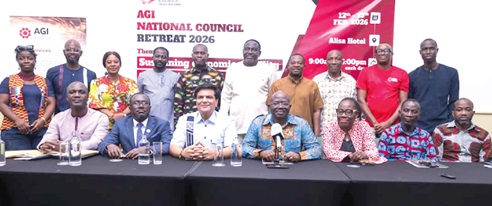
The two-day national council retreat of the AGI, held from February 12 to 13, 2026, in Accra, was on the theme "Sustaining economic stability to drive industrial growth.”
The discussions brought to the fore the urgent need for policymakers and the government to chart a clear path toward strengthening local production and promoting long-term growth in order to sustain recent economic gains.
Participants, therefore, urged the government to complement targeted policy reforms with decisive and aggressive implementation in priority areas to reinforce economic stability and accelerate industrial development.
Mr Nsiah-Poku stated that while the vision of the AfCFTA remained transformative, practical and immediate steps at the sub-regional level could deliver faster results for Ghanaian exporters.
He explained that bilateral engagements between Ghana and its immediate neighbours could remove bottlenecks that currently slow cross-border trade.
The AGI president added that direct state-to-state understanding could simplify customs clearance processes, harmonise standards and reduce delays at border posts.
Mr Nsiah-Poku stated that many Ghanaian manufacturers were already producing goods that met regional demand but struggled to access markets through formal channels.
In some cases, he said, traders resorted to informal routes because official processes were cumbersome and costly.
He added that formalising the trade flows through structured agreements would enhance revenue mobilisation and protect businesses.
Mr Nsiah-Poku said exporting to Europe or Asia was sometimes more predictable than trading within West Africa, in spite of geographical proximity, attributing the gap to inconsistent border procedures, documentation requirements, and varying interpretations of trade protocols across countries.
Anti-dumping measures
The Vice President in charge of large-scale operations at the AGI, Mukesh Thakwani, stated that many industries in Ghana were self-sufficient and had the capacity not only to meet domestic demand but also to serve the wider West African and international markets.
However, Mr Thakwani, who is also the Chief Executive Officer (CEO) of B5 Plus, said the continuous importation of similar goods was undermining local manufacturers and limiting their growth potential.
Citing the steel industry as an example, he said the sector was currently operating at less than 60 percent of its installed capacity despite having the ability to produce a wide range of products locally, including prefabricated structures, engineered buildings, tankers, trailers, nails, and binding wire.
Mr Thakwani stated that cheap imports and exemptions granted to some importers were placing unfair pressure on domestic producers and draining foreign exchange.
He, therefore, urged the government to implement anti-dumping measures and immediate restrictions on products that could be manufactured locally.
“We must protect industries that are already capable of producing here in Ghana so that we create more jobs and save millions of dollars in foreign exchange,” he stated.
24-hour economy
For his part, the CEO of the AGI, Seth Twum-Akwaboah, stated that the industry must serve as the backbone of the government’s 24-hour economy agenda if the policy is to make a meaningful impact.
He said a true round-the-clock economic activity could only be sustained if manufacturing and agriculture operated in three continuous shifts, supported by efficient value chains, competitive pricing, and access to finance.
He explained that once factories operated continuously, complementary services such as transport, security, and banking would naturally expand to support production.
“If industry produces competitively and demand is strong, then the entire service sector will align around it; that is why industry must drive the 24-hour Economy programme,” Mr Twum-Akwaboah added.
Latest Stories
-
Ghana housing finance conference adopts communiqué to improve affordable housing access
2 hours -
Special Initiatives Minister urges Wa Technical Institute to enrol more girls as EU-backed solar training lab opens
2 hours -
In the matter of my first year at the Bar
2 hours -
ActionAid Ghana calls for an end to child marriage, greater investment in girls’ rights
2 hours -
Newsfile to tackle World Cup visa scandal, beach demolitions, education strikes, BRICS bid
3 hours -
UK-Ghana Trade & Investment Summit: Trade Resource Centre to help businesses maximise UK-Ghana trade opportunities
3 hours -
Embassy of Denmark celebrates World Maritime Day
3 hours -
Linking LEAP to productive inclusion could cut extreme poverty by 2030 – UNICEF
4 hours -
Trade Ministry backs use of creative arts to rehabilitate prison inmates
4 hours -
Negotiations with government to continue despite strike suspension – GNAT
4 hours -
‘Ghana cannot afford to waste public resources; every cedi has a job’ – Ato Forson
4 hours -
Ghana expects economic boost as World Assemblies of God Congress brings 10,000 delegates to Accra
5 hours -
Joy in Nayilifong as Farouk Aliu Mahama donates 100kVA transformer to improve power supply
5 hours -
Chief Justice urges employers to tackle mental health stigma in workplaces
6 hours -
Analysis: Ghana’s yellow fever numbers reveal a gap between vaccination and protection
6 hours