

Audio By Carbonatix
The history of writing down thoughts and feelings could be tens of thousands of years older than previously believed, surprising archaeologists who made the discovery.
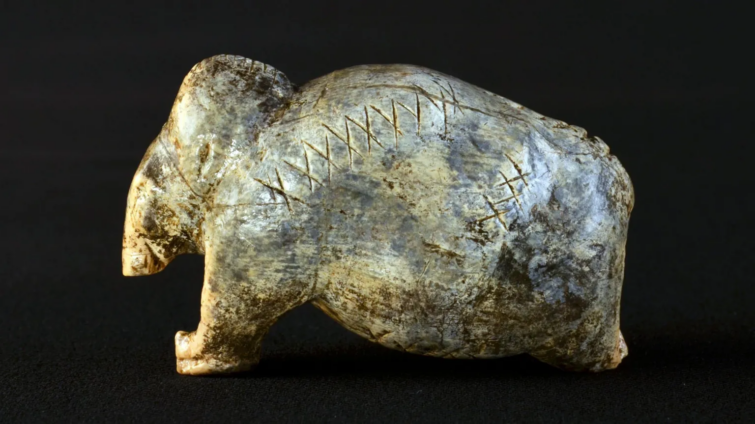
The researchers discerned patterns of meaning in lines, notches, dots, and crosses on objects such as mammoth tusks, as old as 45,000 years, found in caves in Germany.
Traditionally, historians date the first written words to proto-cuneiform scripts from around 5,000 years ago in ancient Iraq (Mesopotamia).
The precise meaning of the symbols in Germany remains a mystery.
The objects are from just before Homo sapiens moved from Africa to Europe, where they interacted with Neanderthals.
Until now, it was thought that writing developed in Mesopotamia around 3,000 BCE, followed by hieroglyphics in Egypt and later in China and Mesoamerica.
"The Stone Age sign sequences are an early alternative to writing," says Prof Christian Bentz from Saarland University, an author of the new research.
The work suggests that Stone Age people were as clever as modern-day humans, according to researcher Ewa Dutkiewicz from Berlin's Museum of Prehistory and Early History.
"So far, we've only scratched the surface of what can be found in terms of symbol sequences on a wide variety of artefacts," she says.
The team analysed more than 3,000 characters on 260 objects to uncover what they call the DNA of writing.
Some of the objects are from a 37-km-long cave system called the Lonetal in Baden-Württemberg, southern Germany.
On a small mammoth carved from tusk, the researchers analysed carefully engraved rows of crosses and dots.
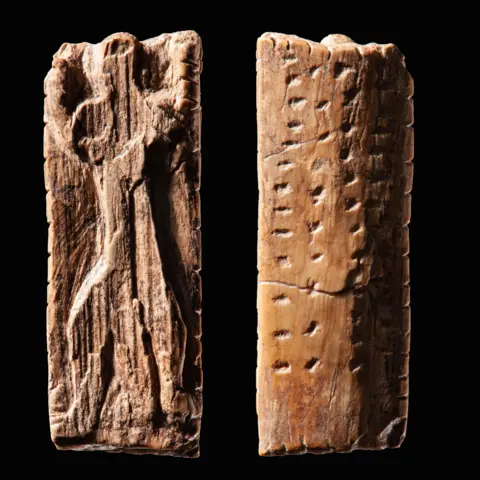
And on an artefact called "adorant" from the Geißenklösterle cave in the Achtal valley, they identified rows of dots and notches on an ivory plaque showing a lion-human creature.
They believe the arrangement of the marks, in particular the dots on the back, show the patterns acted as communication.
The researchers believe that Stone Age people deliberately carved these symbols to communicate messages, meaning, and convey thoughts.
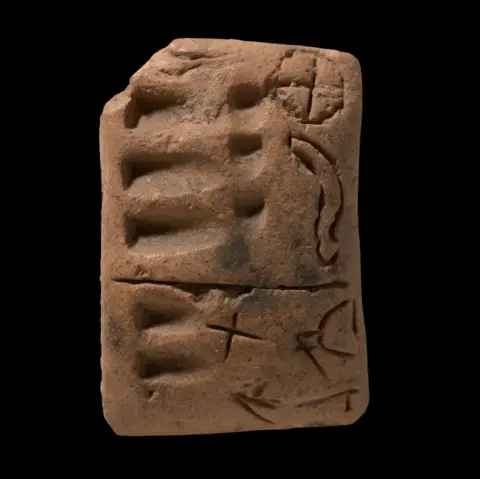
"Our results also show that the hunter-gatherers of the Palaeolithic era developed a symbol system with a statistically comparable information density to the earliest proto-cuneiform tablets from ancient Mesopotamia – a full 40,000 years later," says Bentz.
The clue to finding meaning is in the density of the symbols. They found high repetition of the signs and predictability in the subsequent symbols that is "comparable to much later proto-cuneiform," according to Bentz.
They found denser patterns on figurines than on tools.
The team say that it shows that communicating information was very important for Palaeolithic people.
"They were skilled craftspeople. You can tell they carried the objects with them. Many of them fit very well in the hand, just the right size to fit in the palm," says Dutkiewicz.
The research is published in the journal PNAS.
Latest Stories
-
Why Muzic Mensah walked away from gospel and embraced highlife
2 hours -
Ayariga rallies public, private sector support for Jamestown waste evacuation
2 hours -
NSMQ 2026: Three schools, one trophy – PRESEC, AUGUSCO and Accra Academy set for grand finale
3 hours -
Government directs TDC to comply with TMA development control authority
4 hours -
Recognition of reparatory justice creates responsibility for Ghana – Vice President
4 hours -
KNUST SHS defeats Osei Adutwum SHS to win Luv FM High School Debate
4 hours -
Afenyo-Markin, A-Plus unite to restore peace after New Winneba clashes
4 hours -
A-Plus, Afenyo-Markin to visit families affected by New Winneba violence
4 hours -
A-Plus urges calm as authorities move to end New Winneba tensions
4 hours -
Customs explains red, green channels at Accra International Airport
4 hours -
Agyeman‑Rawlings calls for stronger child protection in armed conflict
4 hours -
History made! Accra Academy book first-ever NSMQ final spot after dominant semi-final display
5 hours -
Woman’s decomposed body found in gutter near Haatso DVLA office
5 hours -
Residents of Akaa, surrounding communities demand improved network coverage
5 hours -
‘Chief Justice’s role is to administer justice, not protect any agenda’ – Haruna replies Franklin Cudjoe
5 hours