

Audio By Carbonatix
Dr Zanetor Agyeman-Rawlings, Minister for Environment, Science, Technology and Innovation, has urged stronger national systems and closer institutional collaboration to prevent children from being recruited or used in armed conflict.
She said child protection must extend beyond responding to consequences of conflict, stressing the need to identify vulnerabilities early and strengthen mechanisms capable of preventing victimisation.
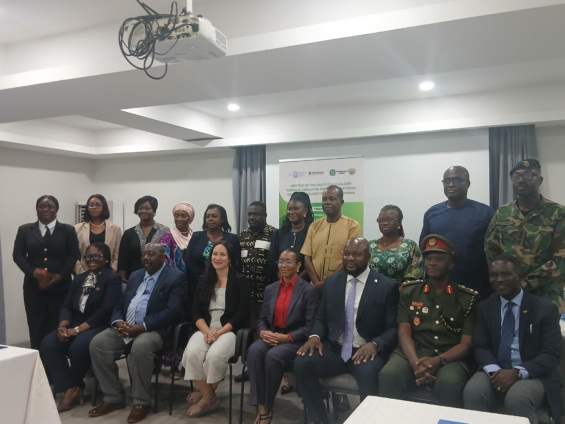
Dr Agyeman‑Rawlings made the call at the opening of a two‑day inaugural meeting of the Multi‑Stakeholder Working Group on the implementation of the Vancouver Principles in Ghana, organised by the National Peace Council (NPC) and the Dallaire Institute, in Accra on Thursday.
The meeting was convened to review and validate the Group’s terms of reference, establish a governance structure, elect leadership and define next steps toward drafting a comprehensive National Vancouver Principles Implementation Strategy.
The Group comprises representatives from the NPC, the Dallaire Institute for Children, Peace and Security, security institutions, Ministries, Departments and Agencies, Parliament, academia, civil society, development partners and international organisations.
Launched by Canada in 2017, the Vancouver Principles are 17 political commitments focused on protecting children in United Nations peacekeeping and preventing their recruitment and use by armed forces and armed groups.
They emphasise prevention across the conflict cycle, including early warning, operational planning, specialised training, monitoring and reporting, and child‑protection coordination.
As of 2025, some 107 countries had endorsed the Principles, including Ghana.
Dr Agyeman‑Rawlings, also the Member of Parliament for Korle Klottey, said Ghana had enjoyed relative peace since its return to democratic rule over three decades ago.
She, however, cautioned against complacency as the country operated within a region facing violent extremism, terrorism, organised crime and political instability.
Dr Agyeman‑Rawlings noted that conflicts in parts of the Sahel could extend beyond conflict zones through displacement, trafficking, exploitation and increased vulnerability of young people to recruitment, calling for stronger systems to protect children.
She also underscored the role of Parliament in ensuring that institutions responsible for national security and child protection had appropriate legal frameworks, resources, training and accountability mechanisms.
Elected Chairperson of the Working Group, Dr Agyeman‑Rawlings urged members to adopt an anticipatory rather than reactive approach by identifying vulnerabilities, strengthening early‑warning systems, building institutional capacity and incorporating child protection into security policies, training, planning and operations.
“By the time a child has been recruited or used by an armed group… we are already responding to harm,” she said.
Dr Agyeman‑Rawlings cautioned against allowing the Group to become another platform for periodic meetings without translating discussions into coordinated action, urging clear responsibilities, realistic timelines and mechanisms for monitoring, accountability and coordination.
She said the ultimate test of Ghana’s implementation efforts would be whether the systems established could “protect a child before that child becomes a victim of conflict.”
“Protecting children from recruitment and use in armed conflict is not only a child‑protection obligation. It is an investment in peace, national security and the future resilience of our society,” she said.
Dr George Amoh, Executive Secretary, NPC, said the implementation of the Vancouver Principles presented Ghana with an opportunity to institutionalise child protection within its national peace and security architecture.
He said the initiative should link community‑level early warning signals to national policy and strategic action, particularly amid emerging security risks, including localised disputes, cross‑border vulnerabilities and violent extremism.
“The Vancouver Principles provide the global blueprint for addressing the situation.
“This Working Group presents the opportunity for Ghana to internalise the Vancouver Principles by creating a sustained, institutionalised mechanism, anchored on the national peace and security architecture, that links community‑level early warning signals directly to national policy and strategic action,” he said.
Dr Amoh urged members to use the meeting to agree on institutional roles, reporting mechanisms and operational procedures, and establish a firm foundation for drafting Ghana’s National Vancouver Principles Implementation Strategy.
Mr Arsene Mukendi Tshidimu, Project Director, Vancouver Principles in Sub‑Saharan Africa Project, Dallaire Institute, cautioned that protecting children from armed conflict should not be treated solely as a child‑protection concern, but also as a peacebuilding, security, governance and development issue.
He said the establishment of the Working Group reflected Ghana’s commitment to strengthening peace, security, and good governance, and to protecting vulnerable populations, particularly children and youth.
Mr Tshidimu said the Dallaire Institute, through its Promoting the Vancouver Principles in Sub‑Saharan Africa Project, had, over the past three years, worked with Ghanaian institutions to train military and police personnel, support pre‑deployment training, engage policymakers, and strengthen collaboration with the NPC.
The project, he said, had also supported the development of community‑based early warning and prevention pathways, demonstrating Ghana’s potential to emerge as a regional leader in the Children, Peace and Security agenda.
Latest Stories
-
‘Carlos Queiroz not the sort of coach Black Stars need’ – Nii Lante Vanderpuye
14 minutes -
AFCON 2027Q: ‘Our Black Stars team is gone’ – Former Sports Minister
34 minutes -
Prof. Prempeh calls for public review of draft constitutional reform bills
46 minutes -
AFCON 2027Q: ‘I have never seen a poor performance from Black Stars like against Gambia’ – Nii Lante Vanderpuye
51 minutes -
Nigeria set to launch National Digital Address System 9 years after Ghana showed the way
1 hour -
Policy rate decision takes time to reflect in lower lending rates – BoG
1 hour -
Western Regional Minister applauds Karpowership’s role in Ghana’s power sector
2 hours -
Livestream: Road safety crises: Where are we getting it wrong?
2 hours -
Enterprise Life celebrates 25 years of protecting families and building trust
2 hours -
ICC London rules in favor of Ghana against Tullow over $400m tax charge
2 hours -
We are disappointed in ICC’s ruling over our corporate income tax assessment in Ghana – Tullow Oil
2 hours -
Cost of building inflation for August 2026 increases to 4.6% – GSS
2 hours -
Today’s front pages: Wednesday, September 30, 2026
3 hours -
Bawumia highlights agricultural, compulsory insurance reforms in IBAG engagement
3 hours -
Ghana will secure Tullow tax revenues while protecting Jubilee, TEN investments – Ato Forson
3 hours