

Audio By Carbonatix
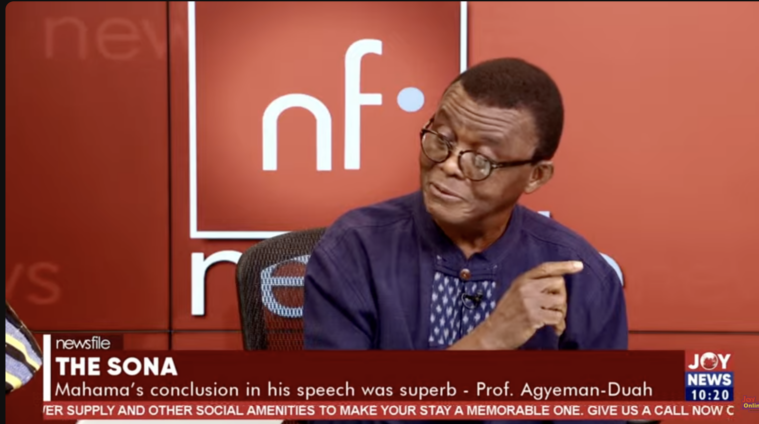
A former United Nations governance advisor, Prof. Baffour Agyeman-Duah, has warned that Ghana’s recent macroeconomic gains will count for little unless the Mahama administration takes bold steps to achieve food self-sufficiency.
Speaking on Newsfile the morning after President Mahama’s 2026 State of the Nation Address, Prof. Agyeman-Duah, who previously championed the “Feed the Nation” initiative, said he is awaiting decisive policies to ensure Ghana can produce its own staple foods.
“I am waiting anxiously to see concrete and aggressive policies for self-sufficiency in the food that we eat — tomato, plantain, pepper, cereals. If we can do that, most of the other problems we can control,” he said.
In 2024, Ghana spent GH¢38.95 billion on imported food, with grains, meat, cereals, sugar products, and fish making up more than half of all food imports, according to the Ghana Revenue Authority.
While the country exports raw commodities, it continues to import processed foods that could theoretically be produced domestically, highlighting structural gaps in the agricultural sector.
Prof. Agyeman-Duah noted that cultural perceptions also contribute to the challenge, with many Ghanaians associating imported foods with higher quality and prestige, reducing demand for local produce even when it is competitively priced.
The Mahama administration has taken steps to address the problem.
In April 2025, the government launched the “Feed Ghana” programme, aiming to reduce the country’s dependence on imported food through mechanised farming, smart agriculture, and strengthened value chains, focusing on maize, rice, and poultry. President Mahama highlighted a “staggering $2 billion” annual food import bill and pledged to promote local production.
But Prof. Agyeman-Duah argue that intent alone is insufficient. Implementation, infrastructure, and institutional coordination must match the ambition if Ghana is to truly transform its agricultural sector.
“My point is simple. Let us begin to look at how we change the structure of the economy,” he emphasised, urging the government to turn policy into tangible action.
Latest Stories
-
Ghana rejected MTN’s GH¢20m donation to sustain diplomatic pressure on South Africa – Int’l Relations Analyst
4 minutes -
World Bank backs Ghana’s recovery, urges sustained reforms
7 minutes -
Heritage Christian University launches LLB programme with focus on practical legal education
10 minutes -
Full Text: OSP address on rebirth, anti-corruption record and investigation into Aksa deal
13 minutes -
Rocky Horror star Tim Curry dies at 80
13 minutes -
Mohammed Kudus closing in on Tottenham return after injury setback
24 minutes -
NSMQ 2026: Pope John sets new benchmark with 72-point demolition to book quarterfinals spot
30 minutes -
Meta to pay $18 billion in landmark settlement over social media addiction claims
32 minutes -
BSIFF 2026 official selection brings films from 11 countries to Kumasi
37 minutes -
Minerals Commission inaugurates GH¢28m multipurpose sports complex in Kenyasi
47 minutes -
OSP has made corruption too costly to engage in lightly – Kissi Agyebeng
57 minutes -
U.S. FDA approves landmark pancreatic cancer drug that’s shown to improve survival
1 hour -
NSA extends August 28 deadline for National Service applicants with biodata mismatches
1 hour -
Ghanaian woman dies in China after collapsing at airport on journey to pursue Master’s Degree
1 hour -
NSMQ 2026: Osei Tutu SHS hold off Ahantaman Girls, Presby SHTS to reach quarterfinals
1 hour