

Audio By Carbonatix
Each March, as drums echo across towns and cities and the red, gold and green fly proudly in the harmattan breeze, Ghanaians at home and abroad pause to mark Heritage Month.
In this year's March, it is a season of memory and meaning, a time to reflect on a nation now 69 years old, to weigh its journey, its triumphs and its trials, and to ask, quietly but firmly, where are we heading?
At the centre of that national reflection stands one enduring figure, Osagyafo Dr Kwame Nkrumah.
On 6th March 1957, he stood before the world and declared Ghana free from colonial rule. Yet independence, for him, was never an end. It was a beginning, a bold promise of self-reliance, dignity and African unity.
Nkrumah was not merely a politician. He was a visionary, an intellectual and a Pan-Africanist, driven by the belief that Ghana, and indeed Africa, could stand on its own feet.
Across the country, he planted the seeds of that vision through ambitious industrial and agricultural projects designed to lift Ghana into a future of prosperity.
One such vision still stands tall in the Volta regional capital, Ho.
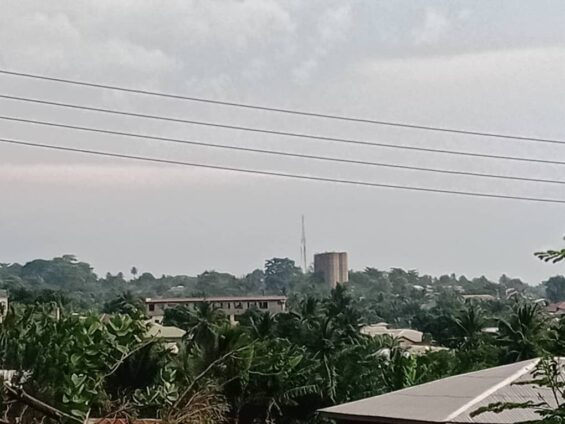
It is a tall, ageing structure, a concrete sentinel watching over a city that has grown and flourished around it. Once distant and isolated, it now sits amid expanding homes and human activity, yet remains untouched, its purpose unfulfilled.
I am in Ho, the oxygen city, to have my Eid-ul-Fitr holiday with my family and standing in the house, taking in the calm skies and the green stretch of the land, my eyes were drawn to this towering figure in the distance.
It stood apart, not just in height, but in story. Though armed only with a modest phone, I tried to capture its image. But no photograph could fully hold its weight, not just of concrete, but of history.
This structure is one of Nkrumah’s silos, part of a wider initiative in the 1960s that sought to reshape Ghana’s economic future. Built at a cost of about £8.5 million, these massive storage towers were designed to hold cocoa and grain.
At the time, Ghana produced over 40 per cent of the world’s cocoa. Nkrumah’s plan was simple yet strategic, store cocoa to influence global prices, and preserve grain to guarantee food security.
Across the country, including near Tema Harbour and in smaller locations like Ho, these silos were meant to hold up to 200,000 tonnes. They were symbols of the foresight of a nation preparing not just for today, but for tomorrow.
But history took a different turn.
Following the 1966 coup that overthrew Nkrumah, these projects were abandoned. Foreign contractors left. Technical plans disappeared. What remained were skeletal structures, monuments not to failure, but to interruption.
Today, many of these silos stand in silence. Weathered by time, they are often seen as relics of an unfulfilled dream, reminders of what could have been.
And yet, they still ask questions.
In Ghanaian politics, it is often said that governance is a continuous process. If that is so, why do we continue to inherit and ignore so many abandoned projects?
Why do visions begin with passion, only to fade with transition?
These are not merely structures of concrete and steel. They are investments, ideas, and opportunities, left idle.
Across the world, similar infrastructure continues to serve nations, supporting agriculture, stabilising prices, and strengthening food systems. The very vision Nkrumah pursued remains relevant today. Its failure to fully materialise was not solely his doing, but the result of both internal disruptions and external pressures.
As a journalist committed to the public interest, I believe these stories must be told, again and again. Not to dwell on the past, but to awaken the present. To remind leadership that continuity is not a slogan, but a responsibility.
Until Ghana learns to sustain its own vision, we risk remaining dependent, borrowing where we could build, importing where we could produce.
Perhaps what we need is not another towering structure, but a renewed sense of purpose. A return to patriotism. A firm embrace of probity and accountability.
And as the silent silo continues to rise above Ho, unmoved, unyielding, it stands as both a warning and a hope.
A warning of abandoned dreams. A hope that one day, we may yet complete them.
The author, Albert Kuzor, is a public interest journalist with the Multimedia Group Limited
Latest Stories
-
Pump prices may stay unchanged as government holds TOR, Sentuo prices
8 minutes -
Akra Reads! 2026: Ladé Wosornu poetry contest expands to JHS
13 minutes -
K9 dog sniffs out 72lbs of prohibited Ghanaian food items at JFK
20 minutes -
If family planning is our choice, why isn’t it in our budget?
26 minutes -
Mahama, Lordina to attend World Assemblies of God Congress opening in Accra
30 minutes -
‘The power play is disgusting’ – Atta Akyea questions Baffour Awuah’s detention by EOCO
38 minutes -
Ghana to review all public-sector AI acquisitions under new directive
44 minutes -
NPP ready for national elections; 7,121 delegates to vote
50 minutes -
‘I didn’t expect this under Mahama’ – Annoh-Dompreh on Baffour Awuah’s detention at EOCO
50 minutes -
GRA welcomes Tribunal decision upholding US$393 million tax assessment
54 minutes -
COMAC says Uniform Fuel Pricing Fund should not be confused with fuel subsidy
1 hour -
Mercy Ships targets over 2,000 surgeries, 3,500 dental treatments during Ghana mission
1 hour -
NITA appoints ShaQ Express founder Anthony Owusu-Ansah as Acting Deputy DG
1 hour -
Government moves to compel public institutions to buy food from Ghanaian farmers
1 hour -
‘Baffour Awuah won’t die in EOCO’s detention, even if he dies there, that’s okay for us’ – John Boadu
1 hour