

Audio By Carbonatix
President John Dramani Mahama is calling for a fundamental shift in how the history of slavery is understood, urging the global community to recognise it as a crime against humanity while restoring the dignity of those affected.
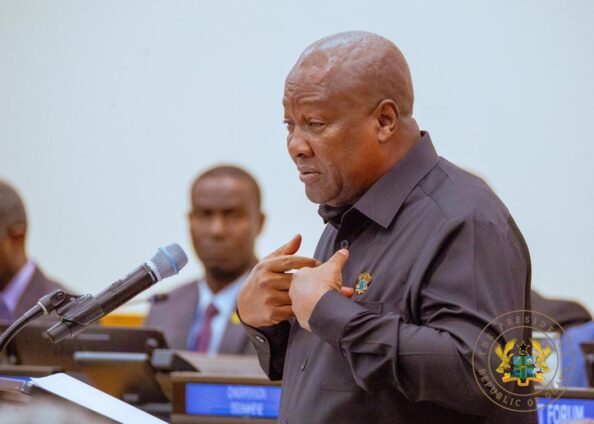
Delivering remarks at a United Nations event on slavery at the United Nations Headquarters on March 24, Mahama emphasised the power of language in shaping perspectives and influencing action.
“With the power that words hold to shape consciousness and perspectives, and to propel action or inaction, I offer this truth as a starting point, there is no such thing as a slave. There were human beings who were trafficked and enslaved by others who believed they could own them as property,” he stated.
He explained that this distinction is not merely semantic, but essential in acknowledging the humanity of those who suffered under the transatlantic slave trade.
“Some may think this is the same thing, but it is not, especially if we are to recognise the humanity and dignity of every individual,” he added.
The President further noted that the system of slavery was deliberately constructed to deny Africans their humanity, rooted in a false racial hierarchy.
“The entire transatlantic slave trade was designed to strip African people of their humanity, premised on a racial hierarchy that falsely elevated one race while dehumanising another without any basis in fact or science,” he stressed.
He pointed out that the atrocities committed during slavery and the injustices that followed were made possible because enslaved Africans were treated as objects rather than human beings.
“These injustices occurred because human beings were reduced to objects. That is why, in discussing slavery and its legacy, we must begin by reclaiming racial equality and restoring the dignity of Africans and their descendants,” he said.
Touching on the importance of an international resolution to formally recognise slavery as a crime against humanity, President described it as a necessary step toward global acknowledgment and justice.
“Such a resolution allows the world to collectively bear witness to the suffering of more than 12.5 million men, women, and children whose homes, identities, families, dreams, and futures were taken from them over 400 years,” he noted.
He added that confronting this history honestly is essential to achieving justice, healing, and meaningful progress in addressing the enduring legacy of slavery.
Latest Stories
-
Oil hits over 1-week low on hopes of boost to diplomacy in Iran war
34 minutes -
They take GH¢100, sometimes GH¢200 – Okada riders allege police extortion in Accra
43 minutes -
NACOC: We’ve found no presidential escort among suspects in €225m France cocaine case
52 minutes -
Don’t turn students away over trunks and chop boxes – GES
1 hour -
Italian Apple store employees strike on iPhone 18 Pro launch day
1 hour -
Apple’s Tim Cook sees Australia’s social media curbs as ‘world-leading’, PM says
1 hour -
Amazon raises minimum hourly pay by $1 to $20 for US operations workers
2 hours -
Insurance cost has largely remained stable – NPA boss on transport fare pressure
2 hours -
Multiple unions threaten strikes at Barrick’s flagship Mali gold mine, documents show
2 hours -
Infantino invited to African summit as he faces challenge to FIFA leadership
2 hours -
NPA boss flags ‘recalcitrant’ transport operators raising fares arbitrarily
2 hours -
GPRTU fare hike put on ice after talks with government – NPA boss reveals
3 hours -
I’m greatly worried – NPA boss on threat of higher transport fares
3 hours -
We are largely import-dependent – NPA boss on Ghana’s fuel vulnerability
3 hours -
Ghana’s fuel market is built for turbulence – NPA’s Edudzi Tamakloe explains why
4 hours