

Audio By Carbonatix
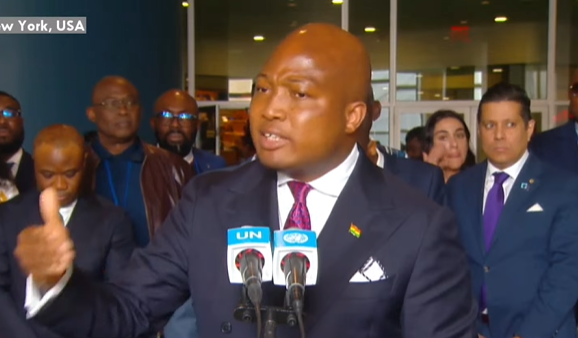
Minister for Foreign Affairs, Samuel Okudzeto Ablakwa, has declared that the trafficking and enslavement of Africans constitute the gravest crime against humanity, following the adoption of a landmark United Nations resolution led by Ghana.
Speaking in the United States after the United Nations approved the resolution on Wednesday, March 25, Mr Ablakwa said the global body had taken a clear and decisive moral position.
“Today, through this resolution, the world has spoken with clarity and truth. We have affirmed that the trafficking of enslaved Africans and their racialised chattel enslavement is the gravest crime against humanity,” he said.
He stated that the scale, structure, and enduring consequences of the transatlantic slave trade demand recognition at the highest level of global conscience, stressing that such acknowledgement is essential for healing and for preventing similar atrocities in the future.
According to him, the resolution is not intended to apportion blame or reopen historical wounds, but rather to ensure that the realities of slavery are neither denied nor forgotten.
“This resolution is not about apportioning blame across generations or nations. It is not about reopening old wounds. It is about ensuring that those wounds are neither forgotten nor denied,” he stated.
Mr Ablakwa noted that while history is complex and layered, certain events stand apart due to their scale and lasting impact on humanity.
He said recognising the transatlantic slave trade in this light does not diminish other historical experiences but strengthens collective moral awareness.
“It recognises that even within complexity, there are moments in history defined by their scale, their systemisation, and their impact on humanity,” he explained.
He added that the adoption of the resolution reinforces a renewed global commitment to remembrance, education, dialogue, and cooperation.
“What we have achieved today helps all of us in our renewed commitment to remembrance so that future generations inherit truth, not silence… and to cooperation so that we address the enduring legacies of history in ways that unite rather than divide,” he said.
The resolution, spearheaded by Ghana, has been widely described as a major step in advancing global conversations on historical justice and the long-term effects of slavery.
Latest Stories
-
‘We have turned the tide’ – Ato Forson says Ghana is ready to take off
1 minute -
Police arrest man captured in viral video assaulting wife in Agona Nkwanta
3 minutes -
KATH Mother and Baby Unit construction stalled for 14 months over unpaid contractor arrears
17 minutes -
Government wanted to ‘tilt the balance’ with new EC appointments – Kwakye Ofosu
23 minutes -
Angry Tema Community 25 residents threaten to sleep at GWL over water shortage
36 minutes -
BoG takes financial literacy drive to Techiman, vows to protect depositors
36 minutes -
‘Stop the distractions’ – Akosua Manu demands answers over GH¢49.7m South Africa evacuation cost
37 minutes -
Formula 1 to return to Africa with Rwanda Grand Prix in early 2030s
44 minutes -
Mahama says Ghana is safer today as he commissions 85-bed ward at Police Hospital
48 minutes -
LA 2028: Black Queens face Zambia in final Olympic qualifier
57 minutes -
WAFU Zone B: Black Starlets seal semifinal place with 3-1 win over Benin
1 hour -
Black Queens thrash Mauritius 7-0 to advance 10-0 on aggregate in Olympic Qualifiers
1 hour -
Kaizen as a strategic pathway for micro business scale-up in Ghana
1 hour -
Minister orders suspension of Obuasi SHS headmaster over alleged sexual misconduct following JoyNews investigation
1 hour -
Over 38,000 commercial, 150,000 residential customers unbilled – Ghana Water MD
2 hours