


Audio By Carbonatix
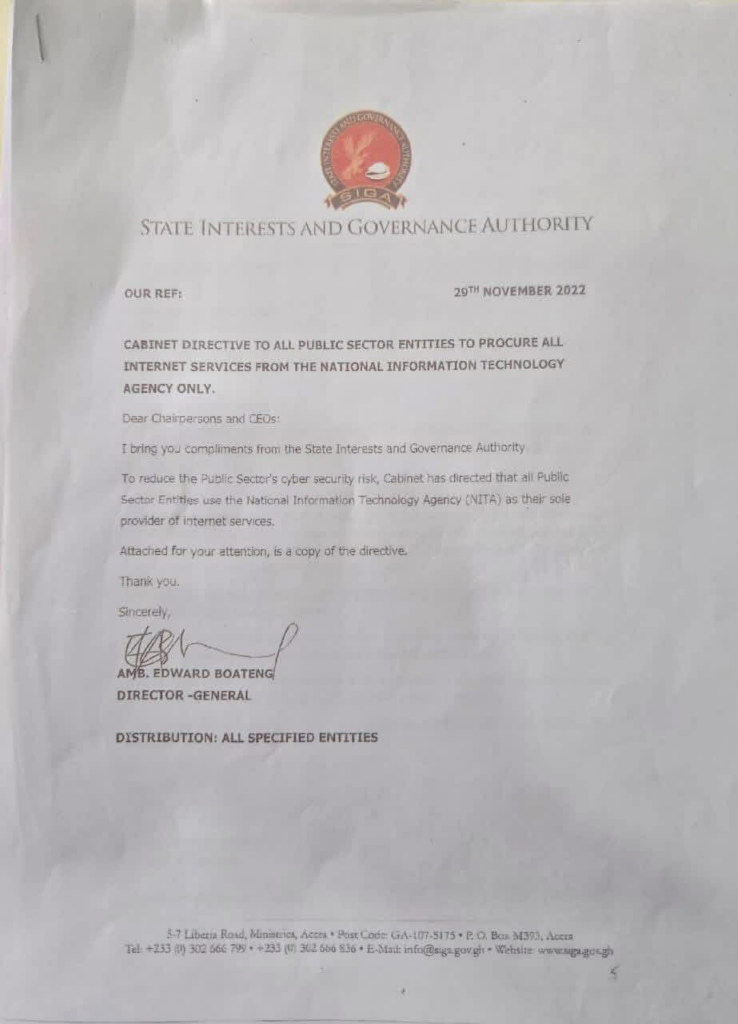
The Managing Director of SIC and the Director-General of SIGA are attempting to draw a comparison between two situations that appear similar on the surface but are fundamentally different in substance, legal basis, and economic impact.
The 2022 directive he provided is a Cabinet-backed instruction communicated through the State Interests and Governance Authority. It mandates that all public sector entities procure internet services exclusively from the National Information Technology Agency (NITA). The justification for this directive is explicitly tied to cybersecurity risk and national digital infrastructure control.
This distinction is critical.
Internet infrastructure is considered a strategic national asset. It carries implications for national security, data sovereignty, surveillance protection, and systemic resilience. Fragmented control of such infrastructure exposes the state to cyber threats, data breaches, and external vulnerabilities. In that context, centralisation is not a commercial preference but a risk containment strategy. The objective is not to create competition but to eliminate exposure.
This is what is referred to as technology sovereignty. It is the principle that a country must retain control over its critical digital systems to protect national interest.
Insurance does not fall into this category.
Insurance is a competitive financial service market, governed by procurement law, regulatory frameworks, and market-based pricing mechanisms. It operates on the basis of:
• Risk assessment and underwriting expertise
• Competitive pricing
• Claims performance and service delivery
• Access to international reinsurance markets
- Financial strength and capital adequacy
Unlike internet infrastructure, insurance is not a system that benefits from centralisation. On the contrary, its strength depends on competition, diversification of risk, and market depth.
This is where the comparison breaks down.
The 2022 NITA directive is:
• A formal Cabinet decision
• Legally binding
• Justified by national security considerations
• Designed to eliminate competition in a specific domain for strategic reasons
The current insurance situation, however, is:
• Not backed by a Cabinet-level mandate overriding procurement law
• Not justified on national security grounds
• Occurring within a sector where competition is required by law
• Influencing market behaviour without formally replacing competitive processes
The Managing Director’s argument suggests that because inter-trading has been encouraged in the past, current developments fall within the same logic. This is inaccurate.
Encouragement of inter-trading is not equivalent to direction that shapes outcomes. The difference lies in whether institutions retain genuine freedom to evaluate options and select providers based on merit.
In the case of NITA, there is no evaluation. The decision is predetermined by law for a specific and justified purpose.
In the case of insurance, procurement law requires:
• Competitive tendering
• Transparent evaluation
• Demonstration of value for money
• Equal opportunity for qualified providers
Any influence that shifts outcomes before these processes are completed introduces market distortion.
The concern being raised is not about supporting a state-linked company. That is a legitimate policy objective. The concern is about how that support is being implemented.
When policy signals, even if informally framed, begin to:
• Influence renewal decisions
• Narrow participation of competing firms
• Shape expectations within public institutions
then the system moves from competition toward administrative allocation.
This is the core issue.
The NITA directive removed competition openly and lawfully for a defined national security purpose.
The current insurance situation appears to be reshaping competition indirectly, without a formal legal framework, and within a sector where competition is essential.
That is why the distinction matters.
One is a sovereign control decision.
The other is a market influence question.
They are not interchangeable, and using one to justify the other obscures the real issue rather than addressing it.
The central question remains unchanged.
Are insurance contracts being awarded through open, competitive, and lawful processes, or are they increasingly being influenced by policy direction?
That is the matter now before the Presidency.
Latest Stories
-
GIIF’s Accra-Kumasi Expressway Ltd. SPV Initiative: A bold blueprint for financing Ghana’s infrastructure development
3 minutes -
From surviving dry spells to building resilience: Alhassan’s Story
3 minutes -
GRA targets over double revenue by 2028
14 minutes -
Black Maidens bring the jama, then bring the goals in WAFU B opener [VIDEO]
18 minutes -
GNPC Explorco showcases Voltaian Basin exploration potential at AOW:Energy 2026
24 minutes -
Black Maidens cruise past Burkina Faso in WAFU B opener
25 minutes -
Dafeamekpor calls for forensic audit after alleged GH¢600m COVID-19 fumigation gap
29 minutes -
Minority demands itemised accounts for GHS50m South Africa evacuation, pulls out of closed-door meeting
34 minutes -
Black Princesses arrive in Ghana after participating in FIFA U20 Women’s World Cup in Poland [PHOTOS]
37 minutes -
Effiduase Asokore MP sues Rev. Owusu Bempah for GH¢10m over alleged defamatory comments
42 minutes -
Chris Wilder backs Jordan Ayew to be a success at Sheffield United
49 minutes -
Forestry Commission arrests 12 illegal miners, impounds three excavators in South Formangso Forest Reserve
58 minutes -
Ghana’s mineral resources must benefit host communities – Lands Minister
1 hour -
Kudus makes first Tottenham start since January against Liverpool
1 hour -
Government launches five-year initiative to improve emergency maternal and newborn care
1 hour