

Audio By Carbonatix
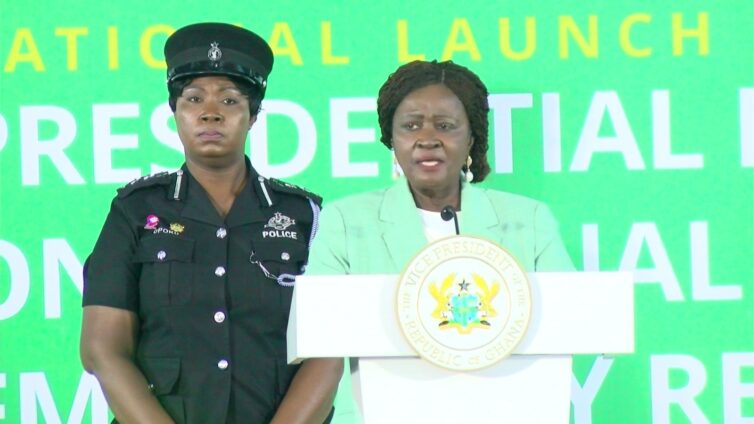
Government has launched a five-year Presidential Initiative on Maternal Health Emergency Response (PRIMER) as part of efforts to reduce maternal mortality and improve emergency care for pregnant women and newborns.
Launching the initiative, Vice President Professor Naana Jane Opoku-Agyemang said Ghana has made progress in expanding access to maternal healthcare, with about nine in 10 women receiving at least four antenatal care visits and a similar proportion delivering in health facilities.
She added that skilled health personnel attend about 86% of births.
However, maternal mortality remains above the Sustainable Development Goal target of fewer than 70 deaths per 100,000 live births by 2030.
Professor Opoku-Agyemang said this means Ghana's next phase of the response must go beyond access to healthcare and focus on the quality, readiness and speed of care women receive.
“Our focus must extend beyond service coverage to quality, readiness, speed,” she said.
According to the Vice President, PRIMER is designed to address challenges that cannot be resolved by individual health facilities alone.
These include financing, infrastructure, staffing, procurement, data and community mobilisation.
“PRIMER is to help address obstacles that no single health institution can remove, whether in financing, infrastructure, staffing, procurement, data or community mobilization,” she said.
The initiative will also identify interventions that are producing better maternal health outcomes and apply lessons from those interventions in other parts of the country.
“PRIMER’s task is to identify what produces better outcomes in places like Dodua, strengthen the quality of care and apply those lessons where they can improve maternal survival,” Professor Opoku-Agyemang said.
She cited Dodua as an example of what targeted interventions can achieve, recalling President John Dramani Mahama's reference to a successful intervention during his first administration that brought maternal deaths in the area to zero.
The Vice President questioned why maternal deaths continue to occur when many of the major causes are known and are largely preventable or treatable.
“Where then is the gap?” she asked.
PRIMER will focus on three broad areas: political leadership and social mobilisation; institutionalised accountability and evidence-based action; and sustainable domestic financing, alongside efforts to mobilise responsible external support.
The initiative will strengthen maternal and perinatal death surveillance and response, improve the timeliness and quality of data, clarify institutional responsibilities and support regular high-level reviews of results.
It will also cover maternity and newborn care, referral and transfer systems, access to blood, medicines and essential equipment, community engagement and the use of data to improve care.
Professor Opoku-Agyemang stressed that maternal survival cannot be achieved by the health sector alone.
She noted that factors such as roads, communication, transportation, water and energy can directly affect women's ability to access timely and quality maternal healthcare.
PRIMER will therefore work with institutions responsible for those areas to identify where existing programmes can contribute to improving maternal health outcomes and where gaps remain.
The Vice President also called for stronger coordination among ministries, public institutions, local authorities, traditional and religious leaders, civil society organisations, the private sector, development partners and communities.
She said families and communities have an important role to play by encouraging women to seek care early, recognising danger signs and ensuring that women are supported rather than delayed when complications arise.
Professor Opoku-Agyemang said the ultimate measure of PRIMER's success should not simply be the number of women who access health facilities, but whether they survive childbirth and return home safely with their babies.
“It is not enough for many more women to enter our health facilities. They must return home safely with their babies to their families.”
Professor Opoku-Agyemang officially launched the Presidential Initiative on Maternal Health Emergency Response on behalf of President John Dramani Mahama.
Latest Stories
-
Gold prices recover from two-month low as dollar rally stalls
31 minutes -
Hormuz transits at lowest in over two months after attacks, data shows
39 minutes -
Bezos says Blue Origin likely to pursue IPO in coming years
48 minutes -
Samsung flags $80 billion profit on AI boom, highest quarterly for any tech company
57 minutes -
Amazon makes fresh job cuts, mainly in retail division
1 hour -
Government plans emergency capacity expansion at Korle Bu, KATH, Tamale, 37 Military
2 hours -
‘Means more than just a trophy’ – Djokovic claims 102nd title of career
2 hours -
African Union launches continent’s first credit rating agency
2 hours -
Ghana, 3 others face large financing needs, debt servicing costs – World Bank warns
3 hours -
Eurobond repayment: Ghana faces US$6.4bn repayment burden between 2027 and 2030 – World Bank
3 hours -
Government to add 100 new ambulances to national fleet in 2027
4 hours -
Ex-Spurs player Vega set to run for FIFA president
4 hours -
Arteta signs new contract with champions Arsenal
4 hours -
Former Man City player Silva comes out of retirement
4 hours -
‘I have a screen in my office’ – Akandoh on real-time emergency bed tracking
4 hours