

Audio By Carbonatix
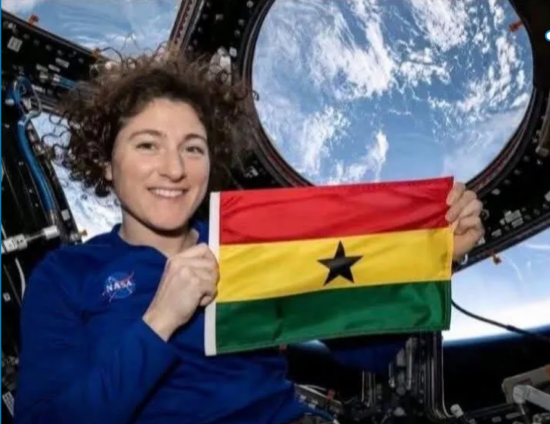
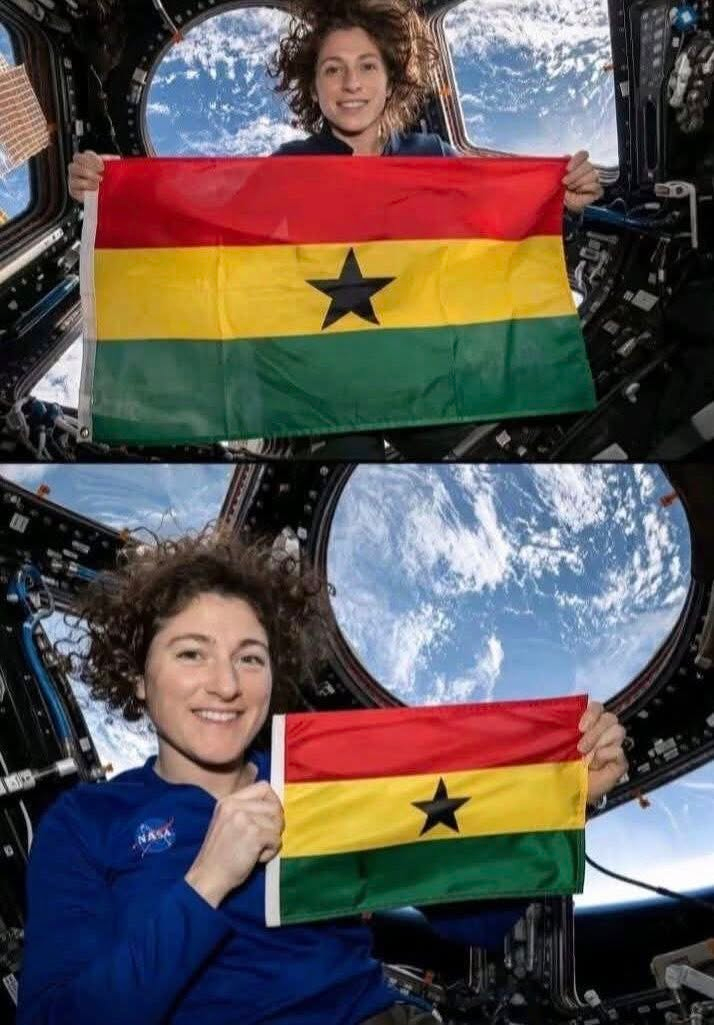
A few days ago, history quietly carried Ghana beyond its borders—far beyond. When Christina Koch displayed the Ghanaian flag aboard Artemis II, she did more than participate in a scientific milestone; she reminded us that Ghana’s presence in the world is not only measured in technology or power, but also in relationships, memory, and human connection.
Much has rightly been said about the achievement of the Orion team and the broader ambitions of space exploration. Yet, nestled within that global triumph was a quieter, deeply meaningful moment: Ghana was there too. Our flag, carried into a space no human had previously occupied in quite this way, symbolised something larger than national pride—it spoke to the invisible threads that connect people, nations, and histories.
Like many Ghanaians, I initially encountered the news with scepticism. In an age saturated with misinformation and AI-generated illusions, it is easy to dismiss the extraordinary as untrue. A social media post suggesting that a University of Ghana alumna was part of such a historic mission sounded implausible. But it was true. And that truth compels reflection.
How does a nation without a space programme find its flag orbiting the Moon? The answer lies not in rockets, but in relationships.
Countries do not possess equal strength across all domains. Yet history shows that influence is not always exercised through military or technological dominance. When Ghana defeated the United States in the FIFA World Cup, it was a moment of symbolic rebalancing—an arena where different rules applied, and where power asymmetries were temporarily reshaped. In much the same way, Ghana’s presence on Artemis II reveals another domain where influence operates: the realm of human connection.
Ghana has long excelled in this domain. From being one of the first countries to welcome the Peace Corps to hosting generations of international students at Legon, our nation has cultivated a legacy of openness and hospitality. The University of Ghana, in particular, has been a hub of cross-cultural exchange for decades. American, European, and other international students have passed through its halls, carrying with them experiences that often endure for a lifetime.
These encounters matter. They shape perceptions, build affinities, and sometimes—years later—manifest in unexpected ways. One such manifestation may well be the image of Ghana’s flag in lunar orbit.
This moment invites us to ask difficult but necessary questions. Have we fully appreciated the strategic value of these long-standing relationships? Are we doing enough to sustain and deepen them? Institutions across the world, from Stanford University to University of Cambridge, maintain enduring connections with their alumni, recognising them as vital assets in a globalised world. Ghanaian institutions must do the same—not merely as a matter of prestige, but as a pathway to national development.
At its core, this story is about love—love for a place, for a people, for shared experiences. As the Bible reminds us in First Epistle to the Corinthians, “faith, hope and love” endure, but the greatest of these is love. Love is what transforms a temporary stay into a lifelong bond. It is what compels someone, years later, to carry a nation’s flag into space.
Philosopher Thomas Hobbes once observed in Leviathan that motion requires a cause—nothing moves unless something sets it in motion. As he puts it “That when a thing lies still, unless something else stirre it, it will lye still forever, is a truth that no man doubts of” If that is true, then Ghana must ask: what more can we do to inspire such motion in others? How many dormant affinities exist across the world, waiting to be awakened through deliberate engagement?
The display of Ghana’s flag on Artemis II is not an accident. It is the outcome of decades of human interaction—of hospitality extended, friendships formed, and respect earned. It is a reminder that while Ghana may not yet compete in the frontiers of space technology, it holds a different kind of power: the power to touch hearts and shape loyalties.
In an uncertain world, that power matters. It is a form of influence that cannot be measured in missiles or machines, but in memory and meaning. Ghana’s conquest of space, then, is not technological—it is relational.
And perhaps that is the greater achievement (at least in the short term, as we continue to develop our science and technology, history, criminology, African studies, law, herbal medicine, etc.).
Emmanuel Sowatey
Email: emmnauel.sowatey@gmail.com
Latest Stories
-
Man City suffer as PSG masterclass sets up Champions League win
32 minutes -
Customer Service Africa CEO urges business leaders to observe staff and customer interactions
42 minutes -
On night of mayhem for Liverpool, Barcola arrives in style
43 minutes -
Muzic Mensah finds healing and renewed love in new single ‘WayƐ Late’
55 minutes -
FIFA to offer extra £2.6bn for football development
57 minutes -
Government backing is no EPA permit – Authority warns GoldBod, ministries
1 hour -
Real Madrid produce stunning late fightback to down Roma
1 hour -
EPA orders immediate halt to unpermitted reclamation and dredging nationwide
1 hour -
Afenyo-Markin’s lawsuit against Sammy Gyamfi takes focus away from development – Kpebu
2 hours -
FWSC urges media to guard against misinformation in proposed IPEC transition
2 hours -
MoMo Fest 2026: Shatta Wale to Rock Accra Stadium on October 17
2 hours -
GTEC’s letter directing public universities to reopen by October 16 is unprofessional – GAUA
2 hours -
Suspect in viral video assaulting wife jailed for 3 months
2 hours -
GAUA insists strike will end only after Fair Wages addresses market premium issue
2 hours -
Kpemka seeks compensation as he sues BOST over alleged unlawful termination
2 hours