

Audio By Carbonatix
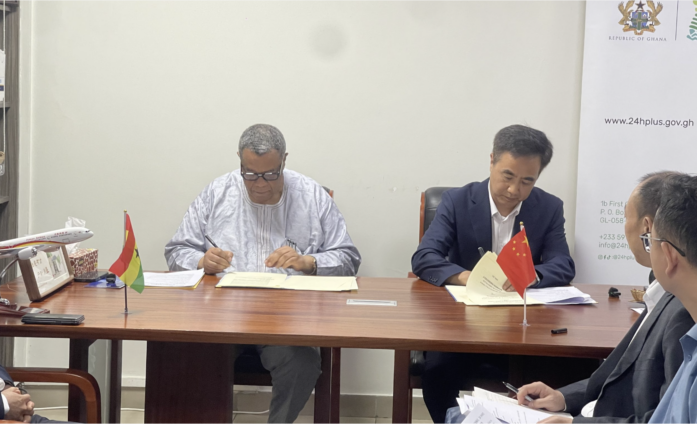
Ghana has taken a significant step toward advancing its industrial transformation agenda under the 24-Hour Economy Programme, following the signing of a Memorandum of Understanding (MoU) with Hunan Architectural Design Institute Group to support large-scale infrastructure planning and development.
The agreement, signed at the Office of the President in Accra, is expected to provide critical technical expertise for the development of the Volta Economic Corridor, a flagship project aimed at boosting agro-industrial production, exports, and job creation.
Mr Augustus Goosie Tanoh, Presidential Adviser on the 24Hour Economy and Accelerated Export Development (24H+)Secretariat, described the partnership as a practical step toward implementing Ghana’s long-term economic transformation strategy.
He noted that the collaboration builds on earlier engagements held in Changsha, capital of China’s Hunan Province, where both sides agreed to focus on concrete areas of cooperation, particularly in spatial planning and infrastructure design.
Mr Tanoh highlighted Hunan’s economic transformation from an agricultural base to a hub for the engineering and construction industries, attributing its success to deliberate investment in spatial planning and infrastructure development.
He said Ghana was adopting a similar approach, emphasising that detailed planning of roads, water systems, energy networks, and industrial zones must precede large-scale industrial activity.
“This partnership brings the same planning discipline that transformed Hunan to Ghana’s development agenda,” he stated.
At the centre of the agreement is the Volta Economic Corridor, a multi-regional development stretch running from Tema through Akosombo, Afram Plains, Yeji, Buipe, and Yapei to Tamale.
The corridor is envisioned as Ghana’s first net-zero green industrial zone, integrating agriculture, manufacturing, and logistics.
Under the 24-Hour Economy Programme, the government plans to convert over two million hectares of arable land into agroecological parks, which will be linked to industrial parks and supported by modern transport infrastructure.
The integrated system is expected to reduce reliance on imports while positioning Ghana as a competitive exporter in global markets.
The MoU mandates Hunan Architectural Design Institute Group to support Ghana in master planning and spatial design for key development zones within the corridor.
This includes designing layouts for agroecological and industrial parks, as well as infrastructure networks for roads, water supply systems, sewage treatment, and pipelines.
Mr. Tanoh stressed that such foundational infrastructure was essential to attracting private investment, noting that investors required reliable utilities and well-planned industrial environments before committing capital.
The agreement also covers support for project structuring using Engineering, Procurement and Construction plus Finance (EPC+F) and EPC+Investment (EPC+I) models, which are expected to ease pressure on public finances by mobilising private sector funding for infrastructure.
The Volta Economic Corridor is projected to generate more than 500,000 direct jobs, making it one of the most ambitious employment-driven initiatives under Ghana’s current economic strategy.
Feasibility studies for the corridor’s multimodal transport systems are already being supported by the African Development Bank, underscoring strong institutional backing for the project.
Mr. Tanoh indicated that the government’s approach prioritises energy availability, with plans to deploy renewable energy solutions along the corridor to reduce electricity costs to below seven cents per kilowatt hour.
This, he said, would significantly enhance Ghana’s competitiveness in manufacturing and agro-processing.
As part of the initial phase, Ghana and its Chinese partner will commence work on pilot projects involving two industrial parks and three agroecological parks within the corridor.
The pilot is expected to test design concepts, refine implementation models, and build technical capacity before scaling up across the entire corridor.
Beyond infrastructure development, the agreement also includes provisions for technical training and knowledge exchange to strengthen Ghana’s local expertise in large-scale project planning and execution.
The MoU signals a broader policy shift toward structured, export-led industrialisation, anchored in integrated infrastructure systems and private-sector participation.
Mr Tanoh emphasised that the partnership was not merely symbolic but results-oriented, with expectations for rapid deployment of technical teams and delivery of detailed spatial plans in the near term.
“The building blocks are in place. What we need now is execution,” he said.
The collaboration is expected to accelerate Ghana’s transition from a resource-dependent economy to a value-added production and export hub, aligning with the government’s long-term vision for sustainable economic growth.
Latest Stories
-
Kodua dismisses rift fears, says he and John Boadu are focused on NPP victory
24 minutes -
‘There is no competition’ – Justin Kodua confident of NPP General Secretary re-election
2 hours -
J100 Accra Doubles Champions : Kolesolva/ Ndukwa, Agarwal/Patel seal title victories
2 hours -
Sydney Wright crowned J100 Accra Champion
2 hours -
J100 Accra Boys’ Singles: Verma denies Beckles back-to-back titles to claim crown
2 hours -
Two friends fined GH¢12,000 for stealing
2 hours -
Son jailed for threatening to stab mother
2 hours -
Drive constitutional reform – GJA urges journalists
3 hours -
NPP Delagates Congress: Confusion delays voting at Ashanti Region TESCON centre
4 hours -
Fire ravages shops, houses near Koforidua Central Police Station
4 hours -
NPP Delegates conference: The wisdom of the masses will prevail – Napo
4 hours -
Flydubai co-pilot attacked captain with axe, UAE official says
4 hours -
NPP Bosome Freho Constituency Chairman reportedly arrested over ballot paper incident
5 hours -
Medical plane with 6 on board missing off Massachusetts coast
5 hours -
Bolt driver jailed 25 years for robbing beautician
5 hours