

Audio By Carbonatix
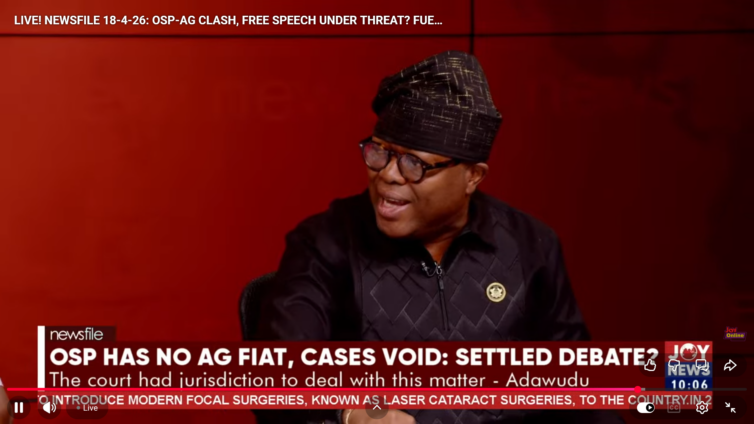
Managing Partner at Lord & Lords Legal Practice and a member of the NDC Legal and Communication Committee, Victor Kwadjoga Adawudu, has described the government’s recent move to reduce fuel prices as a “creative” short-term intervention, while cautioning that Ghana must prioritise domestic refining capacity to reduce long-term vulnerability.
Speaking on Newsfile on Saturday, April 18, Mr Adawudu weighed in on the latest pricing window, which saw diesel prices drop by GH₵2.00 per litre and petrol fall by about 36 pesewas per litre.
The reductions come despite rising global crude oil prices, driven largely by geopolitical tensions in the Middle East.
Ghana, as a net importer of refined petroleum products, remains exposed to such external shocks. In response, the government moved to cushion consumers by adjusting or suspending selected taxes, levies and margins within the fuel pricing structure—effectively absorbing part of the global price increases.
Mr Adawudu characterised the move as a pragmatic, if temporary, solution.
“It’s this has been a short term and I think that was a very innovative and creative ways of doing it.”
He explained that the approach carefully avoids creating fiscal imbalances elsewhere in the economy, drawing parallels with previous debates around energy sector financing.
“It’s just like, you know, the price build-up. We’re not taking money from somewhere to create another problem. Just like the energy sector levy that we all agreed at a point that once it should be added. The people were saying that taxes should be taken off. However, if we take that off, the purpose that we wanted that money to be useful to keep the electricity, we may have created a problem.”
According to him, while tax relief at the pump is often politically attractive, it can undermine critical funding streams if not handled carefully.
He therefore welcomed the government’s balancing act, noting that it offers immediate relief without significantly destabilising other sectors.
“For now, I think it’s good and we’re watching.”
Mr Adawudu also linked the domestic pricing dynamics to developments on the global stage, particularly disruptions in key shipping routes.
“I was a little bit happy when I realised that the Strait of Hormuz has been officially open, so I was like it was going on a line with what we thought that we take some short-term… And now I’ve just been told it’s been closed again, so we are hoping that things will do.”
Despite his support for the current intervention, Mr Adawudu stressed that Ghana must move beyond reactive measures and adopt a more self-sufficient energy strategy.
“As Kofi has suggested, we have refineries here. Let’s look at our own. I think let’s think out of the box… I will leverage all this by the end of the day.”
He called for structural reform aimed at reducing reliance on imported refined products.
“It’s not the same that we are always depending on them,” he said.
Latest Stories
-
Jason Arday: 10 things you may not know about British-born Ghanaian former Cambridge professor found dead at 41
1 hour -
KNUST partners with government to manufacture locally-made agricultural machines and smart traffic lights
1 hour -
Government to add constitutional referendum to 2027 District Assembly elections
2 hours -
Government disburses GH¢23.1 billion to clear road contractors’ arrears – Roads Minister
3 hours -
NPP Ashanti elections: 1,020 delegates to choose 11 regional executives
4 hours -
Galamsey: ‘Challenge is prosecution, not arrest’ — Lands Minister
4 hours -
MTN to build 80 new sites across the five regions of the north as part of a $1.1bn investment
5 hours -
The Polygamist’s creator says women see themselves reflected in her Netflix hit
6 hours -
UEW Hospital suspends OPD services over GAUA strike
7 hours -
Muzic Mensah selected for Boomplay’s inaugural ‘NEXT WAVE’ Programme
7 hours -
Prime Insight to tackle legal vacation controversy and $1million AKSA bribery case
8 hours -
Ghanaian evacuee from South Africa dies on arrival in Accra
8 hours -
Suicide and the fight to stay alive
9 hours -
POS Foundation raises alarm over student cohabitation, sexual harassment on university campuses
9 hours -
Nandom NPP primary heats up as four candidates enter 2028 race
9 hours