

Audio By Carbonatix
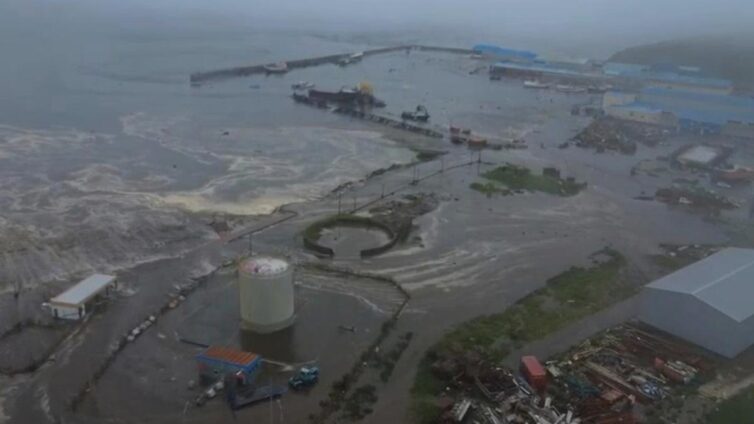
A magnitude 7.7 earthquake struck off the northeastern coast of Japan on Monday, prompting authorities to urge residents to stay away from coastal areas where tsunami waves of up to 3 metres (10 ft) were expected.
Two hours after the tremor, which struck at 4:53 p.m. (0753 GMT), tsunami waves as high as 80 cm had been detected. A tsunami warning was later downgraded to a tsunami advisory.
There were no immediate reports of casualties or major damage, Japan's top government spokesperson Minoru Kihara told a news conference as night fell in the capital Tokyo.
Several port towns including Otsuchi and Kamaishi - both hard-hit by a massive earthquake and tsunami in 2011 - earlier issued evacuation orders for thousands of residents, according to public broadcaster NHK. Bullet train services were halted and some motorways were closed due to the tremors.
Following the quake, the government issued a warning of a heightened risk of a megaquake.
Normally, the probability of an earthquake of magnitude 8 or stronger striking along the Japan Trench and Kuril Trench in the Pacific off northern Japan in a week is about 0.1%, but during the week that follows Monday's quake, it will be higher at around 1%, a government official told a press conference.
"Please take anti-disaster steps, while embracing the idea that one must protect one's own life," the official said.
NO ABNORMALITIES REPORTED AT IDLED NUCLEAR PLANTS
The quake measured an 'upper 5' on Japan's seismic intensity scale - strong enough to make it difficult for people to move around and cause un-reinforced concrete-block walls to collapse. The tremor had an epicentre in the Pacific Ocean and was 20 km deep, the Japan Meteorological Agency said.
A 3-metre tsunami could cause damage to low-lying areas by flooding buildings and carrying off anybody exposed in its currents, according to JMA.
Located in the "Ring of Fire" of volcanoes and oceanic trenches partly encircling the Pacific Basin, Japan is one of the world's most earthquake-prone countries, with a tremor occurring at least every five minutes.
It accounts for about 20% of the world's earthquakes of magnitude 6.0 or more, such as the 2011 disaster that caused nuclear meltdowns at a Fukushima power plant.
There are no nuclear power plants currently in operation in the affected areas and Hokkaido Electric Power Co (9509.T), opens new tab and Tohoku Electric Power Co (9506.T), opens new tab said there were no abnormalities reported at their idled facilities there.
Latest Stories
-
‘I was born in South Africa’, says beauty queen Chidimma Adetshina facing legal bid to deport her
1 hour -
Prince Harry and Meghan moving back to UK
1 hour -
Ghana’s output expansion largely driven by labour, capital rather than innovation – Opoku-Afari
1 hour -
Ghana is ready for nuclear power adoption – Gov’t affirms
1 hour -
GJA@77: Media-government partnership vital to Ghana’s democracy – Shamima Muslim
2 hours -
LUV FM High School Debate: Opoku Ware and St. Hubert Seminary book quarterfinal spots
2 hours -
Stronger research, industry linkages needed to build a competitive digital economy – Deloitte Technology Senior Manager
2 hours -
Economy experience high but unbalanced growth from mid-2000 to 2022 debt crisis – Former 1st Deputy Governor
2 hours -
Tell Your Story: Political, business and industry leaders to share journey with young Ghanaians
2 hours -
‘Gold cannot save you at 2am’ – Obuobia Darko challenges mining giants to invest in healthcare
2 hours -
Wontumi’s incarceration will not stop his chairmanship bid – Palgrave
2 hours -
Eurobond borrowings over 2007-2021 used for budget financing; Ghana borrowed US$15.59bn – Opoku-Afari
2 hours -
Newborn baby found in dustbin at Kasoa Main Station toilet
2 hours -
Ghanaian skincare brand KAEME wins DHL ESG Excellence Exporter of the Year award
3 hours -
Ho Communique: Democracy Not for Sale
3 hours