

Audio By Carbonatix
Founder of Trailblazers Ghana, Lynn Osei-Bonsu, has called for stronger collaboration among communities, institutions and policymakers to effectively combat domestic violence in Ghana.
Delivering a keynote address at a stakeholder dialogue on domestic violence response and collaboration in Accra, Madam Osei-Bonsu emphasised that addressing domestic violence requires coordinated action beyond awareness campaigns.
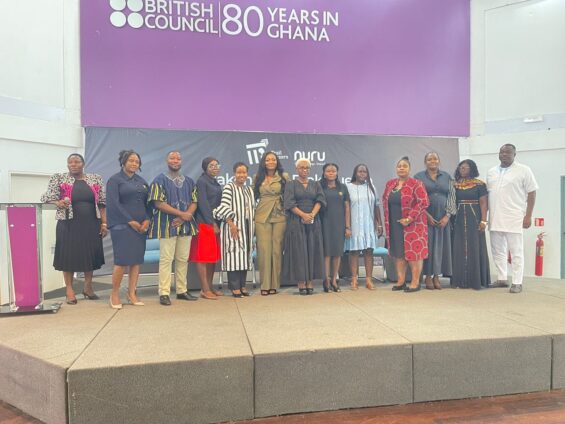
The dialogue, held under the theme “From Awareness to Action: Building a Safe Community,” brought together representatives from government agencies, civil society groups, religious leaders, health professionals, security services and community leaders to discuss strategies for strengthening responses to domestic violence.
Madam Osei-Bonsu described domestic violence as a persistent and often hidden challenge affecting individuals across all social backgrounds.
“Domestic violence remains one of the most pervasive yet often hidden challenges facing our society. It cuts across age, class, religion, and status,” she stated.
She stressed that behind reported figures are real victims enduring multiple forms of abuse.
“Behind closed doors, many endure physical harm, emotional trauma, psychological abuse, and economic deprivation. But beyond the statistics are real people — women, men, and children — whose voices are often silenced by fear, stigma, or lack of support,” she said.
Madam Osei-Bonsu underscored the urgency of collective action, declaring that silence and inaction must no longer be tolerated.
“Today, we say clearly: Silence must be broken. Systems must respond. Communities must act,” she stated.
According to her, communities themselves hold a critical role in preventing and responding to domestic violence, rather than remaining passive observers.
“At the heart of this dialogue is a powerful truth: Communities are not just witnesses to domestic violence — they are key to ending it,” she said.
She explained that informed and empowered communities can become agents of change.
“When communities are informed, they become protective. When communities are engaged, they become responsive. When communities are empowered, they become transformative,” she noted.
Highlighting the importance of collaboration, Madam Osei-Bonsu stated that no single institution could effectively tackle domestic violence in isolation.
“That is why I insist that no single institution can address domestic violence alone,” she said, adding that multiple stakeholders must work together.
She emphasised the need for law enforcement agencies to ensure justice, health professionals to provide care, social services to support recovery, faith leaders to offer guidance, policymakers to create protective frameworks, and community members to speak out.
Madam Osei-Bonsu further urged stakeholders to prioritise practical support systems for victims rather than limiting efforts to awareness campaigns.
“While doing this, we must move beyond awareness to actionable support where victims have safe spaces, access to counselling, legal protection, and economic empowerment,” she stated.
She also emphasised the importance of reassuring survivors that they are not alone.
“But above all, they need to know; they are not alone. They are not to blame. And they can rebuild,” she added.
Encouraging reflection among participants, she posed key questions aimed at strengthening institutional and individual responses to domestic violence.
“What role can I play in preventing domestic violence? How can my institution strengthen its response? What partnerships can we build to ensure no victim falls through the cracks?” she asked.
Madam Osei-Bonsu concluded by stressing that empowering communities to understand and respond to domestic violence is both a social duty and a moral obligation.
“In closing, I want to emphasise that empowering communities to understand and respond to domestic violence is not just a social responsibility, it is a moral imperative,” she said.
She expressed optimism that sustained education, advocacy and collaboration could help build safer communities where justice is accessible and dignity is protected.
“Together, through education, advocacy, and collaboration, we can build communities where safety is guaranteed, justice is accessible, and every individual can live with dignity and peace,” she concluded.
Latest Stories
-
OSP secures approval to serve Ofori-Atta, Akore with SML case summons in US
2 minutes -
Ghana must leverage AfCFTA to unlock climate finance, green technology – Zanetor
3 minutes -
Surprise at vetting as Mahama Ayariga reveals Sunyani West MP is his wife
8 minutes -
Ministers have no business meddling in chieftaincy disputes – Ayariga
8 minutes -
Bawku peace talks showing encouraging signs – National Peace Council
17 minutes -
Anger in Cameroon over femicide after eight women killed in a week
17 minutes -
‘If you started running, they shot you’ – inside Nigeria’s growing kidnapping crisis
18 minutes -
Fire destroys about 300 wooden structures at Asawase
18 minutes -
NRSA calls for urgent action on road infrastructure deficiencies
33 minutes -
Accra International Airport project funded without direct government financing – Mahama
33 minutes -
NDC promised 24-hour economy but cannot deliver 1-hour economy — John Boadu
44 minutes -
‘I can’t take any game for granted’ – Gideon Mensah says ahead of Bundesliga debut
45 minutes -
A look at the ‘Okada’ architecture under the new road traffic regulations, 2026 (L.I. 2519)
50 minutes -
Wontumi’s GH¢30m EXIM Bank case heads to trial as plea bargain talks collapse
58 minutes -
John Boadu is NPP’s ‘only guarantee’ for 2028 victory – Former Effia MP, Joseph Cudjoe
1 hour