

Audio By Carbonatix
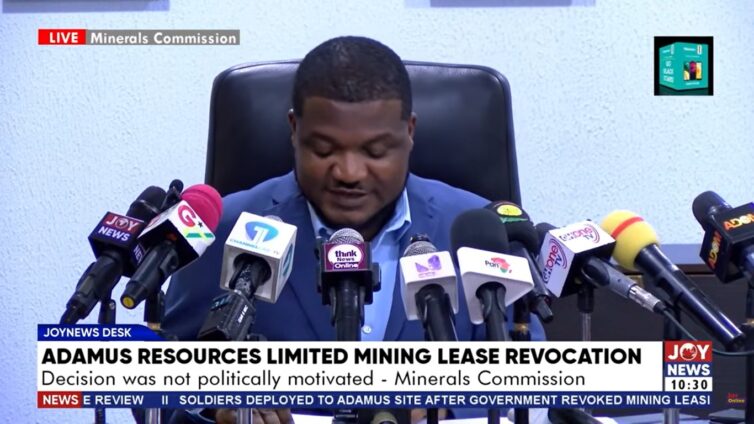
The Minerals Commission has strongly defended the revocation of the mining lease of Adamus Resources Limited, insisting that the decision was taken in the national interest following what it describes as “systemic and flagrant violations” of Ghana’s mining laws.
The Commission maintains that the company engaged in unlawful mining activities, including the unauthorised assignment of parts of its concession and operations carried out without the necessary regulatory approvals. It has further indicated that the company could face prosecution if found culpable.
Speaking at a press briefing in Accra, the Chief Executive Officer of the Minerals Commission, Isaac Tandoh, stressed that the decision was grounded in law and evidence gathered during investigations.
“This decision was neither arbitrarily nor politically motivated. It was a lawful evidence-based action taken to protect Ghana's natural resources, environment, and public interest,” he said.
Mr Tandoh disclosed that the Commission would collaborate with the Attorney General to pursue legal action where necessary, adding, “The Commission will work with the Attorney General to prosecute these perpetrators.”
According to the Commission, investigations uncovered multiple breaches that left regulators with no option but to halt the company’s operations.
The development follows the Minister for Lands and Natural Resources’ decision to revoke the Akango, Salman and Nkroful mining leases previously held by Adamus Resources Limited. A statement issued on Sunday, April 26, said the move was based on findings from the Minerals Commission, which identified several instances of illegal and unauthorised mining activities.
READ ALSO: Government revokes Adamus Resources Limited’s mining leases for illegal activities
The Minister’s directive and the Commission’s enforcement action form part of broader efforts to tighten regulatory oversight of Ghana’s mining sector, particularly in response to persistent concerns over illegal mining activities and environmental degradation.
In recent years, Ghana has intensified its crackdown on unauthorised mining operations—commonly referred to as galamsey—due to their impact on water bodies, forest reserves and local livelihoods. Authorities have repeatedly pledged stronger enforcement of mining laws to ensure responsible resource extraction and protect the environment.
The latest revocation is expected to add to the ongoing national debate over compliance in the extractive sector and the balance between investment and environmental protection.
Latest Stories
-
US military families ride ‘roller coaster of emotions’ over six months of Iran war
21 minutes -
One dead, several injured, in Swiss shooting incident, police say
24 minutes -
Philip Nai: Ghana’s creative industry needs structure, not just talent
29 minutes -
Manhunt after woman, 22, killed and five injured in Swiss shooting
31 minutes -
Rescuers race to find thousands missing after Nepal-China glacier collapse
33 minutes -
Iceland on track to reject EU referendum as counting nears end
33 minutes -
KNUST AI Coordinator urges structured adoption of AI in teacher education
45 minutes -
West African researchers work to turn Lassa fever research into policy evidence
54 minutes -
Guinea-Bissau receives €1.5m in laboratory equipment to strengthen disease detection
56 minutes -
JoySports Invitational 2026: Corporate Ghana raises the bar as latest edition records huge success
2 hours -
Chief of Staff calls for strong government-church partnership to tackle national challenges
3 hours -
The $80m IMF FX intervention cap that broke the cedi, and the gold policy that fixed it
3 hours -
New four-year Treasury Bond opens for bids September 1
3 hours -
Ketu South residents to demonstrate against ECG on 1st September
3 hours -
Fallen live electricity cable kills over 10 cattle in Krachu East
4 hours