

Audio By Carbonatix
The Central Regional Department of Gender has called for amendments to existing legislation or the enactment of a comprehensive law to effectively address technology-facilitated gender-based violence (TFGBV) in Ghana.
It said although laws such as the Cybersecurity Act, 2020 (Act 1038), the Data Protection Act, 2012 (Act 843), the Domestic Violence Act, 2007 (Act 732), and the Electronic Communications Act, 2008 (Act 775) provided some safeguards, their provisions did not adequately address emerging TFGBV issues.
Madam Richlove Amamoo, Acting Central Regional Director of the Department of Gender, who made the call, expressed concern about the emotional trauma many Ghanaian women – including professionals, students, and community leaders – were experiencing as a result of deepfake videos, synthetic sexual images, and online impersonation.
She stressed the need for a participatory, cross-sectoral approach to close existing legal gaps, saying any new legislative framework must reflect Ghana’s constitutional values and social context to ensure offenders were adequately punished.
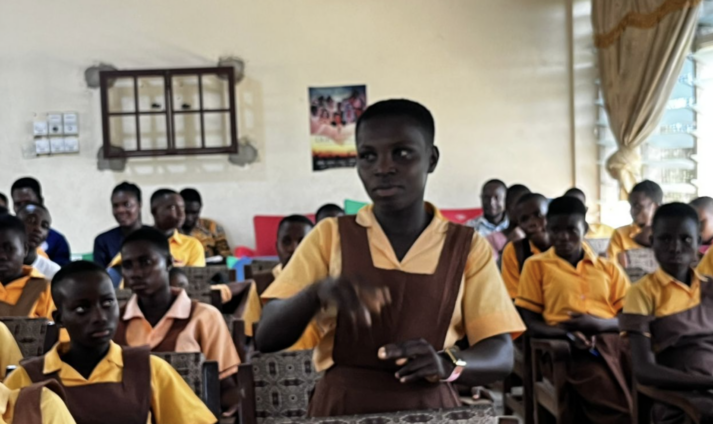
Madam Amamoo was speaking at an educational engagement for students of the Cape Coast School for the Deaf to raise awareness about TFGBV and help curb violence perpetuated against children, particularly vulnerable groups.
The programme was organised by the Central Regional Department of Gender in collaboration with the Central Regional Coordinating Council, with funding support from the United Nations Population Fund (UNFPA).
The students were educated on emerging tactics used by perpetrators to lure children into non-consensual sexual activities, which often had long-term effects on victims’ lives and development.
Madam Amamoo noted that deepfake and image-based sexual abuse, as well as doxing, had severe psychological, social, and economic consequences, particularly for women and children.
She explained that deepfakes involved the creation, manipulation, and dissemination of sexually explicit images or videos by superimposing an individual’s face onto another person’s body using artificial intelligence, adding that about 98 per cent of such abuses targeted women.
Touching on doxing, she said it involved the intentional release of a person’s private information online without consent, often leading to harassment and abuse.
“This can result in reputational, emotional, and economic damage, which is often irreversible, unfortunately, our current legal framework does not adequately address these emerging harms,” she said.
Madam Amamoo urged the students to be confident, assertive, and bold in resisting all forms of violence and called on authorities to identify and prosecute perpetrators while protecting victims to prevent stigma and social repercussions.
Mr Allan Paintsil, UNFPA Regional Focal Person, called for a united front in tackling domestic and gender-based violence, urging communities to move beyond awareness to decisive action to create safer and more supportive environments.
He explained that “action” included reporting abuse, helping victims access legal and psychosocial services, intervening safely when signs of abuse were identified, and creating safe spaces where victims could speak without fear of stigma or retaliation.
Assistant Superintendent of Police (ASP) John Asare-Bediako, Central Regional Director of the Domestic Violence and Victim Support Unit (DOVVSU), said domestic abuse cut across all social classes, genders, and backgrounds.
He urged victims and witnesses to seek help at the earliest signs of danger, emphasizing that no one was immune to abuse.
“Abuse does not know class, gender or status. Anyone can be a victim, and it is important that people speak up and seek help when they sense danger,” he stated.
ASP Asare-Bediako also advised society to promote openness and honesty in relationships and warned against glorifying marriage at the expense of personal safety and well-being.
The programme brought together representatives from the Ghana Health Service, the National Youth Authority, the Judicial Service, and the Legal Aid Commission.
Latest Stories
-
Meko Bono 2026: Vice President pledges agricultural revival as Atebubu hosts grand homecoming
42 minutes -
Russian skydiver Sergey Boytcov sets world record with 11,551-metre stratosphere jump
46 minutes -
Ablakwa-led committee submits five reports to Mahama ahead of 2027 AU chairmanship
52 minutes -
Africa not seeking Western cash in reparations campaign – Ablakwa
1 hour -
Production decline, reserve depletion threaten Ghana’s upstream sector – Jinapor
1 hour -
Surveyors caution against treating compensation disputes as professional misconduct
1 hour -
Mahama calls for AU dialogue on migration after South Africa xenophobic tensions
1 hour -
I haven’t experienced any envy in the gospel music industry — Ohemaa Mercy
3 hours -
Prayer does not solve everything — Ohemaa Mercy
3 hours -
New PURC office symbolises stronger consumer protection – Dr Jinapor
3 hours -
Rev. Wengam re-elected Assemblies of God, Ghana General Superintendent
3 hours -
Less than 20km of clearing left to connect Accra-Kumasi Expressway to Kumasi – Agbodza
4 hours -
US judge strikes down policy suspending immigrant visa processing for 75 nations
4 hours -
MCEs collecting fees from galamseyers are facilitating illegality – Ken Ashigbey
4 hours -
Developer LMI Holdings commits to completing first 700 Saglemi housing units
4 hours