

Audio By Carbonatix
The European Union (EU) says its long-standing relationship with Ghana is shifting from a donor-recipient model to a more balanced partnership focused on reliability, stability, and shared interests in a changing global order.
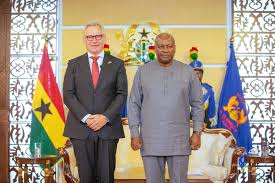
Speaking at a partnership dialogue in Accra, EU Ambassador to Ghana, Rune Skinnebach, said the bloc is repositioning itself after decades of engagement to reflect new global realities and Ghana’s evolving role.
“We may not be the fastest partner, but we are the most reliable,” he stated, underscoring the EU’s emphasis on consistency amid increasing geopolitical uncertainty.
The remarks come as the European Union marks nearly 50 years of diplomatic and development cooperation with Ghana — a relationship that began in the post-independence era, largely centred on aid and technical assistance.
Over time, that engagement has broadened significantly. Trade agreements, governance reforms, infrastructure investment, and private sector collaboration have become central pillars, reflecting a shift from one-directional support to a more complex, interdependent partnership.
Mr Skinnebach noted that in today’s global environment — shaped by conflicts such as the Russia-Ukraine war and the emergence of competing geopolitical blocs — stability has become a key currency in international relations.
He said the EU’s approach is to position itself not just as a development partner, but as a predictable and steady ally.
The EU also reaffirmed its commitment to sustainable development under the global partnerships agenda led by Jutta Urpilainen.
“We do not engage in unsustainable projects, and we do not stop our development support,” the Commissioner said, highlighting the bloc’s focus on long-term impact rather than short-term gains.
For Ghana, analysts say this evolving partnership presents both opportunities and questions. As global alliances shift, the country must navigate how to balance relationships with major partners while ensuring development cooperation remains mutually beneficial and aligned with national priorities.
With nearly five decades of engagement behind them, both Ghana and the EU appear to be entering a new phase — one defined less by aid flows and more by shared direction in an increasingly uncertain world.
Latest Stories
-
Taxpayers’ money should not fund National Cathedral; Christians can contribute towards it – Mahama
29 seconds -
U.S. Embassy launches Girls’ soccer initiative in Ghana to build leaders on and off the pitch
5 minutes -
HIDAH Foundation equips youth with future-ready skills at free 2-day development programme
10 minutes -
Mahama: 24-Hour Markets will boost economic activity across districts
11 minutes -
Ablakwa celebrates PRESEC’s 9th NSMQ triumph, rewards contestants, staff with MacBooks and cash
24 minutes -
Free Primary Healthcare targets most deprived districts – GHS Director General
30 minutes -
Gov’t unveils ambitious cut-flower export corridor from from Daboya to Europe, West Africa and Gulf
40 minutes -
‘Life Is Short’ gospel music hitmaker Bernice Offei dies at 63
1 hour -
Ghana’s economy has moved from standing on broomsticks to concrete pillars – Mahama
1 hour -
Systemic vulnerabilities within banking industry remain broadly subdued- BoG
1 hour -
Ghana, Côte d’Ivoire’s export sectors face heightened risks due to El l Niño – Fitch Solutions
2 hours -
Norway’s Princess Astrid dies two days after attending brother King Harald’s funeral
2 hours -
NCA awards 700MHz spectrum to MTN Ghana for US$109.9m
2 hours -
Saudi Arabia shuts key oil pipeline after drone attack launched from Iraq
2 hours -
Passenger train derails in France leaving at least 44 injured
2 hours