


Audio By Carbonatix
For many businesses in Ghana, climate change does not show up as an abstract global crisis. It shows up as delayed inputs, rising energy costs, flooded premises, unstable supply chains, and growing pressure from regulators, financiers, and customers to “do better” on sustainability. These are operational realities. Yet for a large part of the private sector, especially small and medium enterprises, women-led businesses, and youth-driven ventures, the tools to respond strategically to these pressures remain limited.
This gap between climate exposure and business readiness is where the Integrating Climate Action into Commercial Enterprises (ICACE Project) situates its work. Rather than treating climate action as a compliance exercise or a branding add-on, ICACE approaches sustainability as a core business function, one that influences risk management, access to finance, competitiveness, and long-term growth within Ghana’s commercial landscape.
At its core, ICACE recognises that the private sector, particularly small and medium enterprises, women-led businesses, and youth-driven ventures, sits at the frontline of climate vulnerability. These enterprises form the backbone of Ghana’s economy, yet they often lack the technical knowledge, institutional support, and access to finance required to respond effectively to climate-related risks. ICACE responds to this gap by embedding climate action and Environmental, Social, and Governance principles directly into the way businesses operate, plan, and grow.
One of the project’s most critical contributions is its emphasis on evidence-based decision-making. Rather than assuming what businesses need, ICACE prioritises rigorous scoping, needs assessments, and stakeholder consultations to understand real barriers and opportunities within Ghana’s commercial ecosystem. This approach ensures that climate and ESG strategies are not imported frameworks detached from local realities, but practical tools shaped by the lived experiences of Ghanaian businesses across sectors.
PILLARS OF ESG
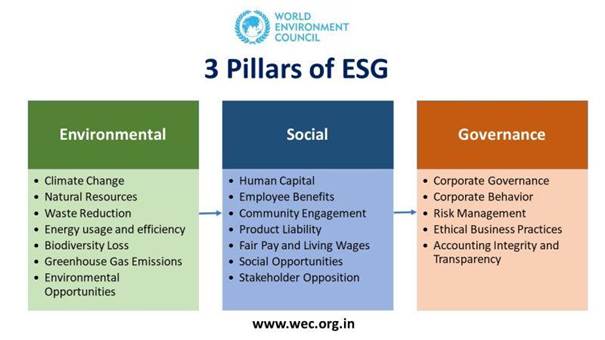
Source: World Environment Council
Capacity building sits at the centre of ICACE’s strategy. By strengthening both internal and external capacity of institutions and stakeholders across the value chain with practical knowledge on climate risk management, ESG compliance, and sustainable finance, the project lays the foundation for long-term transformation. Training workshops, policy guidelines, sector-specific toolkits, and knowledge-sharing platforms are designed to move sustainability from abstract conversations into everyday business decisions. In doing so, ICACE helps businesses anticipate risks, meet emerging regulatory expectations, and position themselves more competitively in both local and international markets.
Source: Forbes.com
Equally important is ICACE’s focus on inclusion and leadership. Women-led and youth-driven enterprises are not treated as passive beneficiaries but as active drivers of climate innovation. By providing tailored tools, visibility, and access to funding opportunities, the project supports these groups to lead climate-responsive initiatives that enhance their market relevance and resilience. This inclusive approach reflects a broader understanding that sustainable economic transformation must be equitable if it is to be effective.
ICACE also recognises that individual business action is not enough. Meaningful climate progress requires coordinated advocacy and collaboration across the private sector, government, financial institutions, and civil society. Through high-level dialogues and strategic communications, the project elevates the role of businesses in national climate conversations, aligning private sector action with Ghana’s broader development and climate goals. This advocacy dimension ensures that sustainability becomes embedded not only in business practices but also in policy frameworks and investment priorities.
Ultimately, the value of ICACE lies in its ability to translate climate ambition into commercial reality. By integrating climate action and ESG principles into the heart of business strategy, the project demonstrates that sustainability and profitability are not competing objectives, but mutually reinforcing ones. With Ghana navigating an increasingly complex climate and economic landscape, initiatives like ICACE offer a clear pathway for businesses to remain resilient, responsible, and ready for the future.
The ICACE project is led by Climate and Development Knowledge Network (CDKN) Ghana, in partnership with the Ghana National Chamber of Commerce and Industry (GNCCI), with funding from International Development Research Centre (IDRC), and seeks to translate global climate and ESG insights into practical tools for Ghanaian businesses.
********
Written by: CDKN ICACE Team - Hilda Aku Asiedu and Bismark Tabi Amponsah
Latest Stories
-
England have another level we can reach – Kane
4 hours -
Sinner holds off Zverev to defend Wimbledon title
4 hours -
Rice in bed for nearly three days before Norway game – Tuchel
5 hours -
Argentina midfield great Rattin dies aged 89
5 hours -
Miss Ghana 2026 contestants join national clean-up exercise to promote civic responsibility
5 hours -
Fifa official refuses to answer BBC’s Balogun ban questions
5 hours -
Rev Stephen Wengam urges sustained prayer for revival at Guyana Assemblies of God Council
5 hours -
Senegal sack manager Pape Thiaw in wake of World Cup exit
5 hours -
LCB Worldwide Ghana partners GHS for major fumigation exercise in Accra
6 hours -
Fourth-Time Candidate Eugene Danquah Ofori-Appiah wins Atwima Nwabiagya South NPP Chairmanship
7 hours -
ASEC2026: Push for African-led security solutions through innovation and inclusion – Major General Kotia
7 hours -
NPP alleges arrest of Dennis Miracles Aboagye by EOCO, demands his immediate release
8 hours -
T-bills auction: Government exceeds target by 77%; but to pay more for one-year bill at maturity
8 hours -
A competent government leads with systems, not brooms
9 hours -
Mahama directs activation of Zoomlion transfer stations to improve waste collection after floods
10 hours