

Audio By Carbonatix
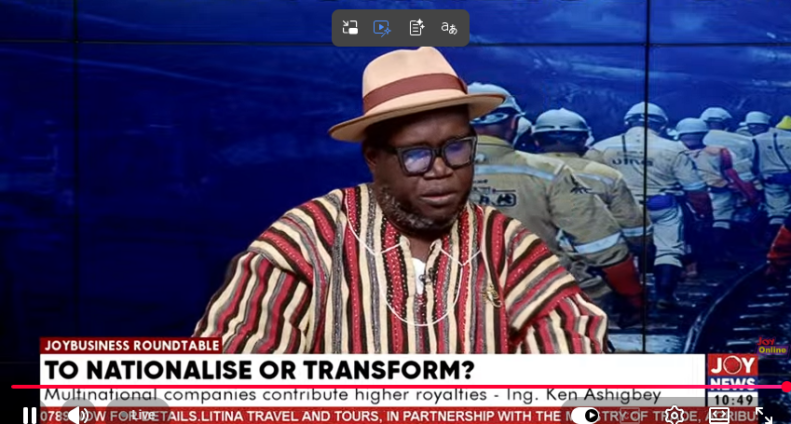
The Chief Executive Officer of the Ghana Chamber of Mines, Ken Ashigbey, has raised concerns about Ghana’s mining revenue structure, revealing that multinational mining companies contribute a higher share of royalties despite accounting for a smaller portion of the country’s total gold production.
Speaking on the JoyBusiness RoundTable, Mr Ashigbey said companies with majority ownership from the United States accounted for 12 per cent of Ghana’s production in 2025 but contributed 23 per cent in royalties.
“Companies whose majority ownership comes from the US contributed 12% of Ghana’s production but paid 23% in royalties,” he stated.
He further noted that Chinese-owned firms produced 10 per cent of total output and also contributed 23 per cent in royalties, while South African companies accounted for 18 per cent of production but paid 37 per cent in royalties.
“South African firms contributed 18% of production, yet they paid 37% in royalties,” he added.
According to him, Canadian and Australian companies contributed 2 per cent and 3 per cent of production, respectively, while each paid 5 per cent in royalties.
In contrast, Ghanaian-owned large-scale mining companies accounted for just 4 per cent of production, with the broader local sector contributing 7 per cent.
Mr Ashigbey argued that the figures point to an imbalance in Ghana’s mining economy, where multinational firms contribute less to overall output but bear a larger share of royalty payments.
“The small-scale sector contributed 52% of production but paid virtually nothing in royalties,” he said.
He maintained that Ghana’s mining revenue system is not delivering optimal value to the state and host communities and requires reform.
Mr Ashigbey further stressed the need to rethink how mining revenues are distributed, noting that most mineral royalties currently flow into the Consolidated Fund rather than directly supporting mining communities.
“Only 8% of mineral royalties are disbursed into mining areas, and that has to change if we want to see development,” he stated.
He also outlined the current distribution structure, explaining that 78 per cent of royalties go into the Consolidated Fund, 2 per cent goes to the Minerals Income Investment Fund (MIIF), while the remaining 20 per cent is shared among various state institutions and beneficiaries.
Mr Ashigbey expressed concern that too much revenue remains centralised in Accra, leaving mining communities with limited direct benefits for local development projects.
He also highlighted the broader tax contributions of large-scale mining firms, noting that despite public criticism, multinational companies remain significant contributors to government revenue through taxes and royalties.
He therefore called for a national conversation on how Ghana can maximise benefits from its mineral resources while ensuring more equitable development for mining communities.
Latest Stories
-
DCOP Rtr Kwaku Ayesu Opare-Addo
12 seconds -
Epiroc urges businesses to deepen support for education in mining communities
5 minutes -
Jay-Z rape accuser says her allegation was false
5 minutes -
KNUST SHS, OWASS, YAGSS progress to national stage of Public Speaking Competition
9 minutes -
10 rooms destroyed in Bebianiha house fire
12 minutes -
Government repatriates 180 Ghanaians from Libya
16 minutes -
GNAT demands independent probe into death of teacher at Gindabour
17 minutes -
Mark Carney says he has considered possibility of US military action against Canada
18 minutes -
Gindabour: GNAT demands GES statement on death of teacher
18 minutes -
6th Western Gospel Awards unveils nominees ahead of November ceremony
19 minutes -
GMTF, GNPC open talks on stronger support for specialised healthcare
21 minutes -
Adu-Boahene case: Atta Akyea files no-case submission, cites evidential gaps, inconsistencies and failure to call material witnesses
39 minutes -
Manchester City ‘found guilty of majority of 115 charges’
47 minutes -
From abandoned ruins to model residence: How Techiman North DCE fulfilled 9-month promise
50 minutes -
Francis Spio Jungo appointed to FanteFest 2026 planning committee
53 minutes