

Audio By Carbonatix
Teenage pregnancy remains a significant public health and socioeconomic challenge in Ghana.
The Bosomtwe District in the Ashanti Region recorded some of the highest adolescent pregnancy rates in 2024, according to data from the Ghana Health Service.
Rural and semi-urban communities across the district, including Pipie, Nkowi, Obbo, Abono, Tetrefu, and Sewua, were identified as hotspots with historically high school dropout rates that disproportionately affected school-going girls.
The surge in cases prompted major local interventions to combat this trend and protect girls in the area.
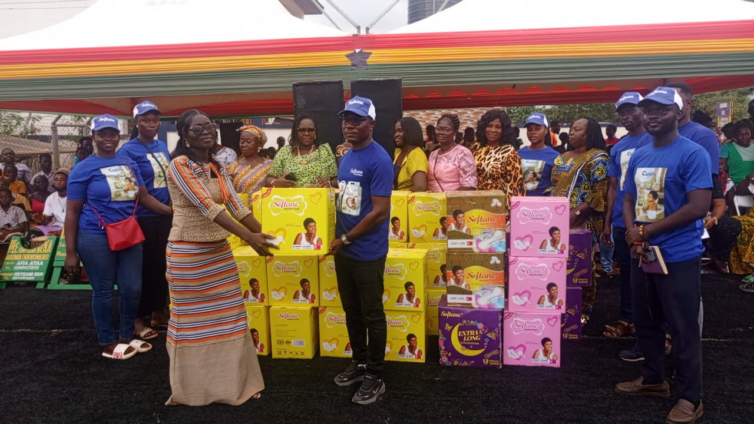
In response, the district authorities and local stakeholders have adopted Pad Bank initiatives.
Speaking during the celebration of World Menstrual Hygiene Day held at Sewua, the Bosomtwe District School Girl Child Coordinator, Rita Laar, revealed that teenage pregnancy figures for 2026 have declined considerably compared to previous years.
She attributed the improvement to the Pad Bank initiative and the government’s free distribution of sanitary pads in schools.
Rita Laar explained that many young girls previously struggled to access sanitary pads during menstruation due to financial difficulties.
"When I became the school Girl Child Coordinator, investigations by the district education directorate and other stakeholders found that some teenage girls were trading sexual favours with boys in their communities for sanitary pads. A situation that exposed many of them to teenage pregnancy and school dropout," she said.
She said this spurred the district assembly and the chief of Sewua to launch the Pad Bank initiative, seeking support from NGOs and philanthropists to provide free sanitary pads to vulnerable schoolgirls who cannot afford them.
Rita Laar said the initiative has eased a major burden for girls, enabling them to attend school confidently during menstruation and reducing their reliance on parents and boys for sanitary products.
Although World Menstrual Hygiene Day 2026 will be observed globally on May 28, the Bosomtwe district marked the occasion on May 22 to spotlight efforts against teenage pregnancy and to promote menstrual hygiene, with a particular focus on hotspot communities.
According to her, the celebration of the Menstrual Hygiene Day served as an opportunity to educate young girls on menstrual hygiene management, self-confidence, and the importance of staying focused on their education.
Nana Akosua Abrafi Afisa, Queen Mother of Sewua, cautioned teenage girls against early sexual activity and urged them to focus on their education and future aspirations.
She emphasised that prioritising their studies and long-term goals would give them the foundation needed to secure a better future for themselves and their communities.
The District Chief Executive for Bosomtwe, Abdellah Hamid, reaffirmed government’s commitment to supporting the welfare and education of the girl child.
He said government remains determined to continue distributing free sanitary pads to school girls across the district to promote menstrual hygiene, protect the dignity of young girls, and help reduce teenage pregnancy.
The Ashanti Region frequently records some of the highest absolute numbers of teenage pregnancies in Ghana, often reporting tens of thousands of cases annually, with the national average exceeding 100,000 cases a year.
The annual global Menstrual Hygiene Day aims to break the stigma surrounding periods, promote proper menstrual health education, and advocate for access to safe, affordable sanitary products for all.
To achieve this year’s theme, #PeriodFriendlyWorld, the 2026 movement emphasises several critical areas of action: breaking the silence, access and infrastructure, and education.
The Bosomtwe District Assembly, in collaboration with the Ghana Health Service at Kuntenase and DOVVSU, regularly organises community and school durbars to educate students on child rights, sexual health, and pregnancy prevention.
The District Assembly, traditional leaders, philanthropists, and NGOs frequently run empowerment and vocational training programs for Junior High School (JHS) graduates in the district to keep girls economically independent and reduce their vulnerability after schooling.
Latest Stories
-
Companies that delay AI adoption risk losing market opportunities – ALX Enterprise
8 minutes -
‘The future is bright’ – Gyan backs Black Princesses squad after U-20 World Cup exit
13 minutes -
We should treat AI has an opportunity rather than a threat – ALX Enterprise
22 minutes -
Malta and Ghana set sights on practical AI partnership
25 minutes -
2026 U-20 WWC: ‘Not all wishes come true’ – Gyan inspires Black Princesses after elimination
30 minutes -
‘I am not a magician’ – Zdravko Logarušić on Nations FC exit from Africa
43 minutes -
Three nights. 28 titles. Ultimate history made
54 minutes -
Ghanaian delegates at IYF 2026 could become bridges for stronger Russia ties – John Aggrey
58 minutes -
Nigeria: Over 30 dead, 50 hospitalised after consuming alcoholic substance in Ondo State
1 hour -
UK lawmakers demand new law to address AI threat to human rights
1 hour -
WAFU B U-17 Girls Cup: Black Maidens depart Accra for tournament in Yamoussokro
1 hour -
Sweden’s center-left bloc narrowly ahead as election remains too close to call
1 hour -
GPL 2026/27: ‘We won ugly’ – Kotoko head coach unimpressed after Lions victory
1 hour -
7 out of 10 human trafficking cases in Ghana never reach prosecution — JoyNews Research
2 hours -
Music, football to converge at Music Meets Football Summit 2026 in Lusaka
2 hours