

Audio By Carbonatix
Asantewaa is a resident of Elubo in the western region of Ghana. Night falls, and she prepares not to sleep but to work.
By day, she sells food by the roadside, Indomie, fried rice, Jollof and many more, serving travellers moving between Ghana and the Ivory Coast. Drivers stop. Traders sell with ease. Faces are visible, and business flows steadily.
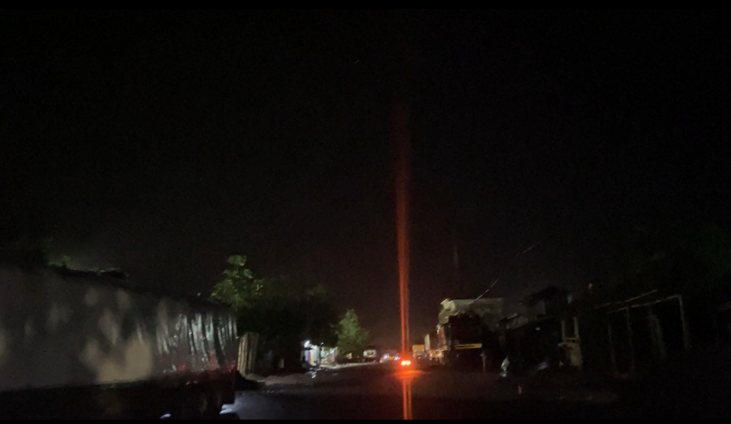
At night, her small lights are turned on. They light her stall, her hands and the few customers who step close, but the light does not travel far. It is at this point that the road disappears from one’s sight.
There are no streetlights, and the town fades quickly into darkness, and movement becomes something you sense before you see. Customers arrive as shadows. Asantewaa listens first to footsteps and low voices before they step into her light. Business goes on, but at a different pace. Slower, more cautious and brief conversations.
A few metres away, the border becomes inactive and barely visible. People move. Vehicles, particularly the tricycle popularly known as ‘Pragya’, move through the town, but in the dark, things are hard to see.
Asantewaa does not close. She stays, working from her small island of light, while the streets of Elubo sink into darkness. Here in Elubo, the night does not stop business; it only makes everything uncertain and risky.
A Border Town In Darkness
Elubo is a major border town in Ghana’s Western Region, located within the Jomoro Municipal District along the boundary between Ghana and the Ivory Coast. The town has a settlement population of 23,952 people according to the 2021 census.
The town has operated for years without streetlights, and in a few areas, the existing ones are non-functional. The only source of light, though limited, comes from residents’ homes, leaving most streets in total darkness. Even at Ghana’s border post, darkness stretches across the town. Houses without electricity are left with no choice but to live in complete darkness. This is not a new situation; it has long been the reality in this border town near the Ivory Coast.
Field observations reveal a consistent pattern:
- A significant proportion of public streetlights in Elubo are non-functional or absent.
- Night-time commercial activity drops sharply due to insecurity and poor visibility.
- Border enforcement personnel operate under severely constrained visibility conditions, particularly between 7:00 pm and 6:00 am.
- Informal cross-border movement increases during night hours when surveillance capacity is weakest.
Voices from Elubo: Residents Speak
Kwame Amponsah, a motor rider and resident of Elubo, explains, “For the past 25 years I have lived in this town, I have never seen working streetlights. Look at Côte d’Ivoire,” he says, pointing toward the border. “Look at how Noe, the next town, has light. The government only fixed the streetlights on the bridge to Noe and left us in darkness. The government has neglected the people of Elubo.”
He is not the only one who believes the government has neglected them for a long time. Many residents feel abandoned and as though they are not part of Ghana at all.
Regina, a vendor at the Elubo station, also confirms that there are no streetlights. The term “streetlight” is unfamiliar to her because the only lights she knows are those at home. Like Asantewaa, her light only lights up her stall, her hands and the few customers nearby, but it does not reach far.
When Darkness Becomes a Security Risk
When a border town like Elubo is deprived of streetlights, it is not just a problem with infrastructure; it is a serious security risk. The continued lack of streetlights in Elubo, a major border town, brings attention to an important but often ignored aspect of national security: Reliable Energy in Strategic Areas.
For years now, the absence of functional street lighting has reshaped the operational environment of this border town in ways that demand urgent attention.
Elubo’s situation is not unique, but it is worse compared to many other places.
Research by the Organisation for Economic Co-operation and Development (OECD) and other border governance studies indicates that improved infrastructure, stronger state visibility, and enhanced border management in frontier communities often contribute to better security outcomes, increased intelligence gathering, and reduced smuggling and trafficking activities. This means Elubo is behind in meeting normal regional standards for managing border areas.
From a security standpoint, effective border security depends on three factors: Visibility, Presence and Control. Darkness weakens all three. What do I mean?
According to the European Union’s Schengen Borders Code, the core purpose of border surveillance is to prevent unauthorised crossings, combat cross-border crime, and intercept individuals who bypass official border controls. The framework further emphasises that effective surveillance should discourage irregular movement outside approved entry points.
How achievable is this in Elubo, then?
Without lighting, security personnel and surveillance systems struggle to see movement clearly. Movement becomes harder to detect, which creates spaces where people, goods and sometimes vehicles can pass without being noticed at night. These blind spots make it easier for illegal activities to take place because there is less chance of being seen or stopped.
CCTV cameras are also affected by poor lighting. When visibility is low, the footage they capture is often unclear, making it difficult to identify faces, number plates or movements. This reduces the usefulness of cameras, even when they are installed.
Not all CCTV cameras perform equally well in low-light conditions. These include Infrared (IR) Night Vision Cameras, Thermal Cameras, Starlight Cameras and Low-Light/Colour Night Vision Cameras. For a border area like Elubo, where streetlights are absent, standard CCTV cameras may be ineffective at night. Patrols are not spared either. Officers tend to move more carefully in dark areas, which can slow them down and reduce how often they check certain places. In some cases, they may avoid poorly lit areas altogether, leaving those spaces even less monitored.
Security presence is not just physical; it also needs to be felt. When an area is bright, it sends a clear message that it is being watched and controlled. People are more careful in such places because they know they can be seen, and this alone can discourage wrongdoing.
In contrast, when a town is poorly lit, that sense of authority begins to fade. The psychological effect is just as important as the physical one. In dark spaces, individuals are more likely to feel that they can act without being seen or held accountable. This weakens the deterrent power of security presence.
Control depends on being able to monitor, verify and respond quickly. Darkness slows response time, makes coordination harder and allows illicit activities such as smuggling, illegal crossings, and movement of contraband to happen with a lower risk of detection.
Police officers in Elubo have reported an increase in smuggling and illegal crossings at night through unauthorised routes.
The security implications of darkness in Elubo follow a clear causal chain:
Poor lighting → Reduced surveillance capacity → Increased movement concealment → Expansion of illicit activity → Economic disruption → Decline in public trust → Weakening of state legitimacy
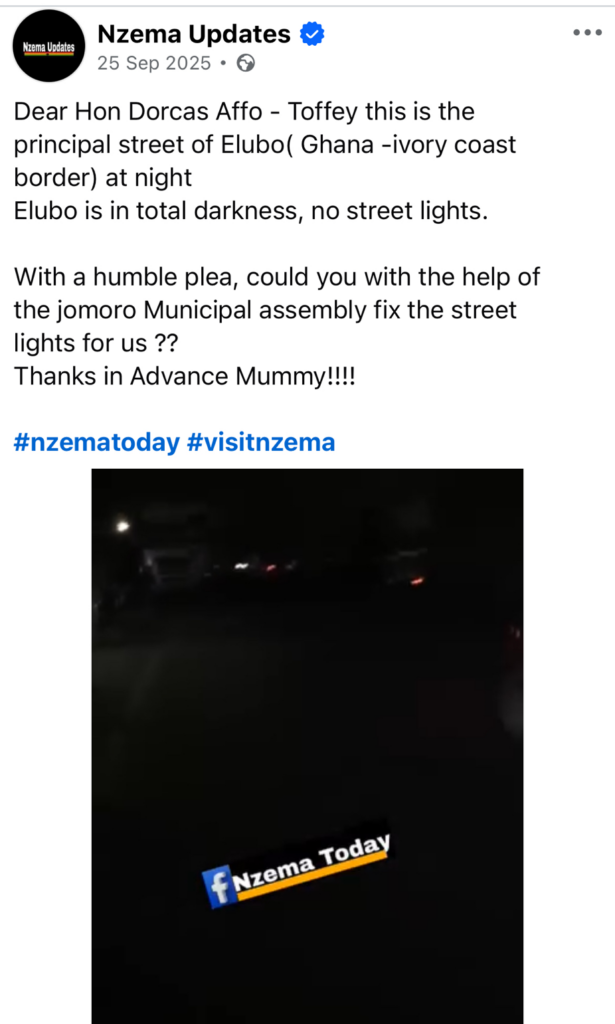
A 2025 public appeal by Nzema Updates captured the severity of the situation.
Addressed to the member of parliament, Dorcas Affo- Toffey, the post described Elubo's principal street as being in “total darkness" at night and pleaded for the restoration of street lights. The video attached to the post showed barely visible vehicle lights cutting through an unlit road near the Ghana-Côte d'Ivoire border, a scene residents say creates conditions that could easily be exploited by smugglers, criminals, or undocumented cross-border movements under the cover of darkness.
Governance, Trust and State Presence
Security threats do not always emerge from major incidents; they often build up gradually as control slowly breaks down over time.
Darkness in a border town like Elubo is more than just poor lighting. It is also a security and governance problem. It increases risks and disrupts business activities along an important trade route. When businesses cannot operate well, people lose income, and frustration grows in the community. This reduces trust in government and its ability to provide basic services over time. When that trust weakens, illegal activities begin to grow. What looks like a simple lack of infrastructure can become a bigger problem affecting security and stability.
It also has a deeper symbolic meaning. Border towns are not just transit points; they are representations of state presence. When infrastructure problems last for a long time in such areas, it can make people feel the government has neglected them or is not very capable. This can have serious effects. When the state seems absent, other groups, whether legal or illegal, often move in to take its place.
The situation shows a bigger problem: the weak coordination between infrastructure development and national security planning. Electricity supply, especially in important and high-risk areas, should be seen as a key part of security and not just a basic service.
Addressing this challenge requires more than fixing technical faults. It needs a coordinated response from the Electricity Company of Ghana (ECG), the Ministry of Energy, the National Security Secretariat, the Ghana Police Service (especially the Border Patrol Unit) and the Jomoro Municipal Assembly.
In the short term, the Assembly should install streetlights in key areas such as the border post, market zones, and main roads. The Ghana Police Service should increase night patrols to deter criminal activity, with support from National Security where necessary.
In the long term, the Ministry of Energy and ECG should invest in more resilient power infrastructure for border communities, while the Jomoro Municipal Assembly should integrate street lighting into urban planning. Regular coordination between security agencies and local authorities should also be established to ensure early warning and quick response to similar disruptions.
Elubo should not be left in the dark, not because of convenience, but because of what that darkness represents. Even something as simple as darkness can become a threat multiplier.
Latest Stories
-
Today marks the beginning of a glorious chapter of the NPP – Bawumia
31 seconds -
‘Justice has prevailed’ – Atta Akyea reacts to Baffour Awuah’s GH¢10m bail
19 minutes -
I’m above board, no dirt can stick on me – Baffour Awuah
25 minutes -
Prince Adu-Owusu: The things the heart sees
28 minutes -
Galamsey is a complex national challenge that deserves seriousness, not slogans – Bawumia
32 minutes -
Boyoyo: Is the new search for a Black Stars coach a faux pas or an own goal?
36 minutes -
We will not wait for campaign before preparing to govern – Bawumia
41 minutes -
Cost of living has risen massively despite lower inflation – Bawumia
45 minutes -
NDC struggling to fulfil many lofty 2024 promises – Bawumia
46 minutes -
Let us vote in peace and accept results in good faith – Bawumia to NPP
51 minutes -
Let’s hold govt accountable without fear of arrest and intimidation – Afenyo tells NPP, Minority
52 minutes -
A litany of failed promises – Bawumia highlights NDC’s “scam” promises to Ghanaians
53 minutes -
NPP shall prevail in 2028 – Afenyo-Markin rallies delegates
1 hour -
Baffour Awuah’s detention is about showing him where power lies after resisting EOCO’s ‘unlawful arrest’ – Oppong Nkrumah
1 hour -
NPP NEC elections – Bawumia sets the tone for post-election peace and unity for victory in 2028
1 hour