

Audio By Carbonatix
On the night of June 3, 2015, disaster struck the nation’s capital. A petrol station near the Kwame Nkrumah Interchange built metres from a floodplain, in a city with no enforced land-use plan exploded as floodwaters surrounded it. At least 150 people died.
Not from the rain, but from a fire that ignited because fuel infrastructure had been permitted to exist in the middle of a natural waterway. The images were apocalyptic. The national grief was genuine.
The political promises were swift and emphatic. Ghana, we were told, had learnt its lesson. It had not.
Since 1935, floods in Ghana have killed over 3,000 people, displaced more than 700,000, and erased a significant amount of money in property and livelihoods. That is not a record of a country fighting a natural disaster. That is the record of a country manufacturing one, year after year, through inaction, indifference, and institutional amnesia.
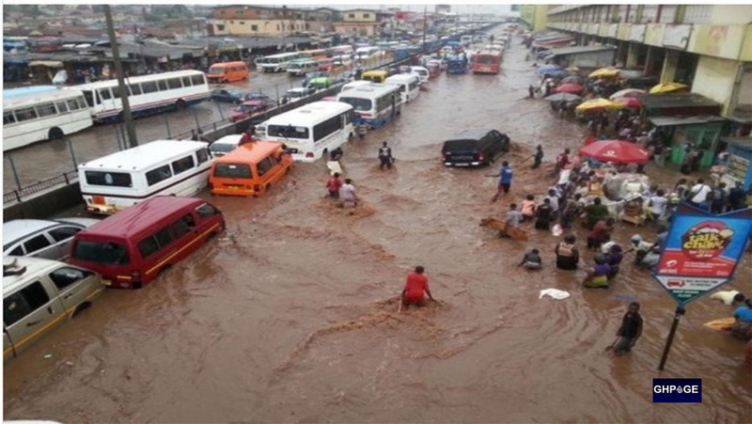
The pattern is now grimly familiar. The rains arrive. Nima, Kaneshie, Dansoman, Kasoa, Mallam Junction all go underwater. Eyewitnesses find clogged drains filled with plastic waste, household refuse, and debris not floodwaters, but the physical evidence of a society that treats its drainage systems as extended dustbins.
Emergency officials appear on television. NADMO officials speak with great urgency about relief operations. In May 2025, NADMO's own deputy director confessed publicly that the organisation did not have enough relief items to support flood victims a decade after June 3 was supposed to have changed everything.
In May 2025 alone, heavy rains killed 4 people and displaced more than 3,000 across Greater Accra, with flooding recorded in Weija, Kaneshie, Adabraka, Adentan, Oyarifa, and parts of Tema. Then, just months later, in March 2026, while Accra slept, the rains arrived again. By dawn, the same streets were underwater. The Ghana Meteorological Agency had warned us weeks earlier. We had been warned. We were not prepared.
The tragedy of Ghanaian flooding is not meteorological but political. The country has experienced catastrophic floods since 2016, every single year without exception and responded to each one with the same cycle of shock, mourning, committee-sitting, and forgetting.
Flooding in Ghana cannot be said to be solely a natural occurrence. It is largely a man-made disaster. Buildings continue to be erected on waterways and floodplains. Drains continue to be blocked by a waste management crisis no government has yet resolved. Urban planning enforcement remains a polite fiction.
June 3, 2015, should have been Ghana's reckoning. It was to be the moment the country's relationship with its own geography permanently changed. Instead, it has become an annual memorial, observed with candlelight and commentary, stripped of consequence. The same outrage returns every rainy season and lasts exactly until the water dries.
The question that haunts every flood season is a simple one: did we learn anything at all? The answer, written in floodwaters across the streets of Accra every single year since 2015, is just as simple.
Not yet.
What Must Change?
The case for despair is easy to make. The case for action is harder, but it is the only one worth making. Ghana is not condemned to drown. Other rapidly urbanising nations have broken the cycle. One third of Netherlands lies below sea level with the lowest point being 22ft (6.7m). What it requires is not sympathy but structural change, not candles at memorials but concrete in the right places. Here is where to begin.
Enforce the Land Use and Spatial Planning Act
Ghana passed the Land Use and Spatial Planning Act in 2016, one year after June 3. It has existed largely on paper ever since. Physical developments continue to be approved or constructed in waterways, floodplains, and buffer zones that no responsible city should permit. Enforcement is the single most critical intervention available, and it costs nothing to begin immediately.
Every structure built on a floodplain that is not demolished or relocated is a future catastrophe the government has pre-approved. District Assemblies, the Lands Commission, and the Ministry of Works and Housing must treat planning violations as the life-and-death matters they are.
Invest in Drainage Infrastructure as Basic National Security.
Ghana's drainage crisis is not a secret. Research across various studies consistently identifies poor and inadequate drainage facilities as one of the top causes of urban flooding in Ghana. Yet drainage budgets remain chronically underfunded relative to the scale of the problem. Accra's drainage network was built for a city of several hundred thousand people; the city now houses several million, with millions more in peri-urban areas whose runoff flows straight into the same channels. The national infrastructure conversation must shift: drainage is not a municipal/metropolitan housekeeping matter. It is national security infrastructure, and it must be funded accordingly.
Integrate Nature-Based Solutions into City Planning.
Engineering alone cannot solve what engineering and concrete partly caused. Sekondi-Takoradi's Metropolitan Assembly has proposed a hybrid infrastructure plan that integrates engineered drainage with nature-based interventions: wetland restoration, green corridors, and urban gardens which are gaining global recognition as cost-effective flood mitigation tools. Accra and other Ghanaian cities must move in the same direction. Wetlands are free infrastructure and not necessarily wasteland. Paving over them is a slow-building disaster with a known price tag.
Build a functional, community-embedded early warning system.
The Ghana Meteorological Agency warned of the March 2026 floods weeks hours in advance. The warning reached political analysts on social media before it reached vulnerable communities in Nima and Dansoman. An early warning system that does not reach the people at risk is a fragile warning system. UNESCO, in partnership with the Government of Ghana, launched a project in 2025 specifically to strengthen community-level resilience and early warning capacity, funded by Japan. Ghana must build on this foundation and invest in last-mile communication: community radio, text alerts in local languages, neighbourhood-level wardens who know who lives in which flood-prone house.
Reform Waste Management as Flood Policy.
Every drain blocked by a plastic sachet is a policy failure disguised as a litter problem. Ghana's flooding crisis and Ghana's waste management crisis are the same crisis. Any government serious about flood mitigation must treat them together not as separate line items managed by separate ministries with separate budgets that never speak to each other. Extended producer responsibility legislation, serious enforcement of waste disposal laws, and investment in collection infrastructure in low-income urban areas are not environmental gestures. They are flood prevention measures.
Make NADMO a Pre-Disaster Agency, not a Post-Disaster Apology.
It is a national embarrassment that in 2025, ten (10) years after June 3 NADMO publicly admitted it lacked enough relief items for flood victims. NADMO's mandate must be restructured around prevention and preparedness, not relief distribution. Its funding must be commensurate with the frequency and scale of Ghana's flood events. Its staff must include urban planners, hydrologists, and community organisers, not only logistics officers. An agency built primarily to hand out mattresses after catastrophe has already failed its most important function.
Make Politicians Legally Accountable for Flood-Prone Development Approvals.
No Ghanaian official has ever faced legal consequence for approving a building permit on a floodplain, for failing to dredge a clogged drain, or for allowing a disaster management agency to become chronically under-resourced. Until there are real consequences, not reassignments the political calculus will not change. Parliament should establish clear accountability mechanisms, including independent post-flood enquiries with the power to name and refer individuals, and a public registry of flood-zone development approvals.
The Choice Ghana Must Make
None of what is listed above is technically beyond Ghana's capacity. The knowledge exists. The legislation, in some cases, already exists. What has been absent is the political will to treat flooding as the civilisational threat it has become, rather than a seasonal news story to be managed and forgotten.
June 3, 2015, gave Ghana 150 reasons to change. Every flood since has added to that number. The names and the streets and the death tolls shift slightly each year, but the story is always the same: water finds the failures a city was too careless to fix, and the poorest people pay the price with their lives.
Ghana can keep holding candlelight vigils and promising to do better. Or it can do better. The rains are not waiting.
Latest Stories
-
Tiptoe Lane’s tech takeover: The story behind Ghana’s booming informal phone market
43 minutes -
Abanga vows to use social media to counter NDC messaging ahead of 2028 elections
45 minutes -
Okai Mintah seeks Sabah Zita Benson’s support for NDC National Youth Organiser bid
59 minutes -
Okai Mintah vows to strengthen NDC campaign machinery ahead of 2028
1 hour -
Mother of four and Jasikan teacher among new Telecel M’ahitti Promo winners
1 hour -
International Youth Shakers Conclave 2026 set to bring global young leaders to London
1 hour -
Gov’t is committed to addressing teachers’ conditions of service, deprived-area allowance – Education Minister
1 hour -
GoldBod’s structure encouraging galamsey – Afenyo-Markin
1 hour -
Tullow starts selling Jubilee, TEN crude to Ghanaian refineries
1 hour -
Local Government Service authorises rationalisation, redistribution of staff
1 hour -
PURC assures consumers of working to ensure quality services in Northern Region
1 hour -
Ghana develops US$4.28bn water financing framework
2 hours -
Christian Council calls for protection of mission schools’ religious identity
2 hours -
Mahama holds discussions with India’s External Affairs Minister
2 hours -
Even when you cough, they come after you — Abanga accuses Mahama govt of criminalising free speech
2 hours