

Audio By Carbonatix
The Plan
When Austria were briefly put under pressure during qualifying by a 1-0 defeat away to Romania last year, the home side’s late coach Mircea Lucescu offered a pointed assessment: “Austria have been playing with the same team for years. That can be an advantage, but also a disadvantage, because opponents now know exactly how they play.” Austria’s coach, Ralf Rangnick, was asked about it later and did not sound especially amused.
There was some truth in it. Austria’s plan has been remarkably stable for years. Personnel have shifted here and there, but the spine has barely changed: Christoph Baumgartner and Marcel Sabitzer in attacking roles, Nicolas Seiwald and Xaver Schlager in central midfield, and a defence built around Philipp Lienhart, Konrad Laimer and Stefan Posch. Continuity is one of their strengths.
The core principles, though, remain press and stress. Austria want to stress the opponent, force the pace of the game, win the ball back quickly and turn mistakes into chances. A few years ago that felt fresh and modern; now, high pressing and aggressive counter-pressing are hardly revolutionary, and if the structure slips even slightly, the approach can expose a team badly. Austria, however, almost never lose that balance. They have absorbed Rangnick’s ideas to the point of reflex.
“We have a very ball-oriented approach,” Rangnick said in one interview. “Where the ball is, we create overloads. We sprint at the opponent, close off his passing lanes and force errors and turnovers. And when we have the ball, backward or sideways passes are not our preferred option. We want to play forward.”
Austria know exactly what they are. More importantly, the players know each other very well. This is a side built less on stardom than on familiarity, trust and collective movement. The players have been together for years, the hierarchy is flat, and they often describe the squad as a family. In football that word is thrown around lightly but, with Austria, it rings true.
The coach
It is not especially easy for a German to win Austrian hearts. Ralf Rangnick has managed it anyway. The 67-year-old has restored something close to footballing pride in Austria, after years of inflated expectations. Long an influential figure in German-speaking football, he made his biggest mark with Red Bull Leipzig, where his ideas helped shape the modern game, even if his spell at Manchester United made less of an impact. Rangnick’s authority lies in his directness: no sugar-coating, no empty phrasing, praise when it is deserved and criticism when it is needed. That can create friction, especially when he challenges long-settled structures, but his results speak loudly. Before Austria’s first World Cup match, he said football “gives the whole country a lift” and added: “We want to enjoy every single game properly.”
Star player
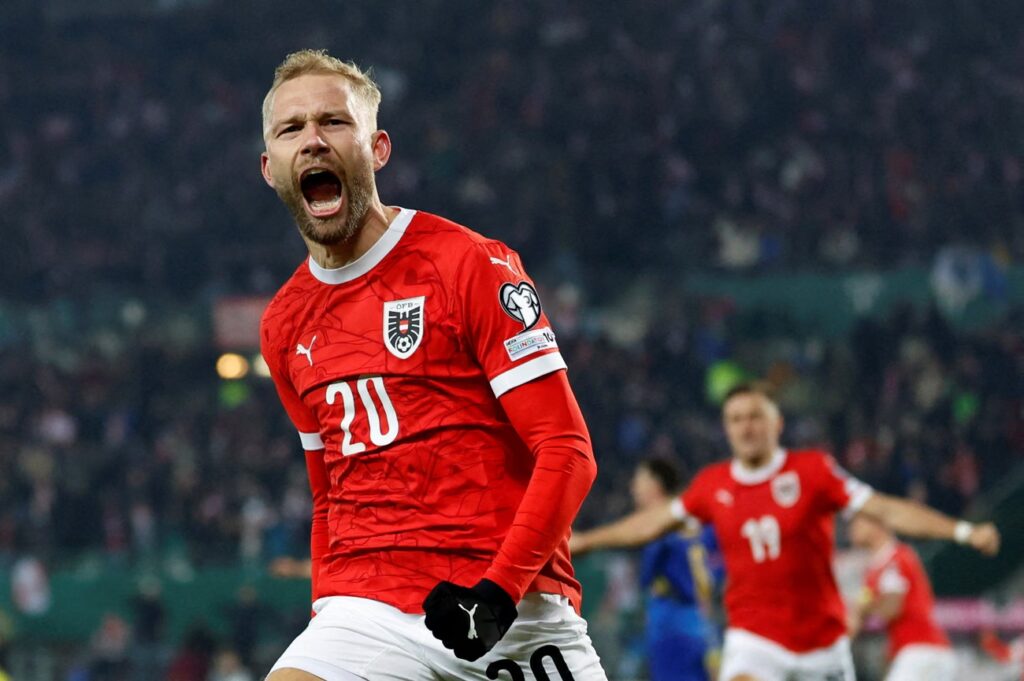
Not the easiest call – and no, that is not because Austria are overflowing with star names. Right now, though, the most important one is probably Konrad Laimer, above all because he plays such a central role for Bayern Munich, still one of the strongest sides on the continent. Laimer is every coach’s dream: he has huge presence, covers ground relentlessly and brings almost everything top-level football demands. What makes him stand out most, though, is his versatility. He can play at left-back, right-back or in central midfield, and do all three at the highest level. His awareness, passing quality, pace and strength in the tackle make him arguably Austria’s most sought-after footballer at the moment.
One to watch
After years of uncertainty, the news in spring was striking: Paul Wanner had made his choice, and he had picked Austria over Germany. Born in Austria to an Austrian mother and a German father, and holding dual nationality, Wanner had long been regarded as one of the brightest young talents around. The reasons are obvious on the pitch: a superb left foot, vision, precision in his passing and real pace with the ball. Developed in Bayern’s academy, he moved to PSV in 2025, where Peter Bosz reshaped him into a No 6 and he won the title straight away. It is unlikely to be the last of his career.
Unsung hero
Nicolas Seiwald rarely attracts the same attention as Austria’s more eye-catching midfielders, but he may be one of the team’s most important players. In Rangnick’s system, he does much of the unseen work: closing spaces, sustaining the press, winning second balls and giving the side its structure. It said plenty that, against South Korea in March, he was left out of Rangnick’s starting line-up for the first time in three and a half years. He is neat and disciplined on the ball rather than flashy, though he did mark the friendly against Ghana with his first goal for Austria. Seiwald is the kind of player every coach trusts and every team needs.
Probable starting XI
4-2-3-1 Schlager - Laimer, Lienhart, Alaba, Mwene - X. Schlager, Seiwald - Schmid, Baumgartner, Sabitzer - Arnautović
What to expect from fans at games?
The national team has clearly broadened its fanbase in recent years. Even for a qualifier in Cyprus, 1,700 supporters travelled, which is unusual by Austrian standards. Demand for US tickets has reportedly been high as well. Austria’s fans are generally welcome visitors: only a small minority come from organised club ultra scenes, the crowd is mixed, cheerful and fond of a drink, and language barriers are often ignored. Expect lederhosen, colourful hats and homemade shirts – and a support determined to stay as long as possible.
This article is part of JoySports' collaboration with The Guardian. The cooperation enables readers to access team news, previews, and more from all 48 teams that qualified for the FIFA World Cup 2026.
Latest Stories
-
ITF J100: America’s Wright wins J100 Accra Girls’ Singles Title
3 minutes -
Expedition hopes to find aviator Amelia Earhart’s plane on remote island
3 minutes -
US seeks changes to rejected $109m health compact with Ghana – Mahama
34 minutes -
Nine dead in mass shooting at Pennsylvania home
51 minutes -
‘Time for Ukraine to get new president,’ says Trump after Zelensky condemns diesel deal
54 minutes -
Hincapie injury adds to Arsenal issues after Guimaraes rescue act
1 hour -
Henderson scores twice as Chelsea thumb Bournemouth
1 hour -
Photos: Mentapulse Africa convenes health and labour summit to address talent retention
1 hour -
Mahama inspects Nkokɔ Nketenkete plant, eyes Bechem as chicken capital
2 hours -
Ghana not seeking full BRICS membership, applying as Partner Country – Ablakwa
2 hours -
Woman injures three people in third Poland school knife attack in a week
2 hours -
Ghana should join BRICS as partner, not member – NPP Bono East Regional Secretary
2 hours -
Ghana High Commission warns nationals in South Africa over protests in Johannesburg, Durban
2 hours -
Mahama praises Roads Minister for keeping Big Push contractors on their toes
2 hours -
World Cup Visa Scandal: ‘My client has not collected money for visas’ – Ampofo Ankrah’s lawyer
2 hours