

Audio By Carbonatix
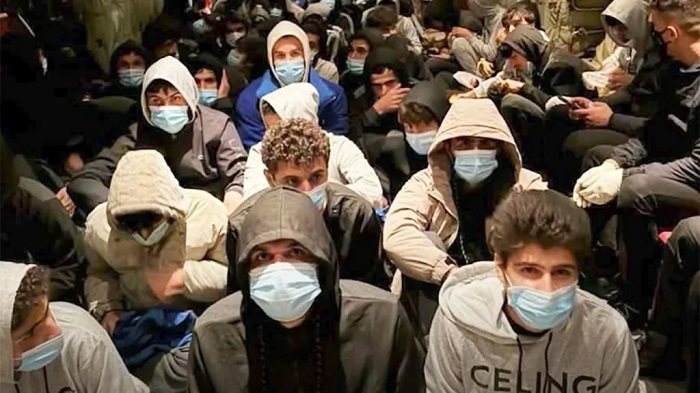
More than 300 migrants heading to the UK last summer were kidnapped, tortured and threatened with forced organ removal, the BBC has learned.
The young men, all from Iraqi Kurdistan, were captured in Libya by a militia who demanded a ransom of $5,000 (£3,700) from each of their families, and threatened to harvest the captives' kidneys if payment was not made promptly.
We have spoken to some hostages who have since been released, and seen photo evidence suggesting that forced operations did take place.
The former captives showed us evidence of torture, and said they had been kept in cramped conditions, with nearly 180 people sharing a cell.
At least one hostage is known to have died, and it is unclear how many remain captive.
The militia was supposed to be guiding the migrants through Libya to the Mediterranean coast. However, a dispute over payment had broken out with the Iraqi Kurd people-smuggler, Noah Aaron, who had organised the migrants' journey.
Aaron is now serving a 10-year prison sentence in France for separate money laundering and smuggling offences.
Details of the kidnappings emerged during a recent BBC investigation into another smuggler, Kardo Jaf, which led to his arrest last month.
The two smugglers are believed to have worked together in the past. Both are from the town of Ranya in Iraqi Kurdistan - a region "riddled with active smuggling networks", according to a report by the UK think tank, Chatham House.
In February, a BBC investigative team was making inquiries about Jaf in Ranya, when they were approached by a local man who said his son had been one of the men held.
The man told the BBC that Aaron's smuggling gang had charged his family thousands of dollars for organising the journey to the UK, which would involve travelling through northern Africa, then across the Mediterranean into Europe.
The route would pass through Libya, a country with a "huge vacuum of government", according to Anthony Dunkerley, a UN adviser who has investigated human trafficking there.
Much of Libya is controlled by rival militias, and smuggling networks rely on their co-operation.
We learned that, during the summer of 2025, successive groups of migrants who had flown into Libya from Iraqi Kurdistan were taken to a guarded compound and imprisoned.
The militia then demanded $5,000 for each hostage, claiming Aaron had failed to pay it for a previous deal. If the money was not delivered quickly, families were warned, payment would be taken "with a kidney".
The Libyans also sent photos and videos of the hostages, many of which were distressing or violent. In one, a young man was filmed while being told he was being taken to a doctor to have his kidney removed.
The local man who approached us in Ranya said he had paid the ransom. His son was among 110 hostages flown home in January, on a plane organised by the Iraqi government. However, he showed a photo he said his son had sent while in captivity, displaying a raw scar they feared was from a forced organ removal.
Within a short time of speaking to this man, dozens more people came forward, many showing similar phone pictures.
We later showed one of the photos to a consultant in the UK, who said the scars looked consistent with the sort of incisions made during a kidney operation. However, we have been unable to verify that organ removal took place.
Kidnapping for ransom has been widely documented along migration routes through Libya. Criminal groups are able to exploit limited state control in some areas, says Dunkerley, making investigations and prosecutions particularly challenging.
Many of the hostages have now been released. Some families paid the ransom promptly, but Kurdish authorities suspect other hostages may have paid with their internal organs.
The BBC spoke to some of those who had returned to Ranya.
One young man said he had been tortured by having his leg burned. He rolled up his trousers to show the scars.
A 16-year-old boy said he had been one of 178 kept in a tiny cell: "We didn't see the Sun for six months."
It was so cramped, he said, that everyone had to sleep sitting up. All the prisoners shared a single toilet, and those who took too long would be beaten.
Food consisted of one piece of bread per day, the hostages' families told the BBC - but only if they paid the captors extra money.
Despite the risks, the flow of illegal migrants from Iraqi Kurdistan to Europe has not stopped, according to Hemn Merany, a senior official at the Kurdistan Regional Government's Ministry of the Interior.
He has urged the returned hostages to tell friends and family about their horrific experiences, he says, to discourage them from setting out on the same journey.
But he tells the story of a father whose son died in Libya after a suspected forced organ removal. At the funeral in Ranya, the man discovered that two of his son's cousins had recently left for Europe.
"The very sad part of this business is we do not learn," says Merany.
Latest Stories
-
Daily Insight for CEOs: Preparing for 2027 Board and Executive Conversations
2 minutes -
World Cup Visa Scandal: There is no ‘justification’ to dismiss me – Kofi Adams
13 minutes -
2028 Olympic Games qualification ‘really tough’ – Black Queens coach Björkegren
39 minutes -
GRFU, GOC Women’s Commission hold breast cancer awareness, expresses gratitude to Sunda International Ghana
42 minutes -
COCOBOD raises GH¢3.4bn as Cocoa Capital PLC lists inaugural commercial paper on GFIM
60 minutes -
No Party Card, just a Party Microphone! A Ghanaian story of Elections, Referees and Convenient Amnesia
1 hour -
Minority welcomes suspension of teachers’ strike, demands timely payment of promotion arrears
1 hour -
Customary ownership accounts for 80% of land; it complicates land administration – Lands Commission
1 hour -
NRSA to auction vehicles of non-subscribers who fail to pay towing charges within 21 days
1 hour -
WAFU B U17: Black Starlets target AFCON slot after booking semi-final place
1 hour -
Ghana faces $6.1bn debt-service burden from 2027 to 2029 due to Akufo-Addo’s DDEP – Haruna Iddrisu
2 hours -
GoldBod targets 150 hectares of forest reclamation in 2027
2 hours -
Despite substantial accommodation capacity, room demand still weakens – GSS report
2 hours -
No amount of foreign exchange is worth a lost forest – GoldBod
2 hours -
Chelsea’s defensive crisis: Alonso’s system, missing pieces, or individual errors?
2 hours