

Audio By Carbonatix
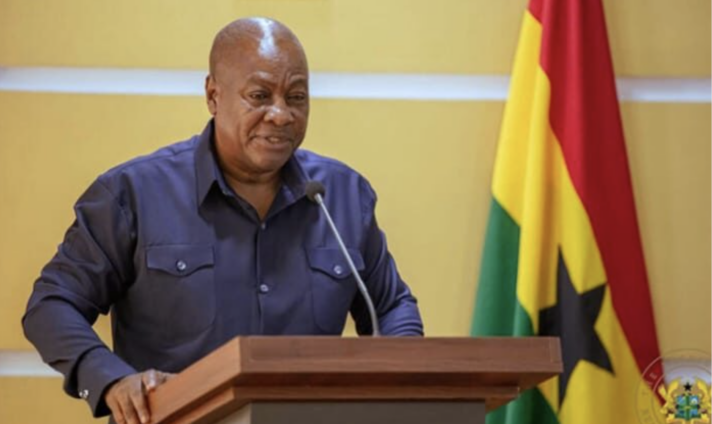
President John Dramani Mahama has urged Ghanaians to adopt a more disciplined and forward-looking approach to national development, warning against what he described as a “vulture-like” attitude of short-term memory and cyclical neglect of responsibility.
Addressing the recent flooding situation in parts of Accra, Mr Mahama said it was time for citizens to abandon complacency in the face of recurring environmental challenges, stressing that collective action was required to prevent the annual destruction caused by heavy rains.
He drew a metaphor of a vulture often associated in popular narrative with inconsistency and forgetfulness, suggesting a pattern where people lament disaster during rainy seasons but gradually return to normal habits without sustaining preventive measures when conditions improve.
"We have to do some soul searching. I think the government must be firm in doing what it has to do in order that we stop the perennial flood issues. We shouldn't be like the vulture, who says it will repair his roofs when the rains stop, when the rains stop, he forgets about it until the next rains come, and it promises again to repair the roofs. This time, we have to really work and repair it," he said while speaking upon his arrival at the Accra International Airport from the UK and Belarus.
According to him, this behavioural cycle undermines long-term planning and weakens efforts to build resilience in rapidly urbanising areas.
He noted that public opposition to the demolition of structures at Ramsar and protected waterway sites had, in many cases, complicated attempts by authorities to enforce planning regulations aimed at reducing flood risk.
"When the Greater Accra Regional Minister and her team went out and demolished houses built in the wetlands, people say the government is inhuman. But it is also partially the fault of those who sold those lands and also the fault of our assemblies and officers who grant the permits," he said.
He further expressed concern over widespread encroachment on waterways in Accra, linking such practices directly to the severity of recent floods.
"We build everywhere. This is a concrete jungle. In many places, in many countries, there are green spaces that soak up the water. In Accra, there is nowhere; the only place left is the children's park and the Achimota forest, and even that one is in danger of being bequeathed to successors and made part of people's wills."
"We need to address this issue of flooding," he added.
Latest Stories
-
T-bills auction: Government fails to achieve target; yield on 91-day-bill remains unchanged
8 minutes -
It’s Ghana’s shame to denigrate Nkrumah when the whole world honours him as African of the Century – Asiedu Nketiah
16 minutes -
No other nationalist can compare to Nkrumah – Asiedu Nketiah
23 minutes -
Collateral Registry: Foreign banks accounted for GH¢19.9bn of secured credit in quarter 2, 2026
24 minutes -
This government should expect scrutiny – Asiedu Nketiah
49 minutes -
Two-year-old girl dies in domestic fire at Cantonments
2 hours -
Asiedu Nketiah urges better working conditions for journalists
2 hours -
JoyNews’ Precious Semevoh wins climate change reporting award at Bono GJA Awards
2 hours -
Kumasi Central Market phase 2 to begin in October after years of abandonment
2 hours -
Sentuo offers fuel supply reassurance as NPA sees steady output through December
3 hours -
Ghanaian smock showcased at Lesotho Tourism Summit
3 hours -
Four pupils to one desk: The painful plight of schools in New Juaben North
4 hours -
Ipswich launch investigation into racist abuse of Abdul Fatawu
4 hours -
Arrest of Techiman nurse is purely political persecution – ‘Ghana Jollof’
4 hours -
Isak nets winner as Liverpool edge Bournemouth
5 hours